Key Takeaways
- A home-defense plan involves more than owning a firearm. Securing entry points, improving exterior lighting, identifying safe areas and preparing your family are all important.
- Home intruders may enter quietly and at any time of day. Many burglars are looking for valuables rather than a confrontation.
- Everyone in your household should know where to go, how to communicate and who will call 911 during an emergency.
- A home-defense plan only works if your family understands it and practices it. Walk through realistic scenarios so everyone knows what to do.
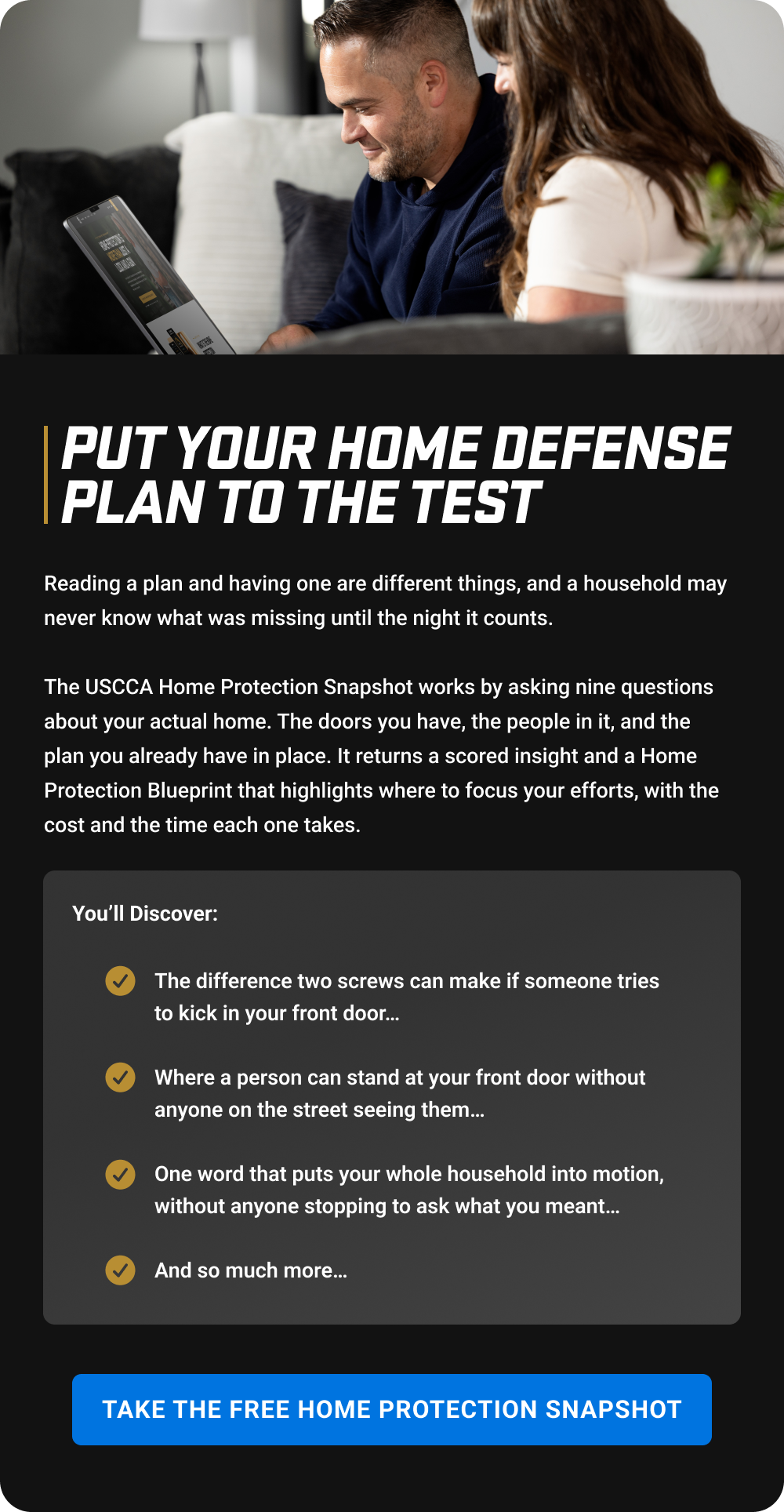
- Not sure how prepared your home is? The USCCA® Home Protection Snapshot can help you assess your household’s readiness and identify areas to improve.
If you interpret “home defense” in the broadest sense, the objective is to protect your people and your home from threats of any kind. Those threats would include not just home invasions but also simple burglary and even fire.
While the concepts overlap a bit, we’re going to focus on the intruder scenario here. When thinking about a home-defense plan to deal with a possible break-in, don’t forget to consider your strategy for more likely “home safety” events like fire.
Many of the same planning principles apply.
Home-Defense Preparations
A threat to your home doesn’t always fit a cookie-cutter mold and is often not as dramatic as television and the movies portray. A home invasion can happen at any hour.
It is not necessarily only a nighttime affair. Criminals are more likely to gain access by stealth.
They may pose as door-to-door salespeople, evangelists or census takers. The most adept have gathered intelligence on your daily routines, watching who lives in your home and your comings and goings.
It is important to prepare and train for all possibilities. Try to think up realistic scenarios — those easily addressed as well as larger problems.
Burglars often choose who they believe are soft targets. It is important to know your own threat profile.
The number of people living in a home and economic standing are factors assailants usually consider.
Home Security Basics
The first step in reducing your target risk is to fortify your home. Like most people, criminals will choose the path of least resistance.
When deciding whether to mug an alert 220-pound man obviously keen to his surroundings or another who has a fat wallet in the back pocket and his face buried in a smartphone, guess who will get bypassed in the victim-selection process? It’s the same with homes.
Physical Security Measures
Keep your doors and windows locked. Maintain the appearance of your home and add exterior lighting to deter unwanted visitors.
You may also want to consider a home-security system.
<script src="https://fast.wistia.net/assets/external/E-v1.js" async></script>
Dogs as Early Warning Systems
If a security system is not in your plans, maybe a furry friend is. Dogs can be used to alert homeowners to unwanted activities in many instances.
However, it’s important to remember that dogs are more likely to signal a problem, not be a solution. Don’t count on any animal attacking a threat.
An animal aggressive enough to bite a burglar is probably too dangerous to have around.
Firearm Storage and Access
While we all like to hope we are secure in our own homes, having a gun — any gun — nearby is still a good idea. And access to that firearm is an important consideration.
Though it is dangerously common, having several guns hidden around the house is a bad plan. Burglars do not gingerly poke around; they tear homes apart.
It will not take them long to find your firearm(s) when they’re upturning furniture or slinging drawer contents around. Keep guns locked away when you are not in control of them but a home-defense firearm safely accessible.
Barricading in Place
If someone breaks into your home, the odds favor a strategy of barricading in a defensible area that’s as safe as possible while you call for reinforcements. If you have to resort to kinetic action, your chances of success are better when YOU decide the circumstances.
Choosing Your Safe Space
Consider the places in your home that are most defensible. Do you have areas that provide both concealment and cover?
When choosing your safe space position, consider entry and exit points and furniture. Ideally, someone would have to enter through an exposed position to find you while you remain hidden.
Also, in a perfect world, your location would have an emergency exit. That could even be a window (assuming your location is on a ground floor).
Big furniture can provide not only concealment but also cover. While nothing is guaranteed to stop a bullet, heavy dressers, bookcases and appliances offer better protection than soft furniture or drywall.
Multiple Safe Locations
If you live in a large or multi-story home, you might define multiple safe locations because you don’t know where you’ll be when a home intrusion occurs. These things happen during the day too, sometimes when we’re in the office, kitchen or basement.
When considering where people in your family might shelter in the event of an emergency, be sure to consider where they will be in the event you have to fire your gun. Most any handgun, rifle or buckshot shotgun load will go through many layers of interior drywall while maintaining lethal velocity.
Home-Defense Gear
Home-defense gear shouldn’t be limited to just a firearm. Equally important is a means of communication, preferably a charged cellphone so you can take it with you.
Get in the habit of keeping your phone on a charger on your nightstand so that it’s readily available in the event of a fire or breaking-and-entering emergency. Also, make sure you keep a quality hand-held flashlight right next to it.
That’s a great tool to have for any nighttime surprise, whether or not it’s a criminal encounter. Likewise, make sure your home-defense firearm is accessible, either near where you sleep or in between your bed and the safe space you’ve identified.
Essential Home Defense Equipment
- Charged cellphone – Keep on nightstand charger
- Quality flashlight – For identifying threats and navigation
- Home defense firearm – Preferably your everyday carry gun for familiarity
- Secure storage – Quick-access gun safe when not under your control
Communicate Your Home Protection Plan
If it’s just you and your significant other in the home, identifying a safe location and planning is relatively easy. If you have children in other rooms, things get more complicated.
Planning for Families with Children
Think about possible points of entry into your home. How does that relate to your location and the children’s rooms?
If you can identify a safe zone for everyone that doesn’t require passing through common areas where you might encounter an intruder, then great, there’s your plan. If the most likely spots for intrusion are between you and your children, you have a difficult problem to solve.
It’s impossible to cover every home-layout and break-in scenario, but there are some general considerations. Statistically, most home entries are burglaries where the intruder is there to steal stuff, not kill or harm people.
Given that, and if your children are in a faraway area of the house or upstairs from your location, you may elect to instruct them to lock themselves in their rooms if they hear a commotion in the house. If you don’t have that home-layout luxury, the “shelter in place” strategy may not be a winner for you.
You may plan for your spouse to remain in a safe area and call for help while you venture out to protect your children.
Communication Protocols
If you and others are in opposite areas of the house, you’ve got a tough problem. You’ll have to think very carefully about where someone might enter and where he or she might go by the time you wake up and orient yourself to the problem.
If you’re a deep sleeper, don’t assume you’ll catch someone coming in the front door. He or she may be in your room or anywhere else in the house by the time you wake up and realize what’s going on.
A perfect plan in your head is worth absolutely nothing unless it’s communicated to the rest of the family and they know and understand the procedures. You’ll also need to establish a way to communicate with others if and when you have to initiate your home-defense plan.
Cellphones are convenient and can allow discreet communication to other parts of the house, but they take time. Your communication plan may rely on shouted instructions like, “Shelter NOW!”
Be sure that the communication tools you choose will work when others are sound asleep in the middle of the night.
Prepare a Home-Defense Plan
Defending your family from a band of night-vision-wearing commandos is only a realistic scenario in the movies. Keep your planning practical based on real scenarios and crime statistics.
Creating a home-defense plan is relatively simple and involves only a few easy steps:
- Maintain as secure a home as possible.
- Have a readily accessible firearm at hand you have practiced with. It is recommended to have your home-defense gun be the same as your everyday carry piece.
- Evade the threat. Running toward trouble is a knee-jerk reaction. Don’t move unless household members are in danger. Make sure younger members of the house know the plan as well. It is children’s natural instinct to run toward parents’ bedrooms in an emergency. This is a good tactic.
- Call 911.
- Use lethal force only as a last resort to protect yourself or a loved one from the threat of death or great bodily harm. Though concerns of overpenetration vanish when you hit the intended target, fire accurately — not in a flurry of undirected fire.
Home-Defense Plan Dry Runs
Nothing works without practice, so as awkward as it might feel, be sure to physically run through it. It is important that your immediate reaction becomes your practiced one.
Practice Scenarios
To practice, lie in bed. Pretend you have been alarmed, and prepare to confront the intruder.
Take a deep breath, then engage in tactical movement. Mix it up.
Stay in the bedroom in one drill, then move down the hall to the living room in another. Address the back door and the front door. Practice moving to other bedrooms.
Safe Movement Techniques
Through all these drills, your firearm should not be extended in front of you. This makes it easier to grasp and turn against you.
Keep your handgun at belt level and your finger off the trigger. There is little point in moving successfully and then having an accident and crippling yourself.
Night Navigation Training
It’s also worthwhile to walk around your home in the dark to learn how to navigate without tripping over the furniture. In an emergency, do not immediately turn on the lights.
Though it will momentarily blind your attacker, the effect will be the same on you. You should know the layout of your house and be able to move smoothly and deliberately.
This way, you will avoid giving your attacker a target. While you’re doing this, take note of nooks, corners and hiding places you might use to keep out of sight while making your way to a safe room, out of the home or to join your children.
Plan, Prepare, Practice
Homeowners and renters alike are more of a threat to invaders if they have a plan. Think things through, and keep practice flexible and frequent.
Be sure to invest some time thinking like an intruder so you can develop a series of meaningful response plans. If you were going to break into your house, where would you do it?
Once inside, where would you go first? How much time would that take?
With preparation, there is no reason to be a victim.
This article is a compilation of previous blog posts authored by Tom McHale, Bob Campbell and Kevin Michalowski.