I first heard the term “carbine” growing up in the 1960s, when westerns and WWII shows filled the TV airwaves. Carbines, firearms that are compact, fast-handling and distinct from a full-size rifle, were heavily featured. That early impression stuck with me and sparked an interest.
What Is a Carbine? Defining the Term
To understand what a carbine is, it helps to start with a traditional definition. According to The Firearms Dictionary by R.A. Steindler, a carbine is a short, lightweight rifle with a barrel measuring less than 22 inches, the standard length of military rifle barrels at the time. Carbines were originally designed for military use.
Though accurate, that definition isn’t quite complete. Other sources, like Small Arms of the World, explain further that early carbines were shortened versions of standard military rifles. They were designed so soldiers could more easily handle their weapons while mounted on horseback. Importantly, the original carbines were chambered for the same cartridge as the full-length rifle from which they were derived.
By that definition, the U.S. M1 Carbine is technically an exception. The M1 was not a shortened version of an existing rifle, and its cartridge — the .30 M1 — was designed specifically for the M1 Carbine. So its name is something of a historical misnomer.
Carbine vs. Rifle
In practical terms, the difference between a rifle and a carbine comes down to length and handling. Carbines are shorter and lighter, making them easier to maneuver, while full-length rifles favor velocity and long-range performance.
Why Carbines Became Popular
Carbines have surged in popularity in the 21st century for a simple reason: lighter, more compact weapons are easier to carry and maneuver. A shorter, lighter firearm allows users to carry additional gear. Except for specialized long-range shooting, full-length rifles are in relatively low demand these days.
Ironically, what many people now call a “full-size rifle” still meets the traditional definition of a carbine. A standard AR-15 with a 20-inch barrel, for example, qualifies as a carbine by historical standards. Terminology evolves, but the functional advantages of the carbine remain the same.
Modern Types of Carbines Explained
There are plenty of carbine options from various manufacturers available today. Carbines can be grouped into four broad categories, differing in operation and configuration but often serving similar roles.
- Lever-action: popular for its simplicity and handling
- Military-pattern: designed specifically for compact service use, like the M1 Carbine
- Modern intermediate-caliber: most common example is the AR-15
- Pistol-caliber: valued for controllability and versatility
I’ll be covering carbines still available today, either in original or reproduction forms, beginning with the oldest designs still in common use and moving toward modern examples.
Lever-Action Carbine: Winchester Model 1892 and Modern Variants
When people talk about “the gun that won the West,” they’re usually referring to either the Winchester lever-action carbine or the .45 Colt revolver. Many on the frontier carried a Model 1892 Winchester or something similar. The Winchester 1892 is still available today, though its production has moved to Japan.
Like the later M1 Carbine, the Winchester 1892 carbine was not chambered for a traditional rifle cartridge. The .44-40 Winchester was both a rifle and pistol round, allowing shooters to use the same ammunition in a Colt revolver and Winchester carbine.
 The .44-40 Winchester 1892 was introduced as lighter alternative to Winchester lever-action rifles. It’s narrow, flat profile and smooth lever action made it quick to handle and easy to carry while still delivering the high power of Winchester pistol caliber cartridges. That basic design spawned additional lever-action rifles and carbines from Winchester and it competitors.
Today, Rossi offers the R92, a modern take on the Winchester 1892. Rossi supplied me with a 20-inch barrel in .357 for evaluation. Barrel lengths for the R92 range from 16 to 24 inches, and while it is not currently chambered in .44-40, it is offered in .44 Magnum/.44 Special, maintaining the original concept of versatility.
The U.S. .30 Caliber M1 Carbine
With the decline of Westerns, attention shifted to a different carbine: the U.S. M1 carbine. This carbine was the favorite in my youth and continues to interest me today. M1 Carbines exploded in popularity after WWII and Korea. In the ‘60s, surplus military firearms, including M1carbines, could be purchased through mail-order catalogs and sent right to your door.
Unlike the Winchester 1892, which was a shortened rifle, the M1 carbine was a purpose-built arm. Prior to its development, nothing like it existed in terms of weight, size and magazine capacity.
The .30 U.S. Carbine cartridge the M1 is chambered for was derived from the .32 Winchester Self-Loading round. It delivers 365 foot-pounds more kinetic energy than the standard .357 Magnum revolver round.
The M1 Carbine was not intended to be a frontline infantry weapon. It was designed for support troops — drivers, mechanics, cooks and later, officers — but its high capacity and light weight led many frontline troops to adopt it anyway.
By D-Day, a Paratrooper version with a wire folding stock had been introduced. I’m a fan of the Paratrooper variant, and my Auto Ordnance M1 Carbine has been mounted in a folding stock for the last eight years.
The M1 Carbine has proven itself to be reliable and effective. Several features still make this carbine appealing today.
- Light weight:5 pounds
- Minimal recoil: a gentle rifle that still packs a punch on the receiving end, the M1 is easy for shooters of all sizes to control.
- Compact: short enough to be wielded indoors
- Magazine availability: 10-, 15- and 30-round magazines
- Simplicity: standard M1 carbines come with sling mounts already installed, and with minimal accessories available, this platform encourages a “ready-to-go” configuration
I don’t recommend modifying the M1 Carbine beyond essentials like a sling or folding stock. Stock up on ammunition and keep it simple.
The .223/5.56mm AR-15 Carbine
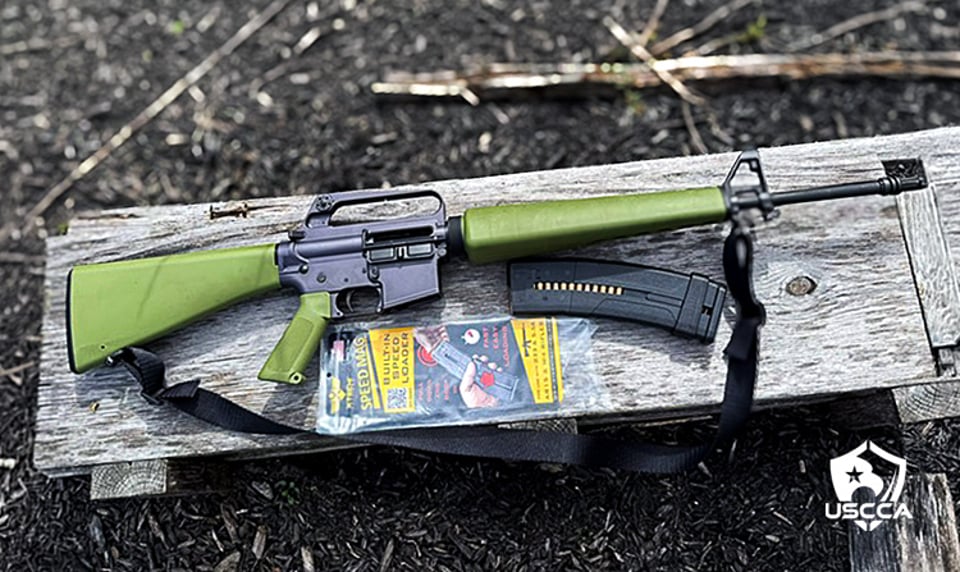
The AR-15 became popular starting in the 1970s with Colt’s introduction of the full-length, fixed-stock rifle. For years, the AR-15 was only available with 20-inch barrels and fixed stocks, but it remained remarkably light, especially the original A1 configuration.
In the 1990s, the 16-inch barrel, adjustable stock M4 Carbine began to replace the full-length rifles in military service. Civilian manufacturers quickly followed, first with fixed carry handles and later with flat-top receivers and railed forends. Demand exploded and has continued since.
The modern flat-top M4-style is considered by many to be not only the ultimate AR-15 but the ultimate carbine. It offers unmatched modularity, is easy to maintain, and the 5.56/.223 chambering is effective at moderate ranges with light recoil and can be found almost anywhere. Compared to the .30 Carbine, 5.56mm/.223 ammunition is significantly more powerful
In the past few years, shorter AR variants and AR pistols, short barrel rifles (SBR) have gained popularity. The reduced barrel length does mean lighter weight and easier maneuverability, but you do lose some ballistic performance. They may also lead to legal complications depending on jurisdiction.
Today, the AR-15 is likely the most commonly owned carbine in America. Basic models remain affordable and widely available, with manufacturers like Colt offering multiple configurations to suit different needs.
The 9mm Semi-Automatic Carbine
The 9mm carbine appeals to shooters who want reduced muzzle blast as compared to 5.56mm/.223 rifles. More importantly, a pistol caliber carbine (PCC) simplifies logistics, using the same ammunition for both carbine and handgun.
One of the earliest examples was the Marlin Camp Carbine, a compact, wood-stocked firearm reminiscent of the M1 Carbine. It accepted Smith & Wesson Model 59 magazines. Despite good sales, Marlin discontinued the Camp Carbine in 1999 due to pending gun legislation of the time.
The Henry Homesteader is a modern alternative. It’s a conventionally styled semi-automatic carbine resembling the Winchester Model 1907. With a 16.37-inch barrel, suppressor capability and weighing only 6.6 pounds, it is easy to carry and handle. It can be configured to accept Glock magazines or SIG/Smith & Wesson magazines, depending on the model.
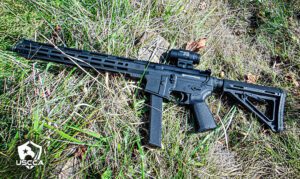
The Diamondback DB9R carbine on a grassy background.
For those who prefer the AR platform, there are several 9mm carbines available today. One of the best examples on the market today is the DB9R from Diamondback Firearms. Using blowback operation rather than a direct gas impingement system, the DB9R has a very mild recoil and reduced fouling. It accepts Glock magazines.
With affordable ammunition, reasonable muzzle blast, and magazine compatibility with popular handguns, a quality 9mm carbine makes a great companion to a 9mm pistol. If you can only afford one 9mm to go with your 9mm handgun, this is the one to get.
Why the Carbine Remains Relevant Today
From early lever-action designs to the M1 Carbine, the AR-15 and modern pistol-caliber carbines, the common thread is the same: light weight, compact size and ease of handling. Those characteristics make a carbine easier to carry, faster to bring into action and simpler to live with than a full-length rifle.
What’s often overlooked is that the definition of a “carbine” has evolved, but its advantages have not. Whether chambered in a traditional rifle cartridge or a handgun round, a carbine offers practical performance without unnecessary bulk. When you need a long gun that balances portability, control and effectiveness, the carbine still stands apart.
Sources
Rossi: RossiUSA.com
Auto Ordnance: Auto-Ordnance.com
Colt: Colt.com
Henry: HenryUSA.com
Diamondback Firearms: DiamondbackFirearms.com
❓ Carbine FAQs
What is a carbine?
A carbine is a short, lightweight rifle, traditionally defined as having a barrel shorter than 22 inches. Carbines were originally developed for easier handling by troops on horseback and support personnel.
Is a carbine different from a rifle?
Historically, a carbine was a shortened version of a full-length rifle, often chambered for the same cartridge. Over time, the term has expanded to include purpose-built compact rifles.
Why do people prefer carbines over full-length rifles?
Carbines are lighter, more compact and easier to maneuver, making them simpler to carry and handle, especially indoors or over long periods.
Are pistol-caliber carbines effective?
Pistol-caliber carbines offer reduced recoil and muzzle blast and can simplify logistics by sharing ammunition and magazines with handguns, making them practical for many shooters.
Is the AR-15 considered a carbine?
By traditional standards, even a 20-inch AR-15 qualifies as a carbine, though modern usage often reserves the term for shorter-barreled versions like the 16-inch M4-style configuration.