I’ve been using laser sights on my defensive handguns and AR-15s since 1995. I think guns mounted with laser sights are the best option in low light because they do not obstruct the user’s view. I’ve also found them useful during my time as church security to pinpoint the wolf among the sheep.
Why Consider a Laser Sight for Self-Defense
Nearly all of my defensive handguns are equipped with laser sights by either Crimson Trace or the now-discontinued laser grip models from Hogue Grips. While the CT Lasergrip has long been my favored system for its momentary laser control switch in a natural position on the grip, as with all products, there’s always room for improvement.
Introducing the Combat Tactical Laser CTL-200
Paul Tolle from Combat Tactical Laser sent me an email earlier this year about his new motion-activated laser sight after my 2023 article about the use of pistol-mounted laser sights in law enforcement aided their product development.
Based on the sample I worked with, I think this innovative sighting system moves laser sighting technology into the 21st century and is definitely worth a look.
What Makes the CTL-200 Different?
The CTL-200 laser sight is the world’s first motion-activated laser sight. The laser automatically responds to the position and movement of the firearm.
Though there is no external on/off switch, the light can be turned off for long-term storage using what CTL calls the “double-tap gesture.” Other than that, on-off controls are triggered by the position of the pistol-mounted light. Operation is natural and easy to learn.
The CTL-200 is a rechargeable green laser that is about the size of most standalone rail-mounted laser sights. For now, it does not incorporate a tactical weapon-mounted light, so users will need to carry a separate handheld light for illumination. I’ve come to prefer that setup for home defense. Perhaps a future version will combine both systems into a single unit.
How the CTL-200 Works
The CTL 200 is a rechargeable, motion-activated laser sight that attaches to most handgun and rifle accessory rails. Though originally developed for defensive pistols, it works well on AR-15s equipped with Picatinny rails.
This sight was designed by a team of police and military veterans, and that practical experience is evident throughout its design. There are no cords, switches or manual activation buttons to think about while drawing or shooting.
The MALTS Operating System
At the heart of the CTL-200 is the patented Motion Activated Laser Targeting System (MALTS).
The system was designed to help maintain a concealed position and improve accuracy should the need to fire arise. I just about guarantee an improvement in accuracy with this sighting system.
MALTS doesn’t use and moving switches or sliding controls. As the CTL-200 manual says, “There are no moving parts except the user.”
Simply raising, lowering or rotating the handgun turns the laser dot on and off, starting the moment the pistol is drawn from a holster. Because the system works from the firearm’s orientation, a conventional vertical holster is essential. Cross-draw or other angled positions can leave the laser activated unintended.
Installing and Setting Up the CTL-200
Before using the CTL-200, take the time to read the manual. It is worth taking the time even if, like me, you tend to skip the directions. This laser isn’t difficult to operate but is different from traditional laser sights.
Everything you need to get started is in the box. Charge the unit with the included USB-C cable before mounting it. The charging port is located on the underside of the light beneath a small removable rubber cover. Be careful not to misplace that while charging.
The LED Status light on the side of the CTL-200 makes the battery condition easy to monitor. A flashing red light indicates a low battery, a green light indicates charging and, once fully charged, the LED turns off after the charging cable is disconnected. Two quick red flashes indicate the laser is in Active mode and ready for use.
Before installing the laser, I spent time operating it by hand to become familiar with the motion-activated system and verify everything was functioning.
Mounting the Laser
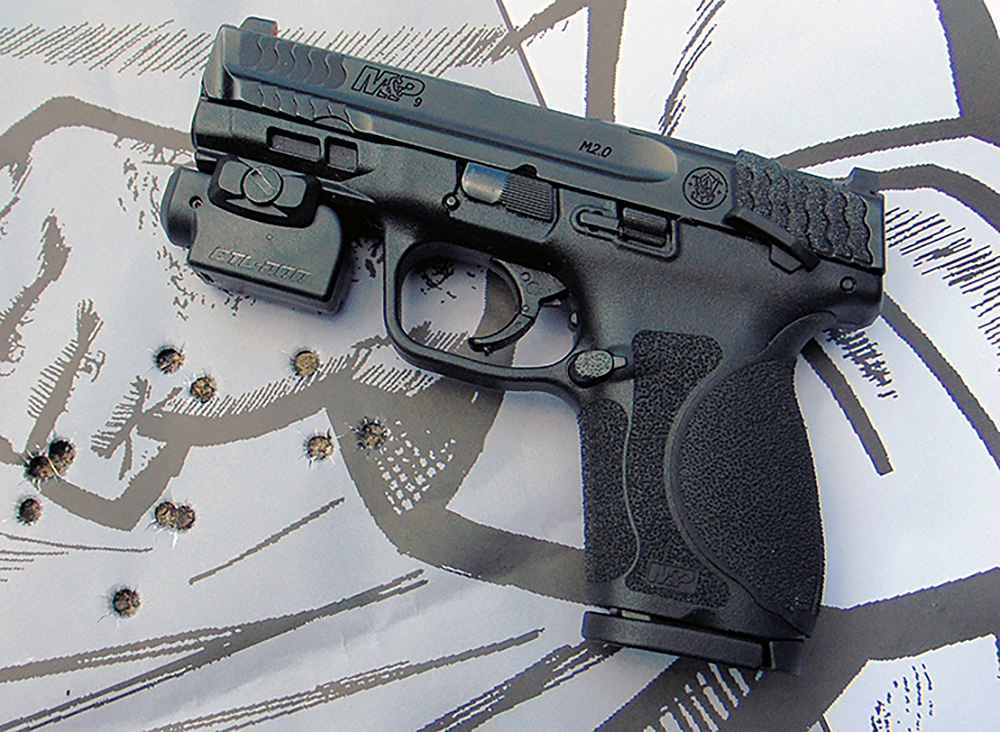
I mounted my sample on my Smith & Wesson M&P M2.0 Compact after charging. Installation could not have been simpler. Combat Tactical Laser includes several rail adaptors to ensure proper fit. A slotted screw on the left side of the light clamps it to the frame. My sample arrived with the correct adapter already installed, so mounting took only a few seconds.
Though no physical manual was included due to the small size of the shipping box, CTL does have a full-sized printable PDF on its website. The larger size is much easier for older shooters like me to read. I highly recommend downloading it before you begin.
CTL-200 Operating Modes
Once the CTL-200 is mounted and charged, you will need to put the laser in Active mode before use. I know some of you are thinking, “But you said there was no switch.” There isn’t. Combat Tactical Laser uses double-tap gesture to move between Active and Disabled modes for storage of carry.
The activation process involves pointing the unloaded firearm straight ahead then at the floor, double-tapping the side of the laser module. The laser dot will flash twice, showing active. It only takes a few seconds to learn but is different from conventional laser sights.
Follow the same sequence to disable the laser. It will give four quick flashes then stay off.
I strongly recommend keeping the instructions nearby the first few times you do it. Once I had the sequence down, it became second nature.
Motion-Activated Operation
This is where the CTL-200 separates itself from every other rail-mounted laser and gave me another one of those “Why didn’t I think of that?” moments.
Once the laser is in Active mode, there is not button to press and grip adjustment to make. The laser automatically turns on or off based on the position of the firearm. This is a bigger advantage than you may initially realize because your shooting grip doesn’t need to change from presenting the pistol through firing multiple rounds.
There are four operating positions to the system that quickly become intuitive.
Sleep Mode
To conserve power, the CTL goes into sleep mode when no motion is detected for 10 seconds. For example, if you are a police officer sitting in your cruiser writing a report, the laser goes to sleep. The moment you step out, the movement immediately returns the laser to Active mode.
Position-Based Activation
When the barrel is pointed straight down, the laser is off. This means a conventional vertical holster is the best option for carrying a CTL-200-mounted firearm. The laser will stay off during the draw until the handgun is brought into a firing position.
I experimented with the angle used by small-of-the-back holsters and found the laser kicked on constantly, so I would recommend vertical carry.
When a pistol with the CTL-200 is laid flat on its right or left side, the laser will go off. Rolling the pistol to the right or left through a 60 Degree arc will turn the laser on, then off on the other side of the arc.
When held in a normal shooting position, the laser stays on as long as the muzzle stays within 45 degrees above or below parallel to the ground.
The CTL-200 motion-activated laser is easy to control through typical defensive handgun movements. The system was clearly designed by people who have carried firearms professionally. It was easy to operate naturally after only a short time.
Range Testing the Combat Tactical Laser CTL-200
I switched out the original factory sights on my M&P for XS DXD2 PRO sights after purchasing it. I expected the green laser dot from the CTL-200 to match nicely with the green glow front sight and tritium rear sight. I was right.
I also found that the M&P with the CTL-200 mounted fit perfectly in an Urban Carry Hyperion 318-R holster, which had originally been sized for my M&P with a Crimson Trace Laser Guard Sight mounted. With everything fitting, I was ready to begin testing.
Live-Fire Performance
I took the laser-mounted gun to a local indoor shooting range over the weekend after zeroing the laser. I used Libert Ammunition Overwatch 9mm. The 72-grain lead-free hollow-point has a velocity of 1,720 feet per second.
I moved the target down to 30 feet and got a feel for the on/off motions before loading 14 rounds. I started shooting and noticed my shots clustering in a 3- to 3 ½-inch group. More importantly, there were no flyers.
What I Noticed Most
The biggest difference, though, was the lack of readjustment between shots. The laser dot never dropped off or out of sight. I didn’t need to make grip adjustments while maintain pressure on an activation switch. And I didn’t need to hunt for the dot.
Even though the target may not immediately show it, I accounted for all 14 rounds fired. Several holes contained two-shot clusters, along with one three-shot cluster. Combined with the light recoil of the Liberty OverWatch ammunition, the results were impressive.
Is the CTL-200 Worth It?
The team at Combat Tactical Laser have taken the rail-mounted laser a quantum leap beyond anything else I have used. The motion-activated MALTS operating system removes one more task from the shooter’s mind, allowing the laser to work naturally with the movements already made while drawing and presenting the handgun.
With an MSRP of $379, I encourage you to visit the Combat Tactical Laser website. I expect more products to come in the near future.
Sources:
Combat Tactical Laser: CombatTacticalLaser.com