The world of carry optics has grown a great deal in the past few years. What began as an innovation for winning pistol competitions has become standard equipment among service members and civilian defensive shooters. The carry optic, or pistol-mounted optic, has earned an important place in handgun deployment.
Improvements in reliability and construction have made these optics service grade. Just as important, LED and battery technology have developed rapidly. I don’t think it is viable for any maker to offer a new handgun today without an optics-ready slide.
According to my research, one third of all optical sights sold today fall into the carry-optics designation. That is a huge portion of the market when you consider the thousands of hunting rifle, .22 rifle, shotgun and competition optics sold.
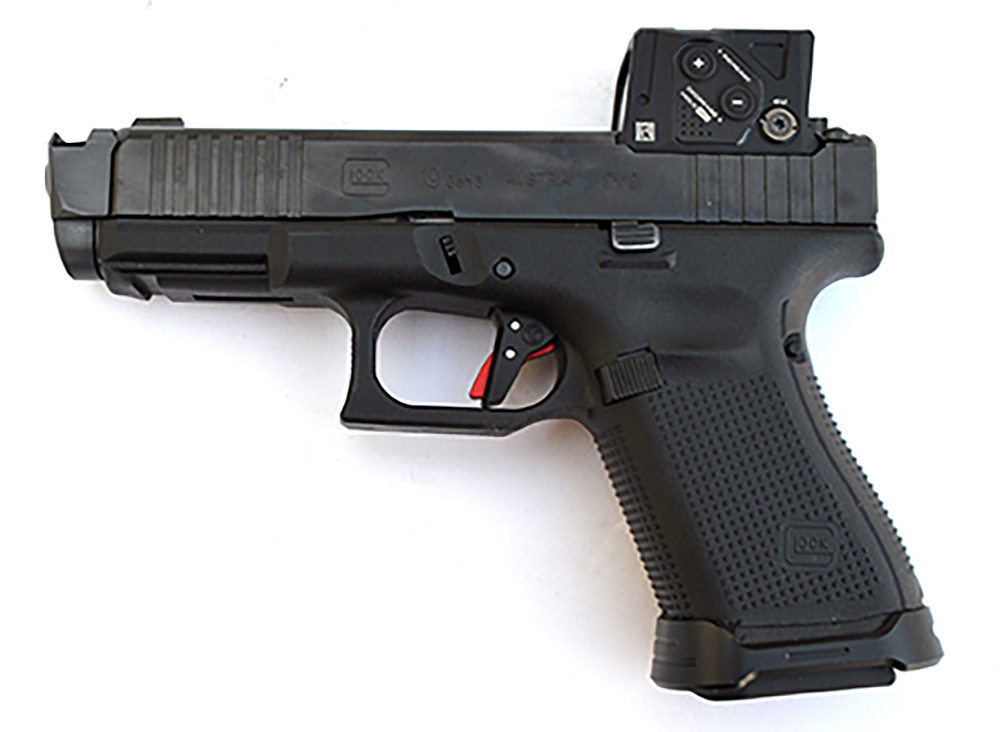
Perhaps the most popular carry gun today is an optics-ready Glock. The Glock COA takes that a step further, pairing a Glock handgun with the Aimpoint COA enclosed-emitter red dot using Glock’s A-CUT mounting system.
Let’s look at the Glock COA and what it means for shooters.
Glock COA M19 Generation 6 Specs
Caliber: 9mm
Barrel length: 4.02 inches (Glock Marksman Barrel)
Capacity: 15 rounds
Weight unloaded: 24 ounces
Optic: Aimpoint COA red dot with A-CUT mounting system
Finish: Black nDLC coating
Grip: RTF6 textured grip
What Makes the Glock COA Different?
The primary difference between the Glock COA and the Glock Generation 5 MOS is the A-CUT interface with the slide. This is a solid wedge-type fitting held securely in place with a direct mount. MOS pistols are supplied with different plates for various sights. The COA uses a different approach.
With the COA, the Aimpoint sight is supplied professionally installed with the Glock handgun. There is no separate optic purchase and no need for the shooter to mount the sight. This mount is widely regarded as the most secure system. Both longitudinal and horizontal interface is stable.
Aimpoint COA Features
The sight itself is another important point. Though commonly referred to as the COA, the pistol is a Glock and the Aimpoint sight is the COA.
Most carry optics are open emitter design. The Aimpoint COA is an enclosed emitter. There is no place for material to invade the sight. The COA may be immersed in water and come up operable.
The Aimpoint COA features a 3.5 MOA red dot. This offers real speed at close range and greater accuracy at longer range than a larger dot. The sight also features positive elevation and windage adjustment. A Torx wrench is supplied for adjustment.
I like this a great deal. The reticle movement is solid and isn’t going out of adjustment. The sight weighs 1.7 ounces.
Getting the dot properly adjusted for your eyes and environment is important. The COA features eight brightness settings that are easy to run through quickly with the push-button controls. There are four night-vision settings as well. The brightness settings are distinct and sharply defined.
Why Carry Optics Continue to Grow
The Aimpoint COA is arguably a superior red-dot sight in many ways. It offers the advantages of the Aimpoint brand and the usual pistol-mounted optics advantages.
Benefits of a carry optic include the ability to keep both eyes open while firing and encourage target-focused shooting. Keep the dot on the target as you fire. Don’t try to follow the dot. Move the dot back to the target as the pistol cycles.
With training and acclimation there is nothing faster than a pistol-mounted optic combination. The advantages are most apparent in defensive shooting. The Glock COA is fast to an accurate hit and reliable. This pistol is well-suited for recreational or competitive shooting.
Glock COA vs. Glock MOS
The Glock COA differs from standard Glock handguns in several important ways. First, the pistol is delivered with the optic properly mounted. There is no separate purchase for an optic and no need to mount the sight properly.
With the older mounting system, it is possible to interfere with the extractor if the dot is not properly set up. This is why Glock changed the mounting system with the Glock Generation 6.
The Glock COA is superior to the Glock Generation 6 in my opinion. However, the COA is more expensive. The COA is now available with the Glock Generation 6 benefits, so the comparison to the Generation 5 MOS is a moot point.
| Feature | Glock COA | Glock MOS |
| Optic setup | Aimpoint COA supplied professionally installed | Supplied with different plates for various sights |
| Mounting system | A-CUT direct-mount | Plate-based |
| Mount security | Solid wedge-type fitting with stable longitudinal and horizontal interface | Dependent on proper plate and optic installation |
| Optic type | Aimpoint COA enclosed-emitter sight | Varies by sight selected |
| Cost | More expensive than MOS | Less expensive than COA |
First Impressions
My first impression of the Glock COA is that the combination is service grade. This is a handgun you would be willing to bet your life on. The Aimpoint COA is impressively well built. It is a sturdy piece of technology, while the Glock pistol itself has already proven its reliability through harsh environments and institutional testing.
I have several Glock handguns on hand. While most of my experience has been with a Generation 5 Glock 19, I would recommend the Generation 6 COA for several reasons. The Generation 5 is a good handgun. The Generation 6 is better.
Glock Generation 6 Improvements
The Generation 6 grip treatment offers an excellent balance of comfort and abrasion. The grip is never uncomfortable during a long firing string. Hand fit is good with either handgun however the Generation 6 COA’s extended grip tang is the superior option.
Fortunately, Glock did not change the control layout of the Gen 6 Glocks. The slide lock, takedown, trigger action and line of sight remain the same. Anyone who learned on an early Glock 17 will be familiar with this newest Glock pistol.
The latest generation also adds an ambidextrous slide lock and the Glock Marksman Barrel.
Glock COA Range Performance
The inherent accuracy of the Glock handgun isn’t changed by the sighting system. But practical accuracy, the ability of the shooter to deliver accurate hits, is upgraded considerably with the COA.
The Glock COA remains well balanced, though the Aimpoint COA adds slightly more weight than a standard slide. The additional weight doesn’t have a noticeable effect on recoil. Most pistol-mounted optics weigh only one to two ounces.
For this evaluation my personal Glock COA was equipped with a Timney trigger and a Radian Weapons Ramjet Afterburner barrel. The compensator reduced muzzle flip by perhaps thirty-five percent, further improving control.
The Aimpoint COA’s sight window is large enough for rapid target acquisition. There is some evidence in training that the enclosed emitter’s tunnel-like sight picture promotes more accurate shooting, although it takes a trained shooter to fully realize those advantages.
The benefits of a carry optic are more apparent in the COA. Bring the pistol to eye level with your nose aligned over the rear of the slide and the dot naturally appears. Another technique is to raise the pistol slightly above the line of sight and tip the muzzle downward until the dot appears in the window. Either method works well with training.
Both-eyes-open shooting and maintaining target focus remain the key. The advantages in speed and accuracy are demonstrable.
Bench Accuracy vs. Practical Accuracy
An advantage of using a carry optic is that slide length and sight radius become less important than with iron sights. Off a solid benchrest, absolute mechanical accuracy changes very little. The newest generation Glock is capable of producing five-shot groups of approximately 2.5 inches at 25 yards with quality ammunition. The COA-equipped pistol may improve on that slightly.
Glock COA for Concealed Carry and Competition
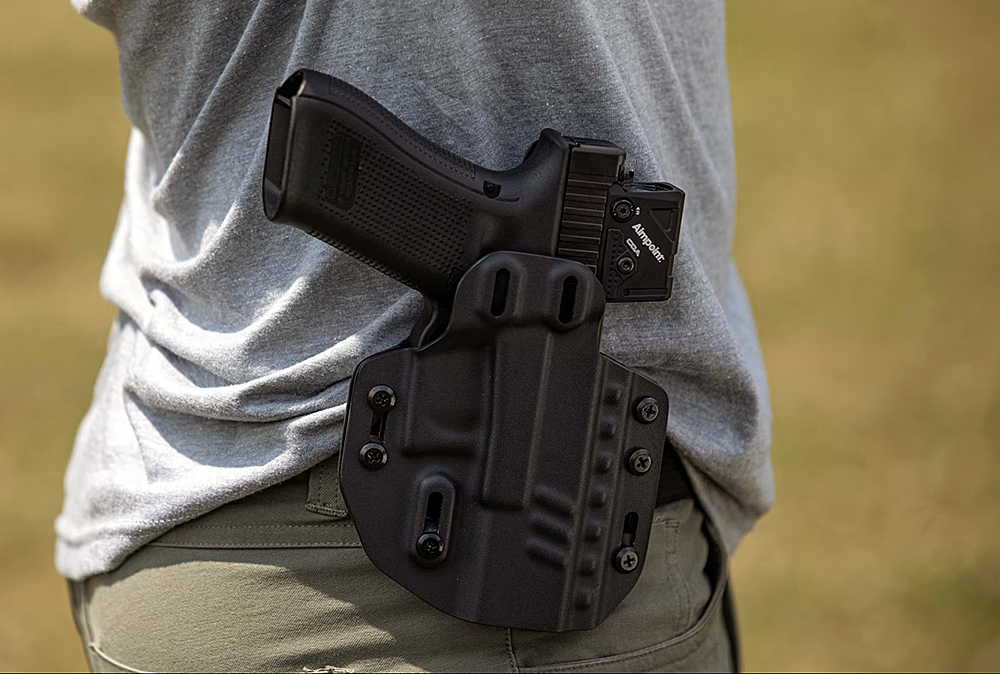
The real advantage is not found on the bench. It is found in speed shooting, where the combination of the Glock pistol and the Aimpoint COA allows faster, more accurate hit
The benefits of the Glock COA are most apparent in defensive shooting. The combination is fast to an accurate hit, controllable and above all reliable. The pistol is well suited to anyone wishing to be all they can be.
Recreational shooting is always a good reason to own a superior handgun. The COA is also well suited to competitive shooting. My personally fitted Glock COA proved accurate and controllable at a level that would make the pistol competitive in many disciplines. This Glock offers a steady baseline for competition because it is simply reliable.
There are also competition opportunities for stock-as-issued handgun and optics combinations. The COA would be at the top of my list.
There are other COA models besides the Glock 19 I tested. Full-size service-grade handguns such as the Glock 17 and compact carry guns such as the Glock 43X are available with the COA sight.
Glock COA Pros and Cons
The pros are many. The Glock COA arrives with the Aimpoint COA properly mounted, eliminating the need for a separate optic purchase or home installation. The A-CUT mounting system is secure, the enclosed-emitter design is rugged and the sight is designed for serious use.
The Glock pistol itself remains familiar, reliable and easy to run for anyone with experience on earlier Glock models. The COA combination improves practical accuracy and speed, particularly in defensive shooting and rapid-fire work.
The only real cons are cost and training. The COA is more expensive than other Glock options and the carry optic demands more practice. The learning curve may be sharp for some shooters. I admit my learning curve was difficult because I was self-taught. The result, however, is well worth the time, effort and expense.
Who Should Buy the Glock COA?
In the end, some will ask whether the red-dot sight is worth it. In my opinion it is more than worthwhile and the Glock COA combination is a good choice.
The Glock COA is for the shooter willing to train with a pistol-mounted optic and learn to take advantage of both-eyes-open, target-focused shooting. It is for the person who wants to move beyond being good enough and work toward being all they can be.
A person desiring a service-grade handgun and optic combination with proven durability would also be well served by the Glock COA.