One of the things that keeps me going as a firearms industry writer is that many companies in our industry are never content to rest on their laurels. The second is their willingness to resurrect and improve firearms designs once considered obsolete or not of interest to modern shooters.
Smith & Wesson has been proving that as the company continues to improve existing designs and introduce new ones. Of late is its return to the lever-action rifle market with the Model 1854.
The Return of the Modern Lever-Action: Smith & Wesson 1854
In March 2025, I covered S&W’s first foray into modern lever-action rifles, the Model 1854 in .357 Magnum/.38 Special. I really liked the .357 Magnum version I tested. It shot well, held 10 rounds of .357 Magnum in its tubular magazine, had a threaded barrel and came with a Picatinny rail and gold bead front sight already mounted. It was well set up as a multi-use rifle and would make an excellent utility, defense or hunting gun.
In 2026, Smith & Wesson expanded the rifle line with the 1854 Stealth Hunter, adding .30-30 Winchester and .45-70 Government to the pistol-caliber lineup.
The Stealth Hunter didn’t capture my attention right away as I was looking for handguns to test. However, my buddy, Bret, who often assists me with testing firearms, spotted it and thought the .30-30 chambering would work well as a law enforcement patrol rifle. After all, lever-action rifles, particularly Winchesters, rode with law enforcement officers all of the West beginning in the 19th century.
Why the .30-30 Winchester Endures
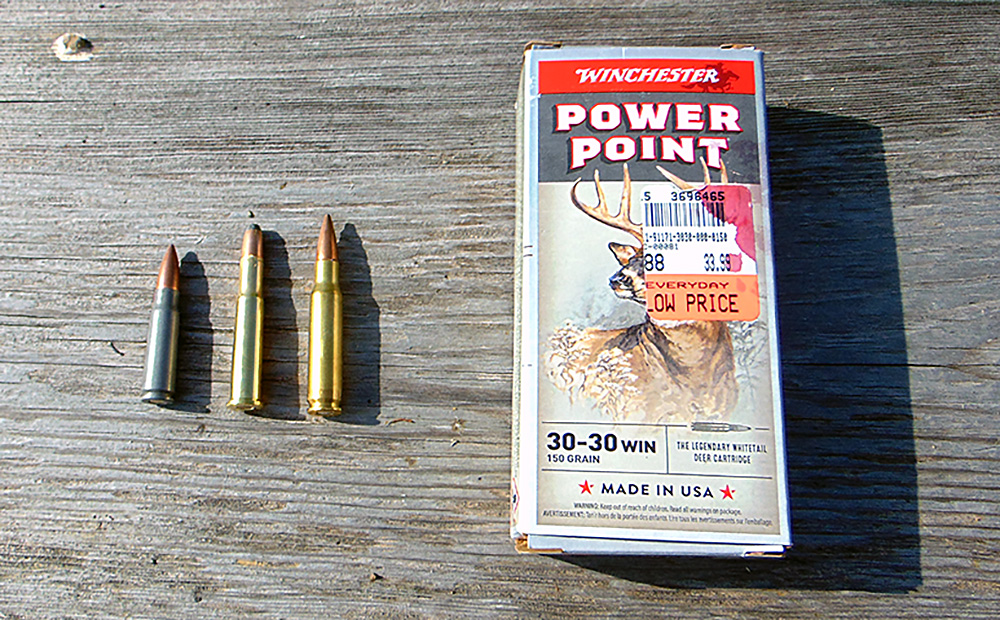
The .30-30 Winchester round was introduced in the Winchester Model 1894 lever-action rifle, which was actually introduced in 1895. Like most cartridges of that era, it is a rimmed round, with the rim positioning the round in the rifle chamber.
The .30-30 was the first small-bore cartridge, compared to the .44- and .45-caliber cartridges of the time, developed for use with the new smokeless powders. The result was a high-velocity, flat-shooting cartridge for its day that soon found its way into the hands of lawmen, hunters and citizens interested in home and property defense.
Not only was the .30-30 Winchester round powerful, but its shape made for smoother and more reliable feeding. Its name comes from the .30-caliber bullet diameter and the original loading of 30 grains of smokeless powder.
The cartridge has a distinctive taper from the main body (.38 diameter) down to the case neck. Its parent case was the earlier straight-walled .38-55. Compared to older straight-wall cartridges, the .30-30’s shape helped make it a natural fit for lever-action rifles.
A Cartridge That Still Makes Sense
The .30-30 sits in an interesting power range. It is below the .308 Winchester but well above classic pistol-caliber lever-action rounds such as the .44-40.
| Cartridge | Bullet Weight/Diameter | Muzzle Velocity | Muzzle Energy |
| .44-40 Winchester | 200 grains/.429 inches | 1,100 feet per second | 500 foot-pounds |
| .30-30 Winchester | 150 grains/.308 inches | 2,390 feet per second | 1,902 foot-pounds |
| .308 Winchester | 150 grains/.308 inches | 2,820 feet per second | 2,648 foot-pounds |
While there are only a few lever-action rifles chambered in .308, I include it because it helps show where the .30-30 sits in the power band.
An important safety note: .30-30 rifles fed by tubular magazines should not be loaded with pointed spitzer bullets unless the rifle is specifically marked for that use. A pointed bullet resting against the primer of the cartridge ahead of it in the magazine risks detonating multiple rounds in the magazine.
Bret believes the .30-30 would work well for rural law enforcement situations such as house or vehicle barricade situations. In those situations, 5.56 may not be enough power while .308 could be too much. With the right bullet weight and construction, the .30-30 could fill that space nicely and do it in a handier package than an AR-15 or M1A chambered in .308 Winchester.
Based on that, we decided to request the new Stealth Hunter in .30-30 for testing.
Smith & Wesson 1854 Stealth Hunter Features and Specifications
When I picked up the rifle, I was impressed. Smith & Wesson upgraded the1854 to be one of the handiest and most versatile modern lever-action rifles to come down the pike. Taking a closer look at it at home, I knew Bret was going to love it. The rifle’s quality is evident right out of the box.
Compact Carbine Design
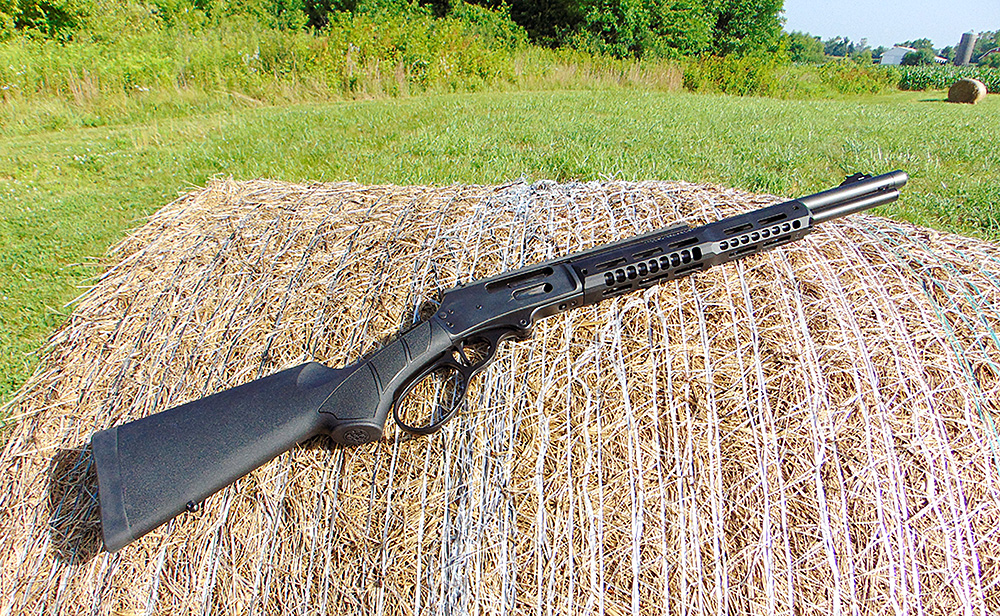
The first thing that stood out was the Stealth Hunger’s shorter barrel. S&W trimmed it from the original 19.25 down to 16.5, including the muzzle cap.
This change gives a new definition to “pointability,” the ability to rapidly acquire and address a target with minimal effort.
The next thing I noticed was the replacement of the original textured forend with a black aluminum M-LOK handguard with 15 M-LOK attachment slots. Besides giving the shooter plenty of room for accessories such as lights, lasers or other equipment, the aluminum handguard provides additional barrel ventilation during multiple rounds of firing.
The black finish on the metal gives the Stealth Hunger a low-profile appearance.
Sights Ready Out of the Box
The final upgrade I noticed was on top of the rifle. The lengthened Picatinny rail extends over the receiver and part of the barrel, providing more room for mounting optics.
While I didn’t immediately notice the change in rail length, what caught my attention was the upgrade to XS fully adjustable peep rear sight paired with a HiViz Litewave H3 fiber-optic front sight.
While I like brass bead sights on many lever-action rifles, there is no doubt this combination is a better fit for the Stealth Hunter. The rifle is ready to go right out of the box, allowing the owner to run the factory iron sights indefinitely or take advantage of the extended rail to mount an optic later. Combined with the M-LOK handguard, the rifle offers an impressive number of sighting and lighting options without requiring any modifications.
Winchester Model 1854 Stealth Hunter Specifications
Safety: Receiver Mounted Cross Bolt
Action: Lever Action with Large Loop Lever/Armonite Finished
Width: 1.6 inches
Trigger pull: 5 pounds, 2 ounces
Overall length: 34.3 inches
Muzzle: 5/8 – 24 Treads with Thread Protector
Rear stock: Black Synthetic with Textured Grip Panels
Forend: Aluminum with Hardcoat Finish and 15 M-Lok Slots
Barrel: 16.5 inches 410 Stainless Steel with Armonite Finish
Receiver: Forged 416 Stainless with Armonite Finish
Weight: 6.95 pounds
Picatinny rail: 10.5 inches mounted atop receiver
Caliber: .30-30 (tested), .45-70, .44 Magnum/.44 Special, .357 Magnum/.38 Special, .45 Colt
Capacity: 5 rounds (with continual top-off as needed)
MSRP: $1,499
The Smith & Wesson 1854 Stealth Hunter retains the traditional lever-action operating system while incorporating a number of modern features. It uses a large-loop lever with an Armornite finish, a forged 416 stainless-steel receiver and a 410 stainless-steel barrel, also treated with Armornite for additional durability.
How the Model 1854 Handles on the Range
I headed to the range with a box of Winchester 150-grain Power Point Ammunition. I didn’t have any .30-30 ammunition on hand, so I had to stop at a nearby Dunham’s Sporting Goods on the way. A box of 20 rounds was $33.99.
Unlike 5.56 NATO, .30-30 isn’t typically sold in bulk. While a popular hunting caliber, most deer hunters won’t shoot large quantities throughout the year. They may confirm their zero before the season, harvest a deer or two and put the rifle away until the following fall. My advice is to practice regularly with less-expensive firearms and ammunition while keeping a good supply of .30-30 on hand for hunting or defensive use.
Bret was immediately impressed with the Stealth Hunter, as I expected he would be. I suspect many lever-gun enthusiasts will react similarly, especially those looking for a compact utility rifle with considerably more power than a pistol-caliber lever-action but without the recoil of a larger rifle cartridge.
I didn’t add an optic before heading out tot Bret’s range for a quick test. If this were my personal rifle, I’d have to spend some time deciding which optic is best. It is entirely possible that I would keep the factory metallic sights in place.
Accuracy Testing
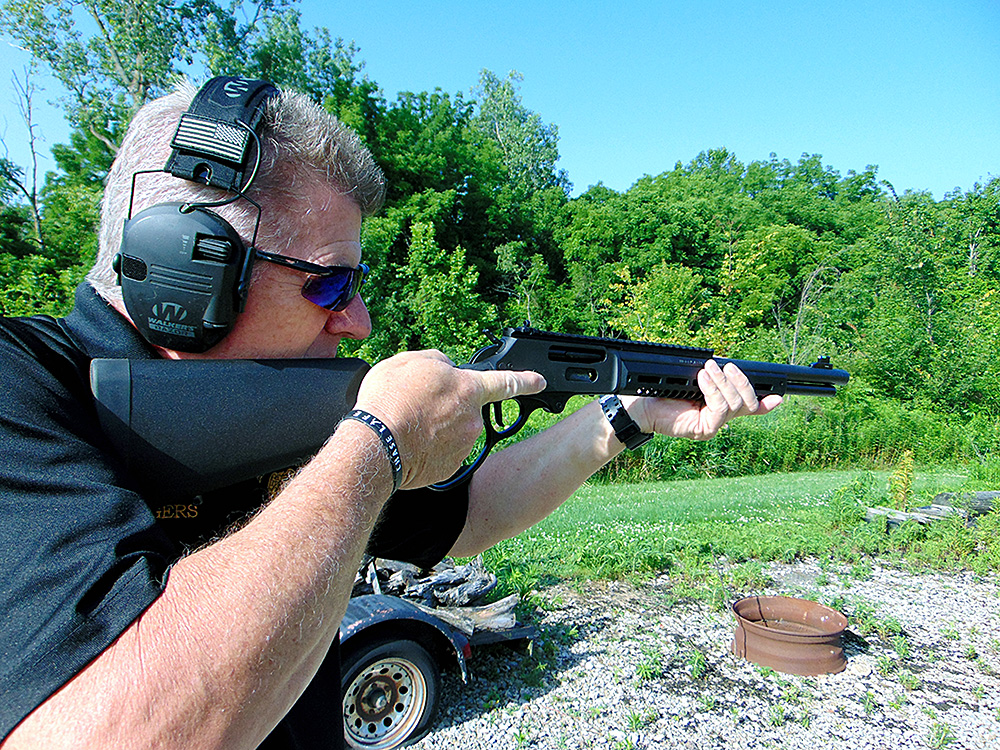
We posted the target and walked back to 20 yards. Watching modern .30-30 ammo being loaded into a rifle based on a 132-year-old design was interesting. Ammunition loaded smoothly into the magazine tube, and the bullet’s longer length and rounded nose allowed the cartridge to glide easily into place in the chamber when cycled.
Bret fired first, four rounds creating a 1 ½-inch grouping. The tight grouping proves the factory sights were zeroed properly straight from the factory.
I aimed my first round at the center orange bullseye. The Hi-Viz front sight stood out vividly against the rear peep sight, and the flat trigger had a crisp break as advertised. I couldn’t get as steady from standing as I would’ve liked but fired the remaining four rounds as best I could. The last round was a flyer to the left, but the first four made a 3-inch group.
Reliability was flawless throughout our testing.
Every empty case ejected cleanly and landed in nearly the same location. The large-loop lever cycled as smoothly as silk, and the rifle balanced naturally right at its midpoint. Everything about its operation reinforced my first impression that this is a very refined modern lever-action rifle.
Recoil and Shootability
It’s been a lot of years since I fired a .30-30 lever action, a Winchester Model 94 with a crossbolt safety that I owned in the early 2000s. It was not as comfortable to shoot as the S&W 1854. The Stealth Hunter has an excellent rubber recoil pad that noticeably reduces felt recoil compared to the curved steel buttplate on the Winchester 94.
The .30-30 Winchester is certainly no .308 Winchester or .30-06 Springfield, but it’s not a wimpy round. The Stealth Hunger’s design made it fun to shoot, though, and would encourage regular practice with its light recoil.
Is a Lever-Action Useful for Home Defense?
I cannot say enough positive things about the Smith & Wesson 1854 Stealth Hunter. It is about as close as you will find to a “go anywhere, do anything” lever-action rifle.
Whether deer hunting, protecting property or carrying along for a camping gun, this rifle will provide reasonable defense. Smith & Wesson has successfully blended the proven handling characteristics of the traditional lever action with practical modern upgrades that genuinely improve the rifle.
Both Bret and I came away convinced that the Stealth Hunter .30-30 would make an outstanding utility rifle and an excellent rural patrol carbine.
Sources:
Smith & Wesson: Smith-Wesson.com
Winchester: Winchester.com