One of my favorite western films is Big Jake, set along the Southwest border in 1909. Though it is one of John Wayne’s best performances, what really stands out to me is the time period. The film captures a transition point of older frontier tools giving way to more modern equipment.
REO automobiles replace horses, temporarily, to track down the bad guys, but those early cars didn’t stand up well under fire and the characters soon end up back on horseback. Alongside that shift in transportation, the movie showcases a range of period firearms that also reflect a transition in technology.
Among the traditional single-action Colts and double-barrel shotguns, the early Bergman 1896 semi-automatic pistol, scope-sighted Mauser Danzig bolt-action rifle and the then brand-new Model 1903A1 Springfield make appearances. That overlap of old and new of the era is especially interesting to me.
The Enduring Appeal of the 1911 Pistol
With that transition era being well-covered in western flicks, it makes sense that Cimarron Firearms, known for producing historically inspired firearms, would offer a GI-style 1911 .45 ACP pistol that closely mirrors the original 1911 design introduced by Colt in 1911.
The Cimarron 1911 .45 ACP is designed to replicate the look and feel of the original military 1911 without the high cost typically expected of premium reproductions. It stays true to the classic design while incorporating a few practical updates.
The original .45 ACP 1911 was designed by John M. Browning and was adopted by the U.S. military in 1911. It remains one of the most influential handgun designs. The later 1911A1 variant introduced modifications requested by the military in 1924.
The A1 modifications were subtle enough to go unnoticed by those unfamiliar with the 1911. Cimarron blends elements of the original 1911 and the 1911A1 variation. Importantly, all components are built to be Colt compatible. At less than $600 rather than $1,500, the Cimarron 1911 .45 ACP delivers the function of a traditional military-style 1911 pistol while remaining accessible to a wide range of shooters.
Overview of the Cimarron 1911 .45 ACP: Classic 1911 vs. 1911A1 Elements
Cimarron’s 1911 blends classic features and select 1911A1 updates, resulting in a GI-style 1911 that maintains historical authenticity while offering practical usability at an accessible price point.
Cimarron 1911 Specifications
Caliber: .45 ACP
Capacity: 8
Barrel length: 5 inches
Overall length: 8.5 inches
Weight: 38.4 ounces (empty magazine)
Width: 1.29 inches
Height: 5.73 inches
MSRP: $598.75
Frame, Grip and Controls
The Cimarron retains many of the defining characteristics of early 1911 pistols, particularly in its grip and frame design:
- Smooth, flat mainspring housing with no checkering or grooves, consistent with the original 1911
- Integrated lanyard retention ring at the base, reflecting military-issue configurations
- Standard checkered magazine release
- Frame is not undercut at the trigger guard like modern .45s are and features scalloped cutouts behind the trigger guard like the 1911A1
The grip safety follows the original narrow 1911 profile and extends slightly beyond the frame like the A1. It is not a beavertail design, and with no memory bump, it preserves the look of the WWI pistol.
The grips themselves follow the classic “double diamond” pattern. Though a lighter, honey-brown than a deep walnut, the Cimarron grips are cut close to the original pattern. The grips can be easily swapped with aftermarket replacements for those seeking a WWII-era look. I found Herrett’s Double Diamond Walnut Grips stained to match the 1911 for $35.99 at PrimaryTactical.com.
Trigger, Hammer and Safeties
This 1911 incorporates a mix of original and updated control features:
- Medium-length trigger, longer than a 1911A1 but shorter than a standard 1911
- Hammer spur is narrower than original 1911, more closely resembling 1911A1 style, with crosshatch checkering
- Standard 1911A1 thumb safety with extended ledge for more control and better leverage
The combination of historical accuracy and modern upgrades provides practical handling, especially for shooters used to modern 1911 controls.
Slide, Sights and Markings
The slide stays true to the traditional military format, with narrow vertical grasping grooves rather than the angled grooves on modern 1911A1 pistols. Like standard GI 1911 and 1911A1 pistols, the top of the slide is rounded. And the slide release is also the standard military-style.
The slide is marked with the original Colt patent dates but features the Cimarron “scout” rider branding rather than the Colt emblem.
Cimarron utilizes the upgraded A1 sights as the original 1911 sights, from what I’ve seen, were horrid: a mere sliver of rounded metal at the front and a tiny notch as the rear sight. The 1911A1 sights are only marginally better, but these pistols were designed for close-range fighting.
Finish, Ejection and Reliability Enhancements
The Cimarron 1911 pistol’s finish is Parkerized, a rust-resistant protectant applied to nearly all small arms in WWII. The original 1911 was blued, but Parkerizing is much less expensive while maintaining the military look. This finish, though helpful in cleaning a 1911, is not as impervious to rust as more modern finishes, however.
Additional functional updates include:
- Lowered ejection port, found on all modern 1911s, improves reliability of ejecting empty cases
- Colt-compatible internal components for ease of maintenance and parts replacement
The Cimarron ships with an eight-round blued steel magazine. There are witness holes on both sides. Its plastic base protrudes beyond the grip, differing from the original seven-round, standard metal flat base. I would like to see Cimarron return to the original style, allowing users to modernize the gun as they see fit.
Range Performance: Shooting the Cimarron 1911 .45
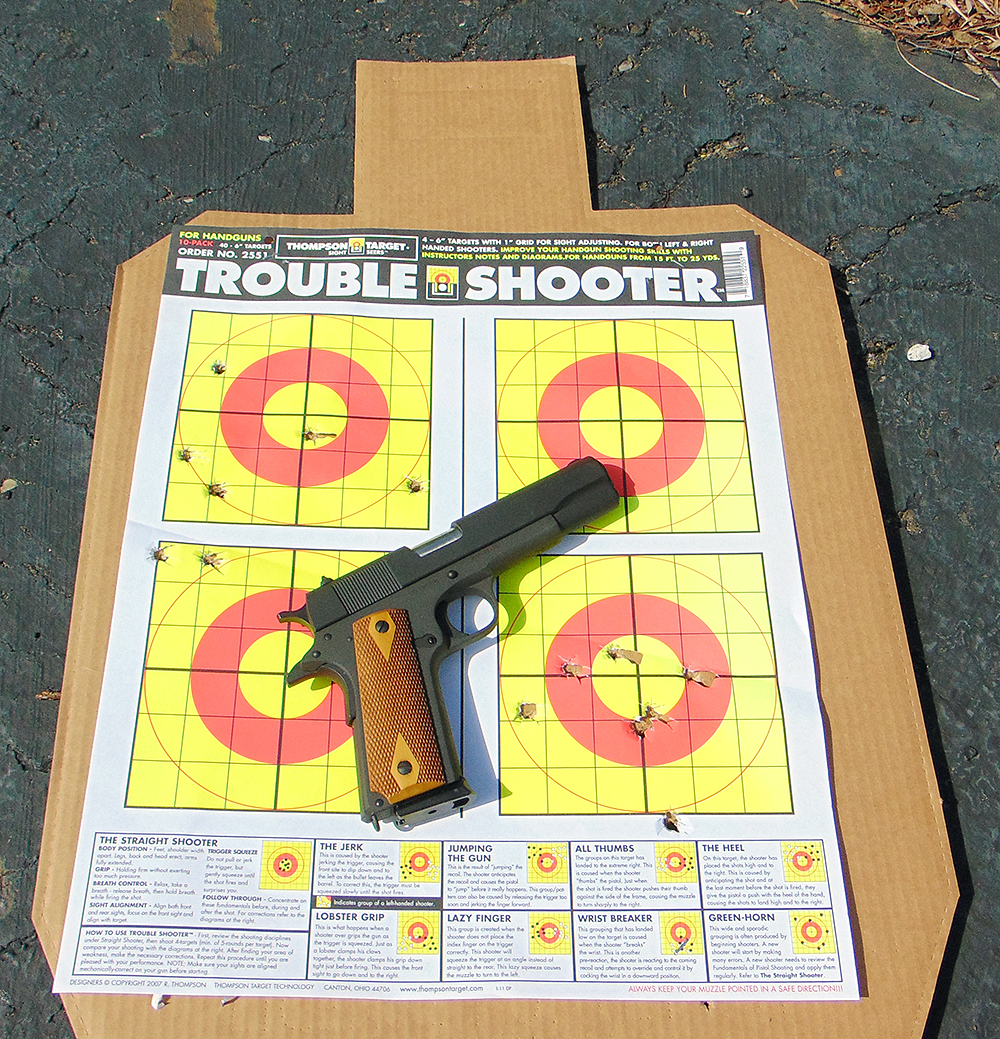 We were granted a warm, sunny day on the range for a change. I tested the Cimarron 1911 .45 ACP pistol with two loads.
- SIG Sauer 230-grain FMJ ball ammunition: muzzle velocity of 832 feet-per-second for 352 foot-pounds of energy
- SIG Sauer Elite Performance 200-grain V-Crown JHP ammo: muzzle velocity of 918 feet-per-second for 374 foot-pounds of energy.
These loads represent a good range of .45 ACP ammunition. Both cycled reliably. We found the magazines to initially be stiff, so we started by loading only six rounds of the 200-grain V-Crown ammunition.
Starting from 20 feet, my friend Bret fired the first group on a plain white cardboard silhouette target, producing a group of about 6 inches plus one called flier that extended it to 8 inches. After loading the full seven rounds, his next group was tighter at about 6 inches with no fliers.
There were no malfunctions, which is pretty good for a military-style 1911 right out of the box.
It was my turn next, and I loaded seven rounds of the 230-grain FMJ ammo. Shooting the Cimarron 1911 was a good reminder of why I put XS sights on all of my defensive guns. In the bright sunlight, the Parkerized front sight was completely washed out. It was difficult to bring the Trouble Shooter targets I had stapled to the cardboard silhouette into focus.
The trigger performed well, though, breaking at 5 pounds, 2.8 ounces. My first seven-shot group, fired at the top right circle of the target, measured 6 inches. My next seven-shot group at the bottom right circle was a tighter 4 inches.
There were no malfunctions with either load throughout testing. The Cimarron demonstrated consistent accuracy for a military-style 1911.
My son was with us and also had the opportunity to shoot the Cimarron 1911, his first .45 ACP. After some initial instruction, I loaded one round for him. He quickly became comfortable with the recoil and followed up with two more magazines on the steel silhouette and previously used cardboard target. There were again no malfunctions, and he clearly enjoyed the afternoon of shooting.
Overall, the Cimarron 1911 .45 ACP delivered dependable performance at the range, combining classic handling with reliable function.
Is the Cimarron 1911 .45 ACP Worth It?
This pistol stands out in its adherence to the original design. The controls, grip profile and overall configuration mirror a traditional military-style 1911, giving shooters an experience that closely reflects the platform’s roots.
From a practical standpoint, this .45 ACP handgun is well-suited for range use, training and historical appreciation. While it can serve in a defensive role, those prioritizing modern defensive performance may prefer upgraded sights or more contemporary 1911 features.
The Cimarron 1911 .45 ACP pistol delivers exactly what it sets out to be: a faithful, GI-style 1911 that captures the look, feel and function of the original military sidearm without the premium price tag. In addition to the Parkerized 1911, Cimarron also offers a beautiful nickel-plated 1911 that is more similar to a commander-sized 1911A1. It is part of their Arizona Ranger series of handguns, rifles and shotguns, which deserves a look.
Source:
Cimarron: Cimarron-Firearms.com