Less-lethal self-defense weapons are tools designed to stop or deter an attacker without the intent to cause death. While often called “non-lethal weapons,” these tools, including pepper spray, Tasers and batons, still carry risks and legal considerations. Understanding how and when to use them is critical for responsible self-defense.
Understanding “Less-Lethal” vs. “Non-Lethal”
There is an important distinction between “less-lethal” and “non-lethal” self-defense tools. When evaluating non-lethal weapons for self-defense, it’s important to understand that “less-lethal” is the more accurate term. Though “non-lethal” is commonly used, it can be misleading.
In reality, all weapons, regardless of their intended level of force, have the potential to be lethal under certain circumstances. Therefore, the more accurate terminology is “less-lethal,” emphasizing that these tools are designed to minimize the likelihood of causing lethal harm rather than completely eliminating it.
Understanding this distinction underscores the importance of treating all self-defense tools with utmost respect and caution. Even those categorized as “less-lethal” should be wielded responsibly, considering their potential impact.
It emphasizes the need for individuals to be well-informed about the proper use of force, ensuring that the chosen self-defense tools are employed judiciously and in accordance with legal guidelines. By acknowledging the inherent potential for lethality in any self-defense situation, individuals can make informed decisions that prioritize safety and legality.
Build confidence with less-lethal tools through hands-on training.
Less-lethal self-defense weapons are a great option in situations when you can’t use a firearm. Explore a wide variety of non-lethal tools in the USCCA’s new Non-Lethal classes.
USCCA’s expert-led classes cover everything from which tool to use to legal considerations and conflict avoidance – giving you the confidence and skills to protect what matters most.
Over 1 million students trained nationwide. Find certified instruction in your area and take the next step in your protector journey.
Non-Lethal and Less-Lethal Self-Defense Options for Personal Protection
You may not always be able to rely on a loaded gun as an effective self-defense response to a lethal threat. As well, there are psychological and physiological complexities involved in using lethal force, as highlighted by military historian Brigadier S.L.A. Marshall.
Marshall’s insights, recorded in his book Men Against Fire, revealed that even well-trained soldiers in World War II exhibited reluctance to shoot at the enemy, raising questions about the automatic response to a lethal attack.
Marshall’s findings, supported by later research by Lt. Col. Dave Grossman in his book On Killing, shed light on the innate aversion humans have to killing their own kind. Societal, cultural, moral and religious norms contribute to this aversion, creating a reluctance to use lethal force even in life-threatening situations. Understanding these psychological realities is part of choosing the right self-defense tools.
Recognizing the multifaceted nature of employing lethal force, law enforcement agencies have developed training scenarios and adopted the 21-foot rule. This rule underscores the imperative for officers to swiftly react to an impending threat within close quarters, underscoring the intricate challenges associated with identifying and responding to a potentially lethal attack effectively.
Types of Less-Lethal Self-Defense Weapons
For civilians, the decision to use lethal force is a personal and legal challenge. Firearms are powerful tools for self-defense, but not everyone is comfortable using them or can carry them in all situations.
In light of this, it’s crucial to explore non-lethal and less-lethal self-defense options that align with legal and personal considerations.
Pepper Spray for Non-Lethal Self-Defense
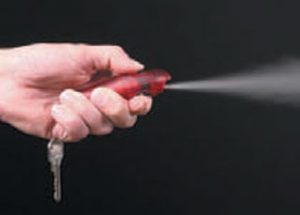
Pepper spray, one of the most common non-lethal weapons for self-defense, is designed to temporarily incapacitate an attacker. The spray is made from oleoresin capsicum, which irritates the eyes, causing intense pain and making it difficult to see.
Pepper spray can also cause those exposed to it to produce tremendous amounts of mucus and tears. Exposure may make the person think he or she is having difficulty breathing.
These effects often allow the user to escape an attack. The primary advantage of carrying pepper spray is that it can be used from a distance, making it a safer option.
Advantages
- Can be deployed from a distance
- Temporarily incapacitates by causing intense eye irritation and pain
- Creates tearing, mucus production and breathing discomfort
- Often allows the defender to disengage and escape
- Compact and easy to carry
Disadvantages
- Risk of indirect exposure to the user or bystanders
- Indoor use may contaminate the entire room
- Deployment in crowds may cause panic or stampede
- Effects vary depending on wind and environment
Pepperball Launchers
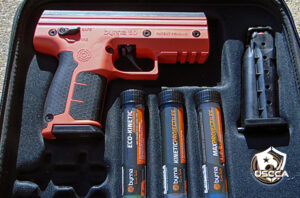
Pepperball launchers are less-lethal projectile systems designed to fire small spherical rounds filled with irritant powder. When the projectile strikes a surface, it breaks apart and releases a cloud of irritant intended to temporarily incapacitate an attacker and create an opportunity to escape.
These launchers are typically powered by compressed gas and resemble compact pistols or handheld launchers. This less-lethal defense option can deliver irritant effects at longer distances.
Advantages
- Can be deployed from a distance
- Allow defenders to create space
- Pistol-style platform may feel familiar to firearm owners
Disadvantages
- Larger and heavier than pocket-sized self-defense tools
- Projectiles must be replaced after use
- Require compressed gas or other power source
 Related Reviews:
Taser vs Stun Gun: What’s the Difference?

Taser is the brand name of an electroshock weapon designed to incapacitate an attacker by sending a jolt of electricity through the body. Electronic stun guns are often mistakenly called Tasers, but the two devices work on completely different principles.
The primary difference between a Taser and a stun gun is the distance at which they can be used. Stun guns only work at contact distance.
The electrodes must be held in place against an attacker. Tasers can be deployed from up to 25 feet away, but if both probes do not sink into the attacker’s flesh, the effect is minimal at best.
Tasers are also difficult to reload and redeploy if you miss your target.
Advantages
- Can be deployed from up to 25 feet
- Designed to incapacitate
- Allow engagement without immediate physical contact
Disadvantages
- Both probes must properly contact attacker for full effectiveness
- Difficult to reload quickly if deployment fails
- Limited opportunity for immediate follow-up
Batons: A Less-Lethal Impact Weapon
A baton is a versatile weapon that can be used for both defensive and offensive purposes. They come in various lengths and can be made from materials such as wood or metal.
The primary advantage of batons is that they can provide enough force to stop an attacker without causing permanent damage. However, a baton as a primary self-defense tool can be difficult to carry and bulky.
Expandable metal batons are smaller but still by no means easy to carry. Using a baton also requires that you be within arm’s reach of your attacker.
The chances you could be grabbed, struck or kicked increase with close proximity. Effective defense with a baton also requires some training and at least a moderate level of strength and mobility.
Advantages
- Can generate sufficient force to stop an attacker
- Available in various lengths and materials
- Expandable models offer improved portability
Disadvantages
- Bulky compared to other self-defense options
- Require arm ‘s-length proximity, increasing risk of being grabbed
Kubatons
A Kubaton is a compact self-defense tool often carried on a keychain. This small metal or plastic device has a pointed end that can be used to strike an assailant in the event of an attack. In addition to being used as a weapon, Kubatons can also be used for breaking glass or even as an aid in rescue situations.
Small and unobtrusive, the Kubaton is easy to carry and can be quick to deploy if you’re using situational awareness and keep it in your hand when you fear an attack. It can enhance the power and pain behind your defensive strikes.
But, like with the baton, the use of a Kubaton requires you be very close to your attacker, meaning you will likely be in the attacker’s grasp when you deploy this tool. With even a basic level of training, a Kubaton can be effective in causing the attacker enough pain to break contact, giving you a chance to escape.
Advantages
- Small and unobtrusive
- Easily carried on a keychain
- Quick to deploy if already in hand
- May create pain compliance to facilitate escape
Disadvantages
- Require very close contact
- Likely used while within attacker’s reach
Knives for Self-Defense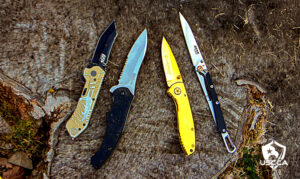
While knives may not be for everyone, they can be an effective tool for self-defense in certain situations. You can purchase knives of various shapes, sizes and styles, all of which can be used to stop an attacker.
It is important to remember that knives require training to be used safely and effectively. This is especially true of folding knives (the most popular knives sold today), which can be difficult and slow to open when under stress.
On the plus side, when you are holding and using a knife for self-defense, it can be very difficult for someone to take the knife away from you without being cut. Conversely, you must be careful when using a knife not to cut yourself.
Like the other defensive tools mentioned above you must be very close to your attacker to use a knife effectively. In a defensive situation, proximity means danger.
State and local knife laws are a patchwork of differing definitions and requirements. A knife that may be legal in one locale may not be legal in another.
Advantages
- Available in many shapes and styles
- Can be difficult for an attacker to disarm without injury
- Widely accessible
Disadvantages
- Require close proximity
- Folding knives may be slow to deploy under stress
- Risk of self-injury
- Patchwork of state and local knife laws
Less-Lethal Self-Defense Tools
| Tool | Effective Range | Requires Close Contact | Key Advantages | Key Limitations |
|---|---|---|---|---|
| Pepper Spray | Distance deployment | No | Compact, can temporarily incapacitate, may allow escape | Risk of indirect exposure, indoor contamination |
| Pepperball Launcher | Up to 150 feet | No | Extended range, pistol-style platform | Requires separate projectiles, larger platform |
| Taser | Up to 25 feet | No | Distance engagement, electrical incapacitation | Probes must properly contact target, difficult to reload |
| Stun Gun | Contact distance | Yes | Compact, electrical deterrence | Must be held in place, requires proximity |
| Baton | Arm’s length | Yes | Can generate sufficient stopping force | Bulky, requires strength and training |
| Kubaton | Arm’s length | Yes | Small, easy to carry, pain compliance potential | Requires close contact |
| Knife | Arm’s length | Yes | Widely available, difficult to disarm | Requires proximity, legal variability |
What Is the Best Less-Lethal Option?
When selecting a non-lethal or less-lethal weapon, consider factors like legal restrictions, personal comfort and training requirements. While these less-lethal weapons may not replace the effectiveness of a loaded firearm, they provide viable self-defense options in situations where deadly force may not be legally or personally appropriate.
Navigating the complexities of self-defense involves understanding the psychological and legal aspects of using force. Non-lethal and less-lethal self-defense options offer valuable alternatives, allowing individuals to protect themselves in situations where firearms may not be suitable.
The best non-lethal self-defense option is the one you understand, can legally carry and are properly trained to use. Each less-lethal weapon offers tradeoffs, and the best choice will vary based on distance, environment and personal readiness.
As you explore these options, prioritize safety, legality and proper training when selecting less-lethal or non-lethal self-defense weapons to make informed choices that align with your personal values and circumstances.
Take Your Protection to the Next Level
Join over 860,000 USCCA Members for leading self-defense education, training and legal protection benefits.
This article is a compilation of previous blog posts authored by Kevin Michalowski, Ed Combs, Scott W. Wagner, Bruce N. Eimer and Rick Baratta.
Less-Lethal Self-Defense FAQs
What is the difference between less-lethal and non-lethal weapons?
While the term “non-lethal weapons” is commonly used, “less-lethal” is more accurate. Any weapon has the potential to be lethal under certain circumstances. Less-lethal weapons are designed to minimize the likelihood of causing death, but they still carry risks and legal considerations.
Are less-lethal weapons safer than firearms?
Less-lethal self-defense weapons may provide alternatives in situations where deadly force is not legally or personally appropriate. However, they still require responsible use, proper training and an understanding of legal restrictions. They are not risk-free and can still cause serious harm.
What is the difference between a Taser and a stun gun?
A Taser can be deployed from up to 25 feet away and uses probes to deliver an electrical impulse. A stun gun requires direct contact with the attacker and must be held in place.
Can pepper spray be used indoors?
Pepper spray can be deployed from a distance and may allow a defender to escape. However, indoor use may contaminate the entire room and cause indirect exposure to the user or bystanders. Environmental conditions can affect its impact.
What less-lethal options require close contact?
Batons, Kubatons, stun guns and knives require close proximity to an attacker. This increases the risk of being grabbed, struck or kicked. Effective use of these tools typically requires training and physical control.
Are less-lethal weapons legal everywhere?
Legal restrictions vary depending on the tool and jurisdiction. State and local laws — particularly for items like knives — can differ significantly. Individuals should understand applicable laws before carrying any self-defense weapon.