Two hands on the gun will usually give you more control, better recoil management and greater stability. That is why most defensive handgun training starts with a two-handed grip.
But real-life emergencies do not always cooperate with what we practiced on a square range.
You may be knocked down and use one hand to catch yourself. You may be pulling a loved one behind you, pushing someone out of danger, blocking an incoming strike or holding onto something to keep from falling. Or you may be moving toward cover or trying to create distance. And, of course, one hand or arm may be injured.
If any of those things happen, you may have to draw and fire with only one hand. The important question is not whether it will feel as natural as your normal two-handed grip. The important question is whether you can do it safely and effectively when you need to.
One-handed shooting is not a trick for the movies. It is a defensive skill that deserves a regular place in your training.
Why Practice One-Handed Shooting?
An injury may make your support hand unavailable. A dominant-hand injury may force you to draw, aim and fire with the hand you normally use only for support. A broken finger, stitches, an injured arm or a hand in a sling can change how you access and control your firearm. If you wait until after an injury to learn those skills, you are making an already difficult situation even harder.
But injury is only one possibility. You may need one hand to:
- fend off an attacker
- strike or block
- guide a child or another loved one
- pull someone behind you
- brace against cover
- catch yourself during a fall
- hold onto something for balance
- move more quickly
- keep yourself from falling into the line of fire
Anything that forces one hand off the gun creates a reason to become competent with the other.
One-handed shooting can also give you options even when both hands are functional. If you are working around cover, switching hands may allow you to expose less of your body. In tight spaces, letting go with the support hand may allow you to move the handgun more freely. If you are running or changing direction, allowing one arm to swing can improve balance and help you move more naturally.
You don’t need to abandon your two-handed grip whenever things become inconvenient, but you should stop treating two hands on the gun as the only acceptable answer. It is better to discover on the range that one-handed shooting feels awkward than when someone is trying to hurt you.
Is One-Handed Shooting Less Accurate?
It can be.
A two-handed grip gives you more contact with the firearm and more control over recoil. With only one hand on the gun, there is less support available to manage movement, stabilize the sights and recover between shots. That means one-handed shooting often requires more concentration and greater attention to grip, trigger control and sight recovery.
Support-hand-only shooting will likely feel even more awkward because that hand is usually less coordinated and receives less practice. The trigger press may feel unfamiliar. The sights may not appear naturally in front of the eye. Recoil may seem more pronounced because you do not yet know how much pressure to apply or how to position the wrist.
However, that doesn’t mean you can’t shoot accurately with one hand. You will need to slow down and build the skill correctly. Start with deliberate single shots. Pay attention to where the sights move. Reset your grip between rounds if necessary. Do not add speed until you can keep the shots where you intend them to go.
You may never shoot one-handed as well as you shoot with a solid two-handed grip. The goal is to become competent enough to solve the problem in front of you.
How to Grip a Pistol With One Hand
The basic principles still apply with only one hand available.
Start with a high grip on the pistol. Place the web of the shooting hand as high as practical on the backstrap and wrap the fingers firmly around the grip. A loose grip allows the handgun to move more during recoil and makes follow-up shots more difficult.
Think about controlling the gun without turning your entire upper body into concrete. The shooting hand should be firm. The wrist should be stable. But the shoulder and arm do not need to be strained beyond usefulness. Don’t squeeze until the hand shakes; just grip firmly enough that the pistol doesn’t shift unnecessarily during recoil.
Your wrist position matters as well. If the wrist collapses, the gun will move more and the sights will take longer to recover. Keep the wrist firm and the muzzle under control.
The exact position of the thumb may vary with the firearm and the size of your hand, but it should not interfere with the slide, controls or trigger finger. Your trigger finger still has one job: press the trigger without disturbing the sights.
That becomes more important when shooting with the support hand. As well, an injured dominant hand may require shooters to experiment with using other fingers if the index finger is compromised. Your grip technique may also need to change when the hand itself is injured.
The larger lesson is that rigid rules are less useful than tested skills. You need to know what you can actually do with the hand available to you.
Should You Cant the Pistol?
There are two common ways to hold the pistol one-handed: keep it upright as you would during normal two-handed shooting or angle it slightly inward.
A slight inward cant may help some shooters lock the wrist and improve control. Referred to as the “McMillan tilt,” many shooters find this position more natural and that it can improve one-handed accuracy and recoil control.
The key word is slight. This is not an excuse to turn the handgun sideways like something from a bad movie. A moderate inward angle may help. An exaggerated angle may create more problems than it solves.
The sensible approach is to test both positions during practice. Shoot the pistol upright. Then try a slight inward cant. Compare your control, comfort and accuracy. Use the position that helps you manage the gun without creating unsafe habits.
You may even find that one hand prefers a slight cant while the other works better with the gun upright. Your hands are not identical.
Where Should Your Other Hand Go?
This question has generated more dogma than it deserves.
Many shooters have been taught to place the unused hand across the chest, often clenched into a fist. That position keeps the hand clear of the muzzle and may feel balanced during a controlled range drill. It is a perfectly workable option when the arm is healthy and available.
Other shooters prefer placing the non-shooting hand on the hip, thigh, lower back, belt or pocket. The unused hand must remain safely out of the gun’s path while allowing the shooter to maintain balance and control.
The problem begins when one position is taught as the only correct answer.
If you are shooting one-handed because the other arm is genuinely injured, you may not be able to fold it across your chest. A broken upper arm, damaged elbow or serious gunshot wound may leave the limb hanging at your side. Trying to force it into a textbook position could be impossible, painful or distracting.
That is why at least some of your one-handed practice should include allowing the unused arm to hang naturally. It changes your balance, how your body moves, and it may make the shooting position feel less tidy. But it may also better reflect the reason you are shooting one-handed in the first place.
You should practice more than one realistic position:
- hand across the chest
- hand secured at the hip or belt
- hand on the thigh
- arm hanging naturally at the side
- hand occupied with another task during an appropriately designed drill
The first rule remains safety. Keep the non-shooting hand clear of the muzzle, trigger guard, slide and ejection port. The second rule is realism. Do not assume an injured arm will politely move to the position your instructor prefers.
One-Handed Shooting Stance and Body Position
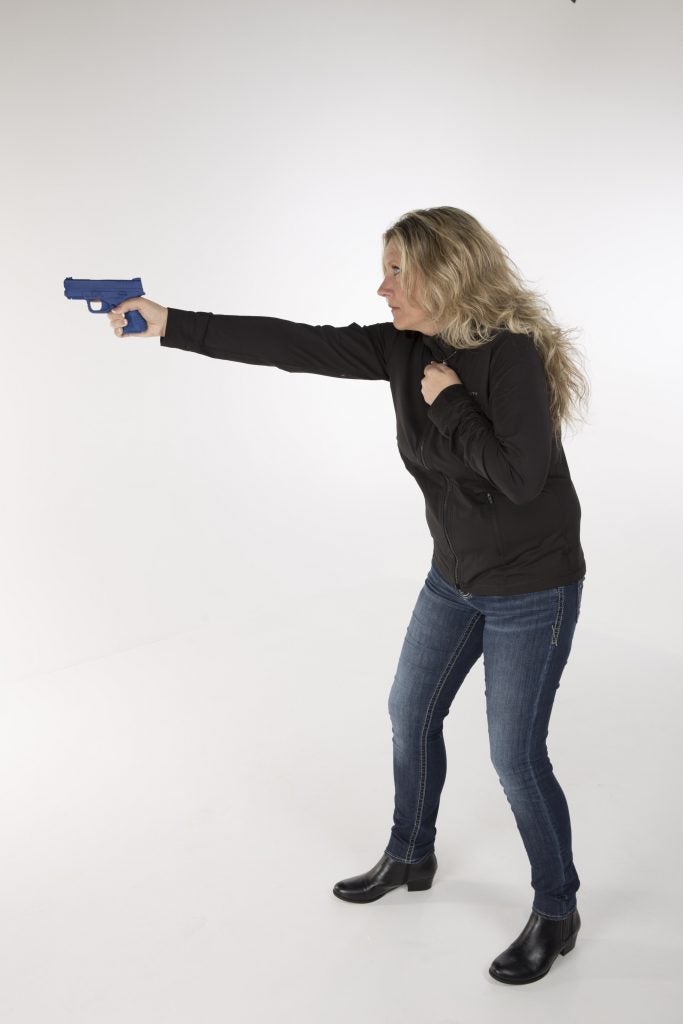
Some instructors teach one-handed shooting with the unused hand across the chest.
You may not get to choose your stance during a defensive encounter. You could be moving, falling, kneeling, working around cover or trying to keep another person behind you. But on the range, you should begin from a stable position that allows you to concentrate on the fundamentals.
Start with an athletic stance. Keep your feet far enough apart to maintain balance and place your body weight slightly forward. Leaning backward gives recoil more leverage and makes the gun harder to control. A slight forward bias helps you manage movement without locking the rest of your body into place.
The shooting arm can be fully extended or slightly bent. The correct answer depends partly on your body and partly on the situation. A locked elbow may feel stable to one shooter and overly rigid to another. A slight bend may help absorb movement, but too much bend can allow the pistol to drift or collapse toward the body.
Whatever position you choose, do not let the wrist go soft. The wrist is part of the recoil-control system. A firm wrist and consistent grip give the pistol a stable platform from which to cycle.
Your stance should also allow movement. A defensive stance is not a pose. It is a temporary position from which you may need to move, turn, lower your body or go to the ground.
If you are knocked down, you may not have time to stand up before using the gun. You can spend time trying to regain a perfect two-handed position or get the pistol on target from where you are. The safer choice is the one that stops the threat sooner.
The same principle applies around cover. A one-handed position may let you brace with the free hand, maintain your balance or switch the pistol to the hand that exposes less of your body. You do not need to force one stance onto every problem. You need enough familiarity with several positions to choose what works.
Strong-Hand-Only Shooting
For most shooters, strong-hand-only shooting is the logical place to begin.
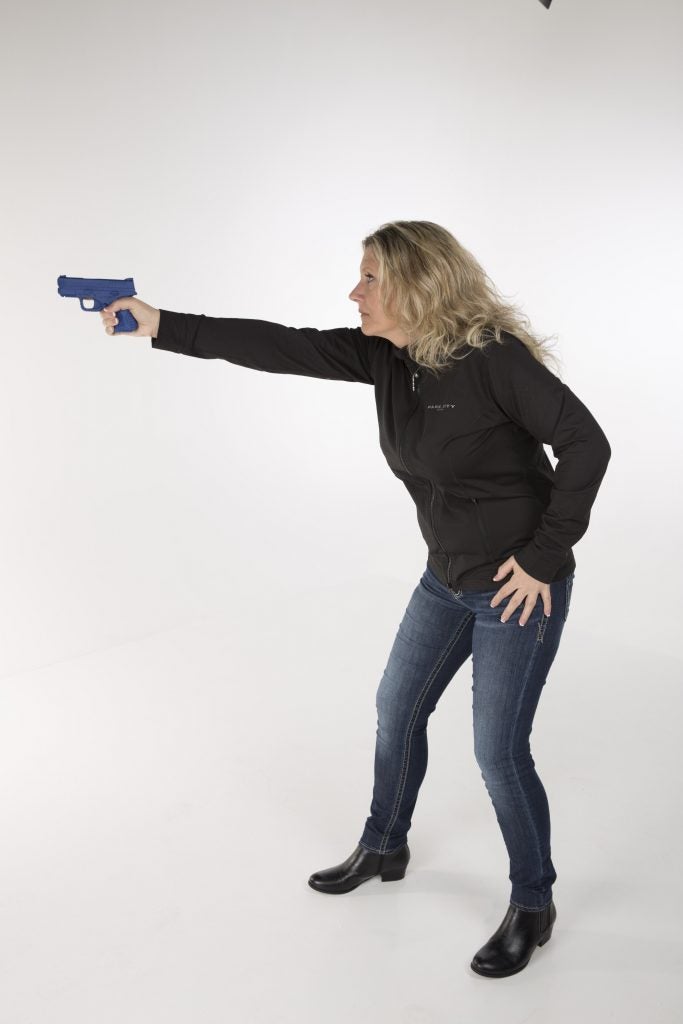
Another option is to rest the unused hand on you hip.
You already use that hand to establish the master grip, operate the trigger and draw from the holster. Removing the support hand reduces stability, but the rest of the process remains familiar.
Start from a low-ready position rather than immediately adding the draw. Present the pistol toward the target, establish the sights and fire deliberate single shots. Pay attention to whether the pistol shifts in your hand during recoil. If it does, adjust the grip before trying to shoot faster.
Once the grip is consistent, add controlled follow-up shots. The objective is to recover the sights and maintain accuracy while learning how the pistol behaves with only one hand controlling it. The “One and Only” drill recommends beginning at 5 to 7 yards and adding speed or additional shots only after accuracy remains consistent.
Strong-hand-only practice should eventually include movement and less-than-perfect body positions. You may need to use the other hand to fend off an attacker, catch yourself during a fall, hold onto cover or guide another person. That is why standing square to a target with the unused hand neatly placed against the chest should not be the only version you practice.
Being comfortable with the strong hand alone allows you to continue moving, change direction, work in confined spaces or respond from the ground without wasting time trying to rebuild a textbook stance.
Drawing With the Strong Hand Only
Drawing one-handed from concealment deserves its own practice.
The support hand usually clears the cover garment while the dominant hand establishes the grip. When the support hand is unavailable, the shooting hand has to perform both jobs.
One method is to hook the fingers of the shooting hand beneath the cover garment, lift it clear and then drive the hand down to establish the master grip. The movement may feel clumsy at first, and the shirt may fall back over the handgun as the hand moves toward the holster.
That is exactly why this skill should begin with an unloaded gun, inert training gun or airsoft gun. Clothing snags are more likely during a one-handed draw, and the process should be learned slowly before any attempt at speed or live fire.
Support-Hand-Only Shooting
Support-hand-only shooting is usually the more difficult half of the skill.
The hand may feel weaker, but strength is not the only issue. The larger problem is coordination. Your support hand does not normally establish the shooting grip, press the trigger or bring the sights into your line of vision. The entire process may feel unfamiliar.
If the dominant hand becomes injured long-term, the normal setup may need to be reversed. A right-handed shooter may need a left-handed holster and may have to learn a mirrored drawstroke. Even basic tasks can become slower because years of repetition have trained one hand to lead.
That is why the time to begin practicing is before an injury.
Start as though you were a new shooter. Use a close target and begin from a low-ready position. Do not immediately attempt a support-hand draw from a strong-side holster. First learn to grip, aim and press the trigger safely with the opposite hand.
The pistol may not naturally align with the dominant eye. You may need to turn the head slightly or alter the gun’s position to bring the sights into view. A slight inward cant may feel more natural with the support hand, but it should be tested rather than assumed.
Trigger control will likely be the greatest challenge. The less-practiced index finger may press the trigger unevenly or pull the gun off target. Dry-fire is especially valuable here because it allows you to concentrate on the trigger press without recoil distracting you. Jackson recommends approaching mirror shooting patiently and building confidence with dry-fire practice before moving to live fire.
The “One and Only” drill follows a similar progression: repeat the same slow-fire and multiple-shot exercises with the non-dominant hand, accepting that it will feel awkward at first and improve only through consistent practice.
Preparing for a Dominant-Hand Injury
A dominant-hand injury creates problems beyond firing the pistol.
You may need to change:
- how you carry
- where you carry
- how you access the holster
- how you clear the cover garment
- which finger operates the trigger
- how you establish a stable grip
A shoulder injury may make it impossible to reach across the body or place the injured arm against the chest. Some shooters may choose a temporary support-side holster. Others may consider a shoulder holster or cross-draw setup. Each requires practice before it can be relied upon.
One-Handed Shooting Drills
Like every other defensive shooting skill, one-handed shooting should progress from simple to complex.
Trying to shoot rapidly before you can consistently hit the target only reinforces bad habits.
Dry-Fire Practice
Dry-fire is the logical place to begin.
Without ammunition in the firearm, you can focus entirely on the mechanics of gripping the pistol, pressing the trigger and maintaining sight alignment without recoil masking your mistakes.
Support-hand practice should begin here as well. The goal is making the unfamiliar feel familiar.
Slow-Fire Accuracy Drill
Once dry-fire becomes comfortable, move to live fire.
Begin at approximately 5 to 7 yards using a target large enough to reward good fundamentals rather than punish minor mistakes. Fire one deliberate round at a time, allowing the sights to settle completely before pressing the next shot.
This drill is designed to develop:
- trigger control
- sight recovery
- grip consistency
- confidence
If the sights consistently jump in one direction or the pistol shifts in your hand, fix the problem before increasing speed.
Multiple-Shot Drill
Once single shots become consistent, begin firing controlled strings.
The purpose is not to empty the magazine as quickly as possible. Instead, concentrate on recovering the sights after each shot and maintaining a consistent grip throughout the string.
Try beginning with two-shot strings before progressing to three and eventually four rounds, provided accuracy remains acceptable.
Support-Hand Practice
Every drill you perform with your dominant hand should eventually be repeated with the support hand.
Expect it to feel awkward. The solution is consistent practice.
Movement and Realistic Practice
Eventually, your practice should begin to resemble the reasons you may need one-handed shooting in the first place.
Practice while:
- moving toward cover
- changing direction
- working around barriers
- shooting from the ground
- using the support hand to steady yourself
- guiding another person
- carrying an object that occupies the support hand
Being able to shoot one-handed allows you to move at sharper angles, maintain better balance and continue engaging a threat while solving other problems at the same time.
Common One-Handed Shooting Mistakes
The encouraging news is that most one-handed shooting problems are training problems and can be fixed.
- Trying too hard to keep both hands on the gun.
The purpose of a two-handed grip is to help you solve the problem, not become the problem. - Never practicing with the support hand.
The first time you press the trigger with your support hand should not be during an emergency. - Believing there’s only one correct position for the free hand.
Reality rarely looks like the square range. - Skipping dry-fire practice.
Dry-fire is where grip, trigger control and confidence are built. - Moving too fast too soon.
Accuracy first. Consistency second. Speed third.
How to Add One-Handed Shooting to Your Range Practice
One-handed shooting shouldn’t be something you practice once a year because an instructor told you to. Like every other defensive skill, it should become part of your normal range routine.
The good news is that it doesn’t require hundreds of rounds or an entire day on the range.
Start each practice session with the fundamentals. Spend a few minutes on dry-fire work before loading the gun. Concentrate on establishing a solid grip, maintaining a stable wrist and pressing the trigger without disturbing the sights.
When you move to live fire, begin with slow, deliberate shots at a modest distance. Fire one accurate shot at a time before progressing to controlled pairs and then slightly longer strings as your confidence grows.
Don’t stop after practicing with your dominant hand.
As your confidence grows, begin adding realistic challenges.
Practice while:
- stepping off the line of attack
- moving toward cover
- working around cover
- shooting from kneeling or from the ground
- guiding a child or training aid with the free hand
- using the support hand for balance
Finally, don’t become trapped by routine. Practice with your unused hand across your chest, on your hip or with it hanging naturally to simulate an injury. Using more than one position in practice helps you become adaptable instead of simply becoming good at repeating one range exercise.
One-Handed Shooting Is a Defensive Skill, Not a Trick
The purpose of one-handed shooting isn’t to impress anyone at the range. It’s to solve problems.
Sometimes that problem is an injured arm. Sometimes it’s protecting a child. It may be moving to better cover or getting back on your feet after being knocked to the ground. Or it’s simply recognizing that forcing yourself into a two-handed grip is making the situation worse instead of better.
You’ll probably never shoot one-handed as well as you shoot with both hands. You may never shoot equally well with your dominant and support hands.
That’s okay.
If you can safely draw the handgun, make accurate hits with either hand and continue solving problems while moving through an imperfect fight, you’ve gained something far more valuable than another shooting drill. One day, it may be enough to save your life—or someone else’s.
This article is a compilation of previous blog posts and Concealed Carry Magazine articles authored by Kevin Michalowski, C.R. Williams, Beth Alcazar and Kristen Jackson.
Frequently Asked Questions
Why should concealed carriers practice one-handed shooting?
Real defensive encounters may require one hand to be used for something other than shooting. You may need to fend off an attacker, guide a loved one, use cover, catch yourself during a fall or continue fighting after an injury. Practicing one-handed shooting prepares you for those possibilities.
Is one-handed shooting less accurate?
Generally, yes. A two-handed grip provides greater stability and recoil control. However, consistent practice with proper fundamentals can significantly improve your accuracy and confidence when shooting with either hand.
Should I practice with both my dominant and support hand?
Yes. An injury to either arm may force you to shoot with the other hand. Developing proficiency with both hands before an emergency gives you more options during a defensive encounter.
Where should I put my other hand when shooting one-handed?
There isn’t one universally correct answer. Depending on the situation, the unused hand may rest across the chest, on the hip, on the thigh, on the belt or hang naturally if simulating an injury. The important considerations are keeping the hand safely away from the muzzle while maintaining balance and preparing for realistic situations.
Should I cant the pistol when shooting one-handed?
Some shooters find that a slight inward cant helps stabilize the wrist and improve control. Others prefer to keep the pistol upright. A dramatic sideways “gangster” angle is not recommended. Experiment during practice to determine which position provides the best control and accuracy.
How should I start practicing one-handed shooting?
Begin with dry-fire practice to build grip, trigger control and confidence. Then progress to slow, deliberate live-fire at close distances before adding multiple-shot drills, movement and support-hand practice.
Should I practice drawing with one hand?
Yes, but start slowly with an unloaded firearm or dedicated training gun. One-handed draws require clearing the cover garment and establishing a secure grip using the same hand, making them more complex than a standard drawstroke.
Will I ever shoot one-handed as well as I do with two hands?
Perhaps not, but the objective is to become competent enough to safely and accurately defend yourself if circumstances prevent you from using both hands.