When I began my career in law enforcement, we had nowhere near as many options for self-defense ammunition. The available rounds were roundnose lead, full-metal jacket, lead semi-wadcutters or a few hollow-point possibilities. Though not up to today’s standards, those of us who carried .38 Special handguns were grateful for the hollow-points that were available, as they were a darn sight better than the original round-nose police duty load.
The Legacy of the .38 Special FBI Load
The Winchester 158-grain +P Lead Semi-Wadcutter Hollow-Point (LSWCHP) took law enforcement by storm in the 1980s. Its sharp shoulder and narrower flat nose proved quite effective in stopping violent criminals.
The newer loads at the time, like the Winchester Silver Tip and Speer Jacketed Hollow-Points, may have looked more intimidating but the Winchester .38 Special proved to be more effective in real-world use.
The original Winchester 158-grain +P LSWCHP is still in production today and retains its original ballistics with a muzzle velocity of 890 feet per second, turning out 278 foot-pounds of energy.
Winchester also currently loads a lead semi-wadcutter .38 Special with no hollow point for target shooting. This standard pressure load delivers 200 foot-pounds of energy with a velocity of 755 feet-per-second. For shooters who cannot handle +P ammunition, that load is likely more useful than the old roundnose .38 Special, although it is mainly designed for putting clean holes in paper targets.
Federal Nyclad and the Evolution of Coated Lead Bullets
As time went on, the 158-grain +P LSWCHP load continued to gain popularity as a law enforcement and civilian defense load, other ammunition manufacturers got into the act, offering their own versions of the same basic design.
For several years, Federal Ammunition marketed its “Nyclad” ammunition line. The first Nyclad ammo I remember seeing was the .38 Special 158-grain LSWC standard pressure. The load was covered in black nylon, inside the cavity and out, to provide smoother feeding and reloading, reduce barrel fouling and limit lead contamination released during firing as compared to plain lead bullets.
Nyclad line is no longer part of Federal’s line, but they do offer the Syntech line of polymer-coated loads, including hollow-point versions in some calibers. There is no current .38 Special available. This is what makes Underwood’s Black Cherry .38 Special ammunition interesting.
What Is Underwood Black Cherry Ammo?
Underwood Ammo, located in Sparta, Illinois, manufactures a large line of ammo designed for self-defense, hunting and target use. I had looked over the company’s website several months ago and was intrigued by the “Black Cherry” handgun ammunition, which looked like a good defensive-use option in my .38 Special revolvers.
I ordered Item 735, a 158-grain LSWCHP gas-check load. It was listed at 980 feet per second, delivering 336.9 foot-pounds of energy. That’s an increase of 58 foot-pounds over the original Winchester 158-grain +P LSWCHP load I carried years ago.
However, Item 735 was not +P rated. No doubt that is due to advances in powder technology and perhaps the Black Cherry coating, which helps the bullet move more efficiently down the bore.
Black Cherry Coating Explained
Underwood describes its Black Cherry coating as a polymer-based compound developed from its previous Hi-Tek coating. According to Underwood, the coating’s thermal stability helps protect against gas cutting, resists wear and abrasion and prevents lead-to-bore contact, which virtually eliminates lead fouling.
For shooters who haven’t fired much plain lead ammunition, lead fouling used to be a real issue. There were special tools sold just to clear lead fouling from handgun rifling, especially for competitive shooters who fired large volumes of lead bullets. The Black Cherry coating should eliminate the need for extra attention.
Additionally, when shooting at an indoor range, the coating prevents the release of lead gases. Even good range ventilation systems cannot catch every impurity, especially if they are not maintained properly.
Item 735 vs. Item 733
After my testing, I spoke with Underwood because I noticed the ballistics on my box of ammo weren’t the same as those on the Underwood website.
As it turns out, Item 735 has been discontinued, though plenty of it is still in the retail pipeline. The current version is Item 733, a +P load using the same 158-grain Black Cherry LSWCHP bullet. Underwood lists that load at 1,160 feet per second and 472 foot-pounds of energy.
That’s a serious amount of energy from a conventional cartridge using a very old-school bullet design with a modern defensive coating.
Both the Item 733 and Item 735 loads use nickel-plated Starline brass cases for smooth loading and unloading.
 Range Testing Underwood Black Cherry .38 Special
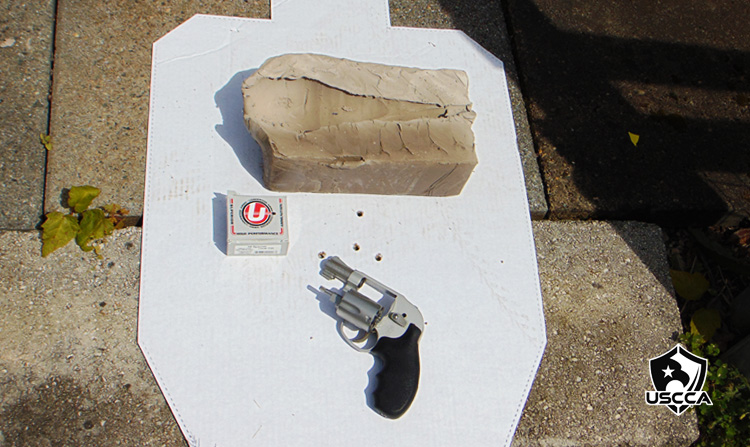
To test the Underwood Black Cherry ammo, I took my Smith & Wesson Model 638 Bodyguard to an outdoor range with a 25-pound block of modeling clay and a cardboard silhouette target.
I set up the clay block first, then loaded the five-shot cylinder with five rounds of the Item 735 ammunition and took a solid, braced seated position. My older version of the 638 has the hammer spur set deeper into the humpback hammer shroud area, which makes it difficult to cock safely for single-action fire. Because of that, I fired the test shot double-action.
Clay Block Results
The shot landed almost perfectly center. The bullet exited the rear of the block and lodged in the backstop. The large entrance hole showed evidence of blowback, while the exit hole was perfectly round and not much larger than the bullet’s diameter.
When I sectioned the block in half, the cavity was practically textbook. The entrance hole was 3 inches at its widest point and tapered to 1¾ inches through the rest of the 8×10-inch block. The exit hole was .34 inch across. There was no fragmentation.
Accuracy Testing
I fired the remaining four rounds at the center of the silhouette from 15 feet, double-action, at a fairly rapid pace. Since it was a bright day, I didn’t use my Hogue laser grip for sighting. Instead I relied on the Birchwood Casey green front sight paint to contrast the stainless-steel front sight from the rear sight.
The four-shot group measured 2½ inches. Recoil was manageable, especially with the Hogue laser grip absorbing some of the impact. I was satisfied with the Item 735’s performance.
Is Underwood Black Cherry .38 Special Ammo Good for Self-Defense?
I really liked Underwood Ammo’s Black Cherry Item 735 .38 Special LSWCHP load. It would make a great self-defense ammunition option for .38 Special and .357 Magnum revolvers. It delivered good practical accuracy, manageable recoil and impressive performance in the clay block from my lightweight Smith & Wesson Model 638.
It’s an especially interesting update for those of us who previously carried the old FBI load, offering the LSWHP design with a modern coating and better performance.
This load could also work particularly well for hiking or carrying concealed on the trail. It delivers a solid performance from a compact revolver, making ideal for long periods of carrying.
Item 735 vs. Item 733 for Concealed Carry
Underwood’s current Item 733 +P version should offer even more power than the Item 735 load I tested, but I would be hesitant to run it regularly through my 14.6-ounce Bodyguard. Not because I believe it would hurt the revolver, but because the recoil would likely be less than enjoyable.
I would like to see Underwood offer both versions of the 158-grain LSWCHP Black Cherry load. The standard-pressure Item 735 gives shooters FBI load-level performance with lighter recoil, while the +P Item 733 gives those who want more power a stronger option.
There is value in having both. Not every .38 Special carrier wants or needs the hottest load available, especially in lightweight snubnose revolvers.
Final Thoughts on Underwood Black Cherry .38 Special Ammo
Underwood Ammo makes defensive ammo for pistols, revolvers and rifles in a wide variety of calibers with a wide variety of bullet designs and styles to meet your needs, from hunting to self-defense. Its Black Cherry .38 Special LSWCHP load is a thoughtful modern update to one of the most respected defensive revolver loads of the last several decades.
Sources:
Underwood Ammunition: UnderwoodAmmo.com
Smith & Wesson: Smith-Wesson.com