Editor’s Note: NFA laws, ATF procedures and court challenges can change. This article is intended for general informational purposes only. Always confirm current requirements through ATF.gov or qualified legal counsel before making, transferring, transporting or modifying an NFA-regulated firearm.
The National Firearms Act of 1934 is a federal law that requires registration and federal regulation of certain firearms and devices, including machine guns, short-barreled rifles, short-barreled shotguns, suppressors, destructive devices and “any other weapons.” Originally structured as a tax law, the NFA remains central to federal firearms regulation.
What Is the National Firearms Act?
Only federal gun laws are more contentious among gun owners than state gun laws. The National Firearms Act of 1934 (NFA) was the first major federal effort to require gun owners to register and pay a tax on certain firearms. Why was the bill introduced and backed by the U.S. attorney general? What questions do modern gun owners regularly have about the NFA’s regulations? And what does the recent “zero tax” mean for the NFA’s future? As the foundational federal gun-control law, it rests on much ambiguity.
Ask any legal scholar and he or she will tell you that if you want to know about the Second Amendment’s legal history, you need to speak to Stephen Halbrook. David B. Kopel, research director at the Independence Institute, called him “the founder of Second Amendment and arms laws as an independent subject worthy of study,” noting his influence in the field is “gigantic.”1
Why Was the NFA Passed?
Halbrook explained that U.S. gun regulations at the federal level came into existence in the 20th century. Before that, they existed only at the state level, and even those were limited. In 1927, Congress prohibited pistols, revolvers and other firearms capable of being concealed from being mailed through the U.S. Postal Service.2 Seven years later, Congress introduced and passed the NFA. So why the push to introduce federal gun-control legislation when no such laws existed in the country’s previous 158-year history?
“[A] couple of things happened that led to the NFA getting proposed,” Halbrook noted. “One was Prohibition, which led to organized crime in the United States. And No. 2 was the Depression, and you had the Depression-era gangsters, and so there were a lot of cries at the federal level for some kind of legislation.”
U.S. Attorney General Homer S. Cummings championed a federal bill, HR 9066, which proposed national registration and taxation on firearms to curb notorious lawbreakers, including John Dillinger.3
Since Congress does not have the authority to outright forbid firearms ownership and could not regulate firearms as articles of commerce, the bill circumvented these obstacles by proposing to require registration of and taxes on certain arms, modeling it after the Harrison Anti-Narcotics Act of 1914 — which required registration and payment of a tax on narcotics used for non-medicinal purposes. The NFA’s proponents settled on a $200 tax, equivalent to the cost of a machine gun — well over $4,000 today.4
What Firearms Are Regulated Under the NFA?

Assistant Attorney General of the Criminal Division Joseph B. Keenan, who represented Cummings at the bill’s five-day hearings before the House of Representatives Ways and Means Committee in April and May of 1934, stated that simply passing legislation to restrict machine guns wasn’t enough. He reasoned that they also needed to include pistols or revolvers in the bill.5 Even though today we generally associate the Thompson submachine gun with 1930s gangsters, the NFA advocates initially called for pistols, revolvers, machine guns, short-barreled shotguns, silencers for concealed weapons and the vaguely termed “any other concealable weapon” to be included in the legislation.6
“[Cummings and Keenan] really didn’t look at the root cause of gangsterism or organized crime,” Halbrook indicated. “They looked at physical objects that mostly normal people, law-abiding people, kept and bore.”
Not all of the firearms and devices originally proposed stayed in the bill, and others were added or expanded — without much forethought or logic, and even by accident. Halbrook compared the haphazard hearings to sausage-making.
“[T]here’s this old saying that you don’t want to see how sausage is made and all the stuff that goes into it,” he said. “It can be very irrational. And it was in this case.”
Halbrook noted that Milton A. Reckord, the executive vice president of the NRA, opposed including pistols and revolvers — commonly possessed by citizens nationwide — in the bill, expressing his willingness not to oppose it if they were stricken. Fortunately, they were removed.7
Harold Knutson, a Republican representative from Minnesota, suggested adding short-barreled rifles (SBRs) to the bill, even though Cummings never claimed they were associated with criminal acts. Halbrook explained that Knutson recommended language to prevent rifles used by deer hunters in his state from being classified and restricted as concealable weapons. As a result, rifles with barrels shorter than 16 inches in length were also stuffed into the bill.8
“[W]hat I always found incredible about putting rifles in,” Halbrook said, “is that the rifled arms that are small — pistols and revolvers — they’re not in the NFA. And then the big rifled arms, they’re not in the NFA. But the medium-sized ones are.”
Another peculiar outcome during the hearings was expanding only concealable suppressors to suppressors for every firearm. Halbrook said this was done without any reasoning, argument or suggestions from anybody. As with SBRs, suppressors were not cited as being widely used by criminals. Ironically, even President Theodore Roosevelt once owned suppressors for his hunting rifles.9
Congress passed the final version of the bill on June 18, 1934, and President Franklin D. Roosevelt signed it into law eight days later.
But Cummings wasn’t satisfied with the exclusion of some firearms from the NFA and endeavored to expand it to “all firearms” as he had originally intended. In a speech delivered before the Annual Convention of the International Association of Chiefs of Police in 1937, he claimed, “No honest man can object to [registration]. Show me the man who does not want his gun registered and I will show you a man who should not have a gun.” He said there was no good reason law-abiding citizens should object to it any more than they would object to registering their automobiles.10
Keenan proved to be more rational — or at least mindful of the public outcry universal registration would cause — reasoning that if they went too far and fast without a publicity campaign, it would lead to a similar outcome as the Volstead (Prohibition) Act but for firearms.
“[A] law which required every person to secure a permit to possess a firearm would be widely violated and virtually unenforceable,” he warned.11
Still, Cummings and Keenan believed they had a constitutional basis for arguing that universal registration was a matter of national defense, reasoning that the government could claim to need to know “the number, location and ownership of all weapons which might conceivably be used in the defense of the country in time of insurrection and invasion,” citing Article I, Section 8 of the Constitution. Cummings was involved in drafting further legislation to include all firearms, which was introduced in Congress, but nothing ultimately came of it.12
Definitions, Transfers and Interstate Travel

Regardless of what you think about the NFA’s validity or legality, abiding by its regulations is federal law, and as a gun owner, you must be well-versed in its language and procedures to stay legal. That said, they can be confusing and convoluted, leading to questions such as what constitutes an NFA firearm, how to legally transfer an NFA firearm and how to stay within the law when you’re transporting an NFA firearm across state lines.
Let’s start by addressing what an NFA firearm is. The definition has changed since 1934. As of this writing, a firearm subject to registration under the NFA is defined as:
- A shotgun that has a barrel or barrels of less than 18 inches in length
- A weapon made from a shotgun that has an overall length of less than 26 inches or a barrel or barrels of less than 18 inches in length
- A rifle that has a barrel or barrels of less than 16 inches in length
- A weapon made from a rifle that has an overall length of less than 26 inches or a barrel or barrels of less than 16 inches in length
- Any other weapon
- A machine gun
- A muffler or silencer for any firearm
- A destructive device13
How Are NFA Firearms Measured?
Where do you measure to determine the length of a shotgun’s or rifle’s barrel? For either with an integral chamber, measure the distance between the furthest end of the barrel and the face of the bolt, breech or breech block with the action fully closed and the firing mechanism cocked. Now, for a firearm originally manufactured as a shotgun or rifle and later modified, measure the overall length by determining the distance between the two furthest points of the firearm, measured along a line parallel to the center line of the bore.14
Randal Beach, a retired ATF agent who is now a police chief in South Carolina, provided insight into NFA firearms classifications and how things can get tricky, especially as firearms evolve and the firearms industry finds ways to cleverly comply with the NFA.
The devil is in the details. For instance, he mentioned some Derringer-type handguns chambered for .45 and .410 bore shotshells. He said that based on appearance, it’s easy to classify them as smoothbore, therefore falling under the NFA’s any other-weapon-classification. But if you examine the barrels closely, there’s about half an inch of rifling in the bore, which excludes them as NFA firearms.
According to the NFA, a rifle or shotgun is designed to be fired from the shoulder, while a pistol or revolver is intended to be fired while held in one hand. This is important, as customizations can alter an arm’s classification. For example, say you were to alter a pistol or revolver by adding an additional vertical handgrip. You have essentially turned it into an “any other weapon” — subject to the NFA — since it’s no longer designed to be fired when held in one hand.15
Beach revealed that there’s a common misconception that it’s illegal to modify a firearm by cutting it down.
“People thought that it was against the law to get a hacksaw out and saw the barrel off their shotgun,” he said.
They would call into his office and ask if they could shorten a 36-inch barrel for home defense.
“Cut it down to 18 and a smidge,” he’d tell them. “[J]ust make sure that it’s more than 18.”
“That’s legal?” they would ask.
He would tell them, “Yeah.”
“Are you kidding me?” they would ask.
“No, I’ll come over and help you. I’ll hold it,” he joked.
As long as you stay within the NFA’s length limits and follow the required procedures, you’re free to put that hacksaw to work. But again, that smidge over 18 inches in the shotgun example can mean the difference between being legal and violating the NFA. Attention to detail is crucial.
How Do NFA Transfers Work?
Another area of confusion among gun owners is a transfer, defined as “selling, assigning, pledging, leasing, loaning, giving away or otherwise disposing of” an NFA firearm. Broadly speaking, to legally transfer an NFA firearm, you’re required to fill out the appropriate transfer form, wait for its approval from the ATF NFA Division and register the firearm to the transferee. To register a firearm to a lawful heir in the case of the distribution of an estate firearm, an executor or administrator must file ATF Form 5, which must be approved before the heir may receive the firearm.16
In the average ATF office, Beach said, they’d regularly have someone contacting them about a firearm he or she discovered after his or her grandfather passed away, such as what appeared to be a machine gun, asking for direction on what to do.
“[W]e would often find that a lot of those firearms were registered in 1986,” he recalled, indicating that they were lawfully possessed before the effective date of the Firearms Owners’ Protection Act (May 19, 1986).
The problem is that family members might not know the status of a firearm, or the original person the NFA firearm was registered to didn’t hang on to the paperwork or misplaced it. Beach said this resulted in many queries to the National Firearms Registration and Transfer Record to confirm registration status.
It’s a reminder to keep your NFA registration paperwork in a safe place, let your loved one know if you want him or her to inherit the NFA gun, draft a will or establish a trust, and register the firearm to the lawful heir. Otherwise, he or she may have to surrender it as contraband. (See “Estate Planning & Firearms,” May/June 2025 issue, Page 38, for guidance.)
Can You Travel Across State Lines With an NFA Firearm?
In terms of moving or transporting an NFA firearm — any destructive device, machine gun, short-barreled shotgun or SBR — interstate, if you are not a Federal Firearms Licensee or do not possess Special Occupational Tax status, you must submit a written request, including the required information, to the NFA Division or complete and file ATF Form 20.17
In Beach’s time with the ATF, this was done by fax. Today, the ATF is working to further digitize the process, introducing new forms and procedures to decrease wait times and mailing costs.18
If you’ll be transporting an NFA firearm to the same location regularly, the NFA Division will approve a transportation request for up to one year. For instance, if you live in Ohio and the gun range you like best is across the state line in Pennsylvania, submit a written request or complete ATF Form 20.19
There are far more NFA nuances than are addressed here, so review the 208-page National Firearms Act Handbook, available online at ATF.gov/firearms/national-firearms-act-handbook. Download the PDF and do a CTRL+F keyword search to quickly search for a term or phrase to find the information you’re seeking. You can also review common questions related to the NFA at ATF.gov/qa-category/national-firearms-act-nfa. If you can’t find an answer to your question, contact the NFA Division. It’s better to ask and get the correct answer than to find out you’ve violated federal law by assuming or guessing.
The NFA’s Uncertain Future
Charles K. Eldred, a Texas attorney specializing in tax law, has presented on and written about the NFA. While there’s hardly room here to cover all of the points he addressed in his Wyoming Law Review article, Eldred argues that the NFA is unconstitutional from a Second Amendment perspective as well as for taxation-related reasons.20
He said it’s hard to predict how the Supreme Court justices would decide if one of these arguments made it to the court, but he discussed some of the most convincing arguments for why the NFA could be unconstitutional.
Eldred explained that the requirement to obtain permission to make, buy or transfer an NFA-regulated arm has no historical analog (i.e., precedent) dating back to 1791. Therefore, it could be subject to a constitutional attack under the Bruen and Rahimi cases.
“The Bruen case, of course, says that firearms regulation without a historical analog to 1791 regulations are unconstitutional,” he stated. “[T]his is a federal law. So the theory would be [that] unless you can find something that was around in 1791 that’s kind of like the NFA, then the NFA is unconstitutional. It violates the Second Amendment.”
The NFA taxes the exercise of a constitutional right, which the Supreme Court has ruled over the years is unconstitutional.
“When the NFA was passed in 1934 and amended in 1968, nobody thought the Second Amendment was a constitutional right, but now we do since 2008 [District of Columbia v. Heller]. So maybe it’s time to revisit this,” Eldred suggested.
He further noted that laws must follow certain constitutional guidelines when they raise revenue through taxation. In his view, the NFA application process does not appear to be a legitimate exercise of Congress’ taxing power.
“The applicant has to request permission to pay the tax. That doesn’t seem like taxing to me. That’s just not how taxes work,” Eldred explained. “Taxes are taxes on a transaction, for instance, or your property. It’s not like you have to ask permission to pay a tax. It just seems very strange.”
And then there’s the direct-tax argument. Eldred noted that the Constitution requires direct taxes to be apportioned (i.e., divided and distributed) among the states in proportion to their populations and that direct taxes generally include real-estate taxes, personal property taxes and capitation (head) taxes.21
“I think the occupation tax of the NFA, which is a yearly tax on doing certain activities, such as importing or selling, is very close to a capitation tax. And I think it might be a direct tax, and therefore, it’s not allowed, because it’s not apportioned,” Eldred indicated. “I think the making tax, similarly, is a tax on your property. It’s not a tax on selling property; it’s a tax on making property.”
He said that the government’s taxing power hasn’t come up very often in the Supreme Court, with the exception of the Sebelius (Obamacare) case. However, HR 1 (commonly referred to as the “One Big Beautiful Bill”), which decreases the tax on NFA firearms to zero — excluding machine guns and destructive devices — could change that.
Eldred pointed out that this zero tax has undermined the NFA.
“[I]f you’re not collecting any revenue, you’re not exercising the taxing power,” he stated. “And everything else you do, such as the application procedure — and stuff like that — which is supposedly helping you collect the tax, that has to fall too because it’s not helping you collect the tax if you’re Congress.”
Halbrook also believes that removing the tax has left the NFA vulnerable to legal challenges. Since the One Big Beautiful Bill passed, the NFA has come under increasing scrutiny and is facing several lawsuits.22
“[T]here’s at least [three] lawsuits that I know of that have been filed on that,” Halbrook said, “and I think they have a shot of prevailing.”
Eldred noted that the plaintiffs in each lawsuit will probably make the right arguments, but the real question is whether they can convince a court of appeals to agree with them.
“If a court of appeals will find any part of the NFA unconstitutional, then I think the Supreme Court will probably take the case, and then maybe there will be a larger discussion of it,” he predicted.
What Would Happen if the NFA Changed?

But Eldred warned that their victory may be “Pyrrhic” since it’s possible the courts could turn around and say, “Sure, the NFA’s application and registration requirements don’t fall under Congress’ taxing power after all, but its power to regulate articles of commerce does” — a reversal of the argument Cummings and Keenan made in 1934. But times (and the law) have changed since then. The Department of Justice has already made this commerce-power argument in a brief filed in one of the lawsuits challenging the NFA.23
“I think the court might go for that. They might say, ‘Yeah, there’s lots of things the government can do via the commerce power, and this might be one of them,’” Eldred warned. “I think it’s possible that the NFA could survive as a commerce regulation.”
Halbrook said even a victory in court would not have the sweeping impact some believe it would. If the Supreme Court were to strike down the NFA, not all of its restrictions would evaporate into thin air. For instance, machine guns are still banned under 18 U.S. Code, Section 922(o). He estimated that roughly 172,000 are registered and “frozen” in terms of private ownership. That number will never increase, even were the NFA’s restrictions to disappear with the swipe of a pen.
Even if the categories for the other firearms are removed from the NFA, they would still be regulated under the Gun Control Act (GCA).
“[Y]ou still have to have the NICS check and the various GCA restrictions crossing state lines,” Halbrook noted. “It’s not like the sky’s gonna fall if these NFA categories are no longer there.”
So before you break out the champagne over the NFA’s downfall, easy. There’s no guarantee that any of the current lawsuits will make it to the Supreme Court and, if one does, we don’t know for sure how the justices will decide. It may even backfire.
And even if the NFA’s firearms regulations are repealed, that would alleviate some paperwork, reduce processing wait times and remove some items from the registry — but only under the NFA. Like it or not, the Roosevelt-era law’s roots are interwoven with modern federal firearms law. It’s going to take more than chainsawing the trunk to root out the NFA’s influence for good.
Endnotes
(1) Firearms Research Center, “FRC NFA Conference — Panel Discussion ‘Regulated Arms and Taxation’ at the 2024 Fall Conference,” YouTube, 1:00:06, Nov. 5, 2024, https://youtu.be/8kXCYh0tktY?si=QVMQ0x6h9usTePEf.
(2) Postal Laws and Regulations Applicable to the Railway Mail Service: 1929 (Washington, D.C.: U.S. Government Printing Office, 1929), 21.
(3) Stephen P. Halbrook, “The Power to Tax, The Second Amendment, and the Search for Which ‘Gangster Weapons’ to Tax,” Wyoming Law Review 25, No. 1 (2025): 153-154.
(4) Halbrook, “The Power to Tax,” 150-151, 155; Charles K. Eldred, “The National Firearms Act is an Unconstitutional Tax,” Wyoming Law Review 25, No. 1 (2025): 194-196.
(5) National Firearms Act: Hearings Before the Committee on Ways and Means, House of Representatives, Seventy-Third Congress, Second Session, on H.R. 9066, April 16, 18, and May 14, 15, and 16, 1934 (Washington, D.C.: U.S. Government Printing Office, 1934), 117.
(6) Halbrook, “The Power to Tax,” 153, 166.
(7) Halbrook, “The Power to Tax,” 167-168.
(8) Halbrook, “The Power to Tax,” 169-170.
(9) Halbrook, “The Power to Tax,” 172-174; NRA National Firearms Museum, “Curator’s Corner: Theodore Roosevelt’s 1894 Winchester Lever-Action Rifle,” YouTube, 6:16, July 13, 2012, https://youtu.be/wQMoWmK1mn4?si=y_n6wU2kCE9rPuSb.
(10) Address entitled “Firearms and the Crime Problem,” delivered before the Annual Convention of the International Association of Chiefs of Police, Baltimore, Maryland, October 5, 1937,” in Selected Papers of Homer Cummings, Attorney General of the United States, 1933-1939, ed. Carl Brent Swisher (New York: Charles Scribner’s Sons, 1939), 89; “The Small Arms Bill” The Evening Star (Washington, D.C.), March 28, 1938, in Papers of Homer Stille Cummings, 1850-1956, Series III: Correspondence of the Attorney General and Post-Attorney General, 1933-1956, Box 103, Attorney General Personal File — Firearms and National Firearms Act 1935-1938, Special Collections Department, University of Virginia Library, Charlottesville, Virginia.
(11) Joseph B. Keenan, “The Future of Federal Firearms Legislation,” in Papers of Homer Stille Cummings, 1850-1956, 7-8.
(12) Keenan, “The Future of Federal Firearms Legislation,” 6; Halbrook, “The Power to Tax,” 176-177.
(13) National Firearms Act Handbook (Washington, DC: U.S. Department of Justice, Bureau of Alcohol, Tobacco, Firearms and Explosives, Office of Enforcement Programs and Services, 2009),106-107, ATF.gov/firearms/national-firearms-act-handbook.
(14) National Firearms Act Handbook, 107.
(15) National Firearms Act Handbook, 9, 108.
(16) National Firearms Act Handbook, 58, 60-61.
(17) National Firearms Act Handbook, 82.
(18) Stephen Gutowski, “ATF Streamlines Process for Moving Machineguns, SBRs Across State Lines,” The Reload, Nov. 28, 2025, TheReload.com/atf-streamlines-process-for-moving-machineguns-sbrs-across-state-lines.
(19) National Firearms Act Handbook, 82-83.
(20) The views expressed in this article are not necessarily the views of Eldred’s employer. Eldred, “The National Firearms Act is an Unconstitutional Tax,” 192.
(21) Apportioned taxes have been levied only three times in U.S. history, the last during the Civil War. Eldred, “The National Firearms Act is an Unconstitutional Tax,” 210.
(22) Stephen P. Halbrook, “Second Amendment Roundup: The Zero Tax on NFA Firearms,” Reason, Aug. 10, 2025, Reason.com/volokh/2025/08/10/second-amendment-roundup-the-zero-tax-on-nfa-firearms/; Charles K. Eldred, “Constitutional Challenges to the NFA’s Zero-Dollar ‘Tax,’” Firearms Research Center Forum, Oct. 15, 2025, FirearmsResearchCenter.org/forum/constitutional-challenges-to-the-nfas-zero-dollar-tax.
(23) Eldred, “Constitutional Challenges to the NFA’s Zero-Dollar ‘Tax;’” Jake Fogleman, “Analysis: How DOJ Justifies the NFA Despite its New $0 Tax,” The Reload, Nov. 23, 2025, TheReload.com/analysis-how-doj-justifies-the-nfa-despite-its-new-0-tax-member-exclusive/; Stephen P. Halbrook, “Second Amendment Roundup: The U.S. Defends NFA Restrictions Lacking a Tax Nexus,” Reason, Dec. 2, 2025, Reason.com/volokh/2025/12/02/second-amendment-roundup-the-u-s-defends-nfa-restrictions-lacking-a-tax-nexus.
Collecting NFA Tax Stamps
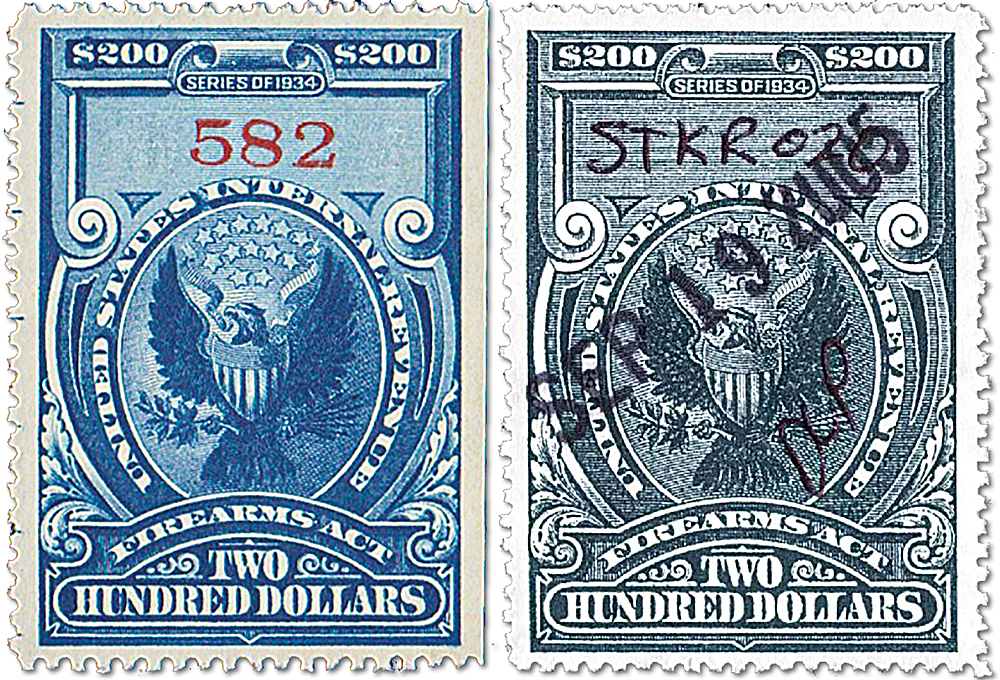
Depending on type and condition, firearms transfer tax stamps can bring collector prices ranging from $25 to a couple thousand dollars. There are currently eight easily distinguished $200 stamps produced using three different printing methods, created between 1934 and roughly 2020.
Type I stamps (RY2 and RY4) are engraved and have printed serial numbers with serifs. Both are watermarked and have perforations that measure 12 on a standard perforation gauge. Although there’s a slight dimensional difference between the two, the most easily distinguished difference is the number of dashed lines in the left margin: RY4 stamps have six, and RY2 have five. These were in use between 1934 and about 1974.
Type II (RY6) is engraved and has a printed serial number without serifs. Although it also measures 12 on a perforation gauge, the stamp does not bear a watermark. This type was in use from roughly 1974 to 1990.
Types I and II are the only units that bear printed serial numbers.
The Type III stamps — RY7, RY8, RY10, RY11 and RY12 — were produced by offset lithography (except for RY12). RY7 was produced without gum and is imperforate, while RY8 was produced without gum and measures 12.5 on a perforation gauge. RY10 and RY11 are self-adhesive, measuring 11.5 and 11 on a perforation gauge, respectively. Although RY12 is considered a Type III stamp because it was produced by photogravure (and is die-cut 6.3), it has a very different appearance, with a much crisper design.
The stamps are valuable to collectors, and several are quite scarce. The design of each type has remained essentially the same, but the stamps are easily distinguished by collectors and dealers. As a rule, these stamps are worth more when they’re left on a license, and condition will always play a significant role in value.
To read more about collecting NFA tax stamps, including “any other weapon” stamps, check out my Substack post: WayneYoungblood.Substack.com/p/chicagos-st-valentines-day-massacre.
— Wayne L. Youngblood