As of February 2026, suppressors remain regulated under the National Firearms Act. While the One Big Beautiful Bill modified aspects of the suppressor tax stamp and registration process, Congress has not fully removed suppressors from NFA oversight. Proposals such as the Constitutional Hearing Protection Act would eliminate federal registration, but they have not yet passed.
The first commercially successful suppressor wasn’t invented for criminal activity or cinematic stealth. Designed in 1909 by Hiram Percy Maxim, the son of machine gun inventor Hiram Maxim, it was marketed through the Maxim Silencer Company as a practical device for sportsmen.
Early advertisements promoted suppressors as tools for protecting hearing, reducing noise complaints and making target shooting more neighbor-friendly, especially in rural and suburban communities. At the time, suppressors could be purchased through mail-order catalogs and were treated much like other firearms accessories.
Suppressors and Crime
Although suppressors are often portrayed in popular media as tools for criminal concealment, federal data shows they are rarely used in violent crime.
According to the Bureau of Alcohol, Tobacco, Firearms and Explosives (ATF), there were more than 2.6 million suppressors registered in the United States as of recent federal reporting. Yet suppressor-related prosecutions represent a small fraction of federal firearms cases each year, and the Bureau of Justice Statistics has consistently reported that crimes involving silencers are exceedingly uncommon compared to other weapons offenses.¹
Why Were Suppressors Added to the National Firearms Act?
It was not until the passage of the National Firearms Act (NFA) in 1934 that suppressors, along with machine guns and short-barreled rifles, became heavily regulated. The NFA imposed a $200 tax stamp, an enormous sum during the Great Depression, along with federal registration requirements.
Importantly, suppressors were not widely used in crime even then. Many historians note that they were included in the NFA largely as a precautionary measure rather than in response to documented misuse.
Are Suppressors Legal Right Now?
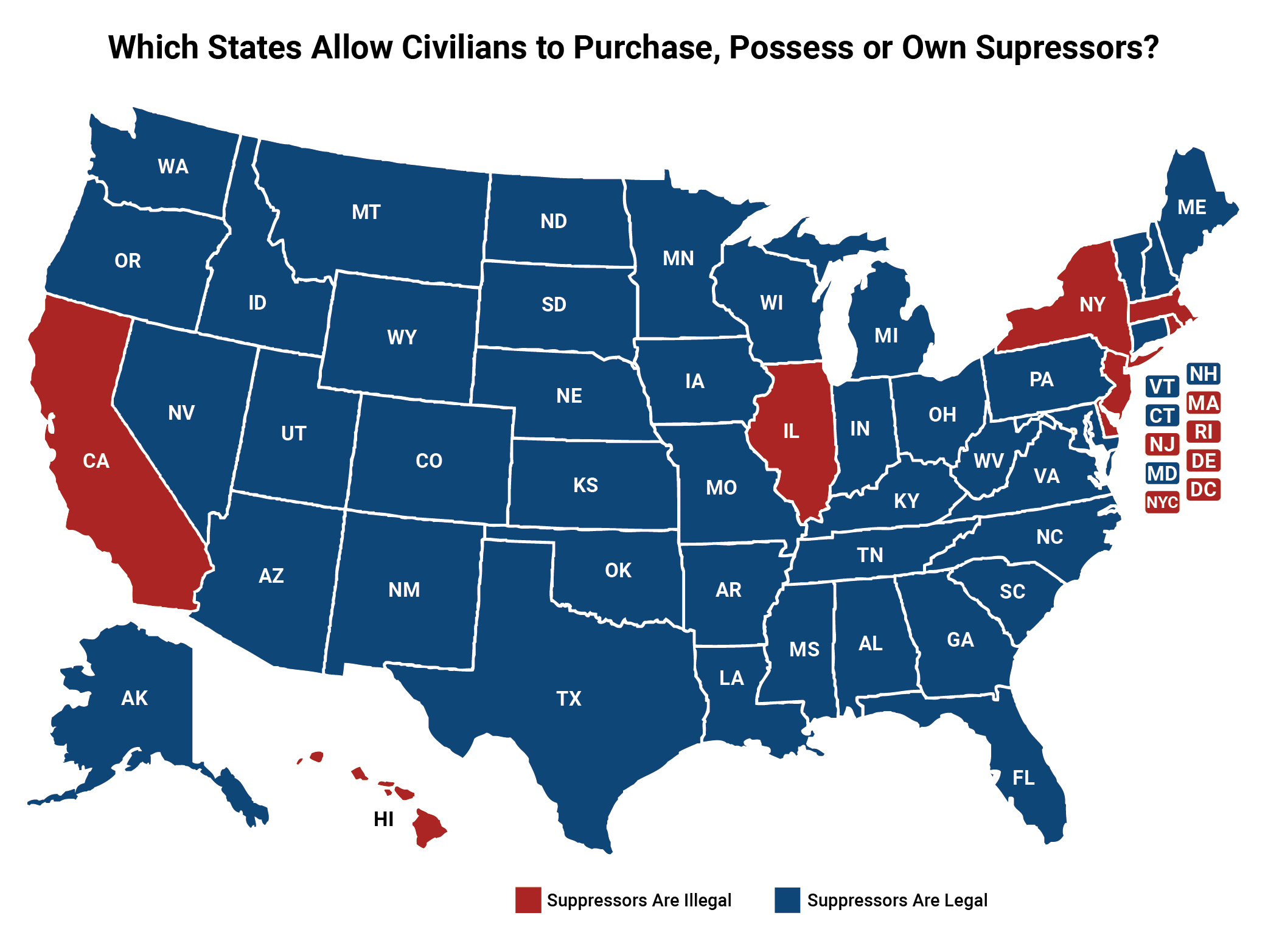
Today, suppressors are legal in most states and are overwhelmingly owned by law-abiding citizens who comply with background checks and federal registration.
These states, and the District of Columbia, do not allow civilians to purchase, possess or use suppressors:
- California
- Delaware
- Hawaii
- Illinois
- Massachusetts
- New Jersey
- New York
- Rhode Island
Did Congress Eliminate the Suppressor Tax Stamp?
As of February 2026, suppressors remain regulated under the National Firearms Act. However, the suppressor provisions included in the “One Big Beautiful Bill” (OBBB) represent a meaningful reform of the outdated regulatory framework.
For decades, responsible Americans have been required to submit fingerprints, photographs, federal paperwork and wait many months for approval, all while paying a tax originally designed to discourage ownership. Reforming this system recognizes suppressors for what they truly are: safety devices that reduce harmful decibel levels, protect hearing, lessen recoil and minimize noise pollution, much like a muffler on a vehicle.
This reform is not about expanding access recklessly. It is about removing unnecessary burdens on citizens who already pass background checks and follow the law. Constitutional rights should not hinge on excessive taxation or prolonged bureaucratic delays. By modernizing suppressor regulations, lawmakers are affirming both individual liberty and practical safety.
What the Suppressor Bill Actually Does?
- Removed or significantly reduced the $200 federal tax stamp requirement for suppressors
- Streamlined or eliminated lengthy NFA registration processes
- Reduced approval wait times by shifting suppressors out of full NFA classification
- Treated suppressors more like standard firearm accessories rather than restricted NFA items
- Maintained prohibitions for prohibited persons, including felons and domestic abusers
- Preserved existing state authority, meaning state laws still apply
Even with the passage of the OBBB, you still must:
- Go through the ATF National Firearms Act (NFA) process for suppressors, whether you are transferring one or making your own (Form 4 or Form 1 as applicable)
- Submit fingerprints and a passport-style photo as part of the application
- Pass an enhanced federal background check
- Wait for ATF approval before taking possession
How to Legally Buy a Suppressor: ATF Form 4 vs. Form 1
There are two primary application pathways: ATF Form 4 and ATF Form 1. A Form 4 is used when purchasing a commercially manufactured suppressor from a licensed dealer. The buyer selects the suppressor, submits fingerprints, a photograph and required background information to the Bureau of Alcohol, Tobacco, Firearms and Explosives (ATF), and receives approval before taking possession.
A Form 1 is used when an individual or legal entity intends to manufacture their own suppressor (where lawful). The applicant must receive ATF approval prior to beginning construction.
Processing times vary depending on submission method and application volume. Electronic submissions (ATF eForms) have significantly improved approval times compared to historical paper filings, with some approvals occurring in weeks, though timeframes can still extend longer in certain cases.
Status of the Hearing Protection Act
Although full suppressor deregulation was not included in the final version of the OBBB, legislative efforts have not stopped.
In the 119th Congress, Representative Andrew Clyde (R-GA) introduced the Constitutional Hearing Protection Act (H.R. 3228), which seeks to remove suppressors from regulation under the National Firearms Act entirely.
If passed, the bill would eliminate federal registration requirements, background paperwork specific to the NFA process and other regulatory burdens that have applied to suppressors since 1934.
While the measure has been referred to committee and has not yet become law, it reflects continued momentum among lawmakers who view suppressors as hearing protection devices rather than items warranting heightened federal control. At the same time, some states are moving independently to ease suppressor restrictions, signaling that reform efforts remain active at both the federal and state levels.
What This Means for Gun Owners in 2026
Suppressors remain regulated under the National Firearms Act. While the OBBB adjusted certain aspects of suppressor regulation, it did not fully remove suppressors from the NFA. Gun owners should verify current ATF guidance before initiating any purchase.
- If you are considering how to legally buy a suppressor, the process still requires federal paperwork, fingerprint submission and advance approval. Electronic ATF eForms have shortened wait times in many cases, but approval is not automatic.
- If you already own a suppressor that was lawfully registered, no additional action is required. Existing registrations remain valid.
- If you are waiting to see whether suppressors will be removed from the NFA entirely, that outcome would depend on the passage of the Constitutional Hearing Protection Act or similar legislation. As of this writing, that bill has been referred to committee and has not become law.
In short, suppressor laws have evolved, but they have not disappeared. Compliance with current federal and state requirements remains essential.
Endnotes
(1)U.S. Department of Justice, Bureau of Alcohol, Tobacco, Firearms and Explosives. Crime Guns Recovered and Traced Within the United States and Its Territories. ATF Publication, Table CCG-13.
❓Suppressor Bill FAQs
Are suppressors legal in the United States?
Yes, suppressors are legal under federal law but regulated under the National Firearms Act. Ownership requires ATF approval and compliance with federal procedures. Some states prohibit civilian possession.
Did Congress eliminate the suppressor tax stamp?
No, while recent legislation adjusted certain suppressor regulations, suppressors have not been fully removed from the NFA. Tax and registration requirements continue to apply unless future legislation changes federal law.
Are suppressors removed from the NFA? Has the suppressor bill passed?
Not at this time. Suppressors remain regulated under the National Firearms Act. The Constitutional Hearing Protection Act proposes removing suppressors from NFA regulation, but it has not been enacted.
How long does it take to get a suppressor approved?
Approval times vary. Electronic submissions through ATF eForms have reduced wait times compared to historical paper filings, but processing depends on application volume and administrative review.
Are suppressors used frequently in crime?
Available federal data indicate suppressors are rarely used in violent crime relative to overall firearms offenses. ATF reporting shows millions of lawfully registered suppressors in civilian hands, with comparatively few criminal cases involving them.
Do suppressors make firearms silent?
No. Suppressors reduce muzzle blast and decibel levels but do not eliminate sound. They function similarly to automotive mufflers by mitigating noise rather than erasing it.