Like your home, your vehicle should be a safe space, but modern criminals see it differently. Carjackers view vehicles as assets to sell, commit crimes in or take for a joyride, which is why carjacking prevention is critical for responsible self-defenders.
Rise in Carjackings
According to recent reports, carjacking has surged 93 percent since 2019, driven by tougher vehicle security systems that make key theft the easier option.
Prior to new key technology, a thief could hotwire a car when you were not around. It was safer for him or her as well as safer for you. Then automakers started putting coded chips in vehicles’ keys. Even if a vehicle were hotwired, it could not be driven. The computer would not allow the vehicle to move without the chip in place. It was almost enough to put a thief out of business. Almost.
Since a thief could not steal the car without the chipped key, the obvious solution was to first steal said key. But to do that, the thief needed to interact with the intended victim, and that meant turning a property crime into a violent crime. And anyone considering grand theft auto in the first place is probably only going to express so much moral concern about a victim’s health, safety and well-being.
Despite increases, your risk drops significantly with proper self-defense against carjacking strategies.
What Is Carjacking?
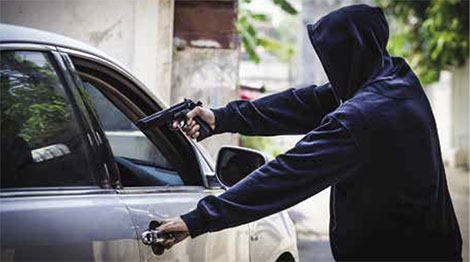
According to the BJS, offenders use a weapon in 59 percent of nonfatal carjackings.
Carjacking is the violent theft of a vehicle directly from its driver, often under the threat or use of force. It involves physical confrontation, typically with weapons, making it one of the most dangerous forms of theft.
In the U.S., roughly 38,000 carjackings happen annually, and these events are successful about 50 percent of the time. Carjacking prevention tips can drastically reduce your risk.
Carjacking Hot Spots and Common Schemes
Criminals thrive in environments where cars, drivers and distractions intersect. Gas stations, especially at night or in low-traffic areas are common carjacking hot spots. ATMs are another prime target because the victim is often distracted handling cash, and criminals get the added bonus of quick money.
Fast-food drive-thrus present a dual-threat environment where drivers are focused on transactions through a window and often boxed in by other vehicles. Grocery store parking lots are also frequent targets, particularly when people are distracted loading groceries or tending to children. Driveways, especially in suburban areas, can lull you into a false sense of security, but many attacks happen just steps from home.
Criminal tactics go beyond location. Schemes like “bump and run,” where a minor collision is staged to force you out of your vehicle, remain prevalent. Others include fake requests for directions or assistance, following you to your residence, or staging distractions like dropped wallets or lost items.
Situational Awareness: Your First Line of Defense
Your first line of self-defense against carjacking is proactive avoidance. Start by eliminating distractions and maintaining situational awareness. Gas stations are prime locations for ambushes. Always scan your surroundings before exiting your vehicle. Choose pumps near store entrances or high-traffic areas where surveillance cameras are present.
When driving, position your vehicle for escape. Leave ample space between yourself and the vehicle ahead at traffic lights. You should always leave enough space to see the rear tires on the pavement of the car ahead. This gap allows you to maneuver around vehicles in emergencies.
Your choice of lane matters, too. The middle lane offers escape routes to both sides in multi-lane traffic. In two-lane traffic, the right lane often provides a shoulder or curb option to drive onto, giving you another avenue of escape in a crisis.
Time of day plays a significant role in carjacking risk. Bureau of Justice Statistics data shows the majority of carjackings happen at night, away from home. Therefore, limiting nighttime travel, especially in unfamiliar areas, reduces your exposure to violent encounters.
Ready to Master Your Shooting Skills Like a Pro?
Learning carjacking prevention tactics is just the first step. Proper training transforms you from a gun owner into a confident protector.
USCCA’s expert-led classes cover everything from firearm fundamentals and accuracy training to legal considerations and conflict avoidance – giving you the confidence and skills to protect what matters most.
Over 1 million students trained nationwide. Find certified instruction in your area and take the next step in your protector journey.
Carjacking Safety Tips: Build Strong Defensive Habits
One of the simplest but most overlooked practices is ensuring your doors remain locked and windows up whenever you are in or near your vehicle. This applies even in seemingly secure environments like grocery store parking lots or suburban driveways as mentioned above.
Your parking choices can increase vulnerability as well. Choose well-lit, high-visibility areas close to entrances when parking in public spaces. Avoid secluded areas or spots near large vehicles that could block your view and create opportunities for criminals to approach unseen.
Be mindful of your own behavior. Avoid standing outside your car fumbling with items or distracted by your phone. At the pump or in parking lots, stand with your back to your vehicle, facing outward, so you can monitor anyone approaching.
Equip your vehicle with emergency tools to be prepared for worst-case scenarios. A high-lumen flashlight (1,000 lumens or more) not only assists with nighttime emergencies but can also be used to disorient a potential attacker. Defensive tools like pepper spray or firearms (where legal) should be positioned for quick access while seated.
Carrying first-aid gear and keeping your fuel tank at least half-full are overlooked but critical aspects of readiness. Breakdowns or delays in unsafe areas become less hazardous when you’re equipped to handle them.
Defensive Tools and Considerations
Owning defensive tools is only part of the equation. Practice drawing and deploying these tools from a seated, belted position. Drawing from a hip holster may be slow or awkward when seated. Alternative carry positions, like chest rigs or crossdraw holsters, can offer quicker access.
Specialized carjacking defense training, including simulated attacks during vehicle entry or exit, provides valuable muscle memory for high-stress scenarios. Regular practice helps you maintain awareness of your surroundings while improving your physical response under pressure.
Car Doors: Cover or Concealment?
A comprehensive vehicle ballistics experiment revealed a sobering truth: car doors offer virtually no ballistic protection. Controlled testing showed standard 9mm defensive rounds consistently penetrated both sides of a car door and often fragmented, increasing internal injury risks.
The only reliable cover on a typical vehicle is the engine block. Other sections of the vehicle — doors, trunks and windows — offer at best concealment but little to no true ballistic protection. This evidence supports an escape-first strategy over confrontation whenever feasible.
Legal Realities: When Force Is Justified
Self-defense during a carjacking depends heavily on your jurisdiction. Most states extend Castle Doctrine protections to occupied vehicles, allowing use of deadly force if your life is at imminent risk.
However, statistics repeatedly show most carjackers prioritize stealing vehicles, not harming occupants. Compliance, especially if no additional threat exists, can prevent physical harm. Remember, material possessions can be replaced, but your life cannot.
Legal experts stress:
- Escape is often safer than resistance
- Use of force is a last resort
Final Takeaway: Master Prevention and Preparation
Avoidance remains the best protection. Carjacking prevention means adopting proactive situational awareness, practicing defensive driving techniques and carrying tools that give you options to escape or fight back if necessary.
Training, preparation and vigilance transform you from a potential victim into a hardened target. As criminals evolve their tactics, responsible citizens must continually refine their skills to stay ahead.
Take Your Protection to the Next Level
Join over 860,000 USCCA Members and gain access to leading self-defense education, training and legal protection.
This article is a compilation of previous blog posts and CCM articles authored by Steve Brass, Schuyler P. Robertson, Anthony L. DeWitt and Joel T. Nadler.