The first handgun I ever shot was a small, blued-steel, six-shot .22 Smith & Wesson revolver with a 4-inch barrel. Though it seemed much larger to me when my dad first let my brother and me handle it unloaded, it would be almost seven years before we actually got to shoot it.
By then, I had read many of Jeff Cooper’s writings and learned how to handle and fire a revolver — in theory, at least. I also learned from the firearms magazines of the day that this blued-steel beauty with slim, checkered wood grips, prominent black ramp front sight and fully adjustable rear sight had a name: the .22/32 Kit Gun.
Our family Kit Gun had belonged to my late Grandpa Joe, an avid hunter, fisherman and outdoorsman. I’m sure he used it for exactly the purposes for which it was designed.
The Smith & Wesson “.22/32 Kit Gun” name originally signified a .22 revolver built on the company’s slightly larger .32-caliber revolver frame. When Smith & Wesson switched to its numerical model-naming system in 1957, the Kit Gun became the Model 34 and was eventually built on the somewhat larger J-frame used for the five-shot .38 Special Chiefs Special.
But to those familiar with the little revolver and its mission, it remained the Kit Gun.
Today, that concept lives on in the stainless-steel Smith & Wesson Model 63 .22/32 Kit Gun.
What Is a Kit Gun?
A Kit Gun is a small handgun designed to fit in a sportsman’s “kit” or kit bag like a small pack or tackle box.
A true kit gun needs to be small enough to easily carry while large enough to accurately perform the chores that might come up when fishing, hunting, hiking or camping. That could mean dispatching unwanted critters, shooting small game for dinner or simply plinking tin cans to pass the time.
The .22 LR revolver has often been the favored choice for a kit gun because of its adequate close-range power and zero recoil. There are also plenty of ammunition choices, from birdshot to full-power .22LR loads.
I once dispatched a bat in our garage at about 10 feet with a .22 birdshot round fired from our family Kit Gun. It was like the bat had been hit by the hammer of Thor.
Another popular purpose is informal target shooting. Of course, the same gun could also be used for home or personal defense. My dad later kept our Model 34 loaded and prepared for home defense as the 1960s got wilder.
Smith & Wesson Model 63 Features and Specifications
I am happy to report that the .22/32 Kit Gun is still alive and well.
As matter of fact, Smith & Wesson catalogs two distinct versions of this legendary and useful revolver. The first is the Model 63, the subject of this review. The other is the Model 317 Kit Gun.
With its aluminum frame, eight-shot cylinder and 3-inch barrel, the Model 317 is actually more similar to the original Kit Gun that I grew up with. It may deserve a separate review down the line.
I appreciate that Smith & Wesson kept the “.22/32 Kit Gun” name as it reinforces the mission of the current firearm and harkens back to simpler time when hunting fields and trails abounded.
Stainless-Steel Construction and Eight-Round Capacity
The modern Model 63 uses all-stainless-steel construction and an eight-shot cylinder. The original Smith & Wesson Kit Guns were six-shooters, so the current gun gives you two additional rounds and increases its self-defense potential.
Stainless construction also makes sense for a handgun intended to spend time outdoors. It reduces the possibility of rust, although stainless steel is not rustproof. I would still keep a small cleaning kit and bottle of oil in the kit bag and wipe the revolver down periodically.
The new Model 63 has a 3-inch heavy barrel with a full-length underlug that protects the ejector rod.
Trigger and Hammer
The trigger is smooth-faced, and the hammer has a checkered spur. Both appear to have a simulated case-hardened finish. The hammer spur is the only complaint I have about this fine revolver.
It uses the narrow combat-style hammer found on modern Smith & Wesson J-frames. I learned to shoot our original .22/32 Kit Gun single-action using its wider hammer spur and steeper angle. That design provided more leverage for thumb-cocking the revolver.
Teaching new shooters how to accurately fire a high-quality .22 revolver should begin with single action shooting.
Adjustable Sights
The rear sight is the familiar S&W serrated black, fully adjustable target sight. Rather than the plain black ramp front sight of the original Kit Gun, the Model 63 uses a stainless-steel front ramp with a modern red HI-VIZ red fiber-optic sight.
The fiber-optic tube gathers available natural or artificial light and makes the red insert easier to see. However, the fiber-optic sight does not glow in the dark. That is one reason I prefer the sight setup by XS, which includes a tritium front insert. It has a luminescent glow dot that works in complete darkness.
Internal Lock
This version of the Model 63 retains the built-in locking mechanism that comes with two keys.
I’ve never cared for a lock on a defensive revolver and wouldn’t want to try to unlock this gun during an emergency with my hands shaking from adrenaline.
Smith & Wesson has begun removing the internal lock from some new and classic models. My hat is off to them for that.
S&W Model 63 Specifications
Caliber: .22 LR; also accepts .22 Short and .22 Long
Action: Double-action/single-action
Barrel Length: 3 inches with full underlug
Construction: Stainless steel
Weight: 25 ounces
Overall length: 7.25 inches
Capacity: 8 rounds
Sights: Fully adjustable/fiber optic front
Grips: S&W finger-groove rubber
Single-action trigger pull: 2 pounds, 11.6 ounces
MSRP: $909
Is the Model 63 a Good Training Revolver?
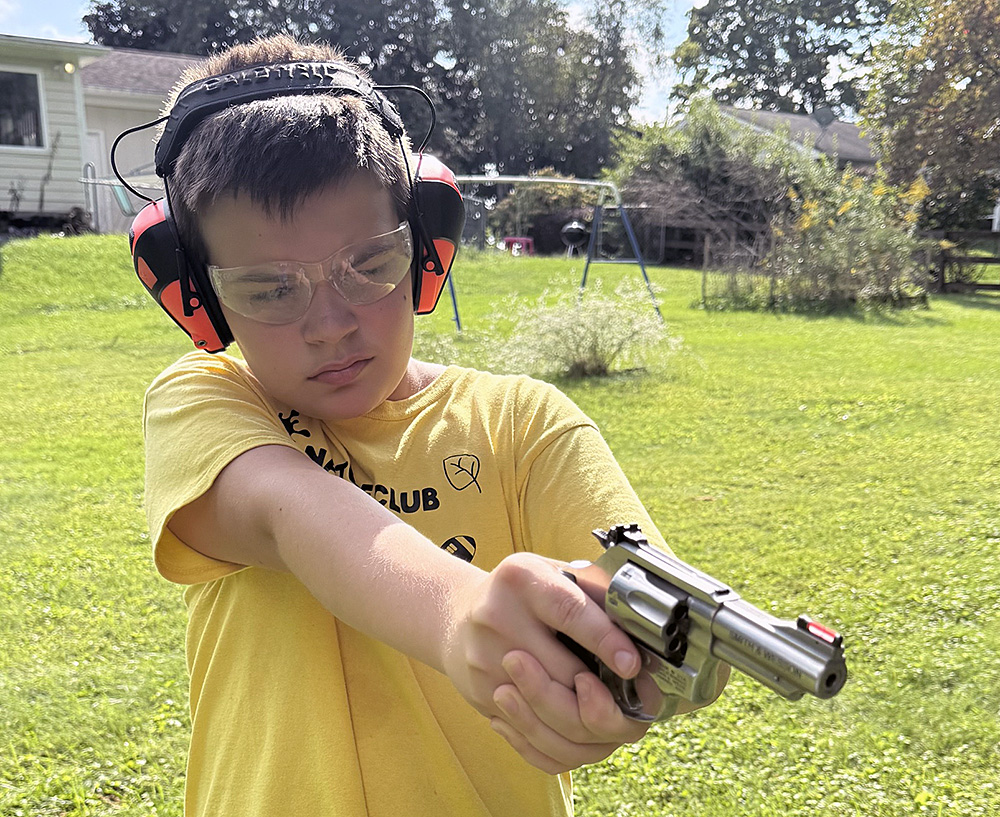
A good .22 revolver can be a great tool for introducing someone to handgun shooting, and I wanted my son Owen’s opinion of the Model 63 for that reason.
He liked the revolver as soon as I brought it home.
The Model 63’s light-recoiling .22 ammunition makes it very comfortable to shoot. The Smith & Wesson finger-groove rubber grips also fit Owen’s hands well.
But the hammer reinforced my earlier criticism.
Owen found the small hammer spur difficult to cock while handling the unloaded revolver. He has been shooting single-action .22s since he was eight and has no trouble cocking his own Western-style revolver. Its larger, more curved hammer simply gives him more leverage.
For someone learning to shoot a revolver through deliberate single-action fire, I think the older Kit Gun hammer design was more user-friendly.
Once we started shooting, however, the Model 63 proved to be an easy revolver to handle.
Testing the Smith & Wesson Model 63
After what seemed like endless Ohio rain, we finally got a relatively sunny day and enough time to test the Model 63 in our backyard.
Our township backyard is large enough, and I had two quiet loads available that would be well suited to campsite plinking or pest control.
Test Ammunition
The first round was the CCI .22 CB (Conical Bullet) Short round, which sends a 29-grain round nose lead bullet downrange at 710 feet per second.
CCI also makes a .22 Long CB round with a .22 LR case using the same bullet and velocity as the CB Short roundThe longer case may work better in some manually operated repeating firearms than the shorter cartridge.
Our second load was Aguila Colibri ammunition. The Colibri uses a .22 LR case loaded with a pointed 20-grain bullet at a very leisurely 420 feet per second.
Both loads make sense for recreational use where a quiet report and limited range are useful. For comparison, a full-power CCI .22 Short hollow point launches a 27-grain projectile at a listed 1,105 feet per second. There is clearly a substantial difference in power, range and noise between that load and a CB Short.
Shooting the Model 63
We set up a plain cardboard silhouette against a large log and moved back about 15 feet.
Owen loaded the Model 63 with eight CCI .22 CB Shorts and fired his first group entirely double-action. His shots formed a respectable group a bit to the right in the upper chest area, measuring approximately 5 by 5 inches.
The Model 63 was comfortable for him to shoot. Between the rubber grips, 25-ounce all-steel construction, heavy barrel and virtually nonexistent recoil, the revolver stayed easily on target.
I then loaded eight CB Shorts and fired my own group double-action at the lower center of the silhouette.
It was easy to obtain a clear sight picture via the red Hi-Viz sight in the bright sunshine. My group measured approximately 4 by 4 inches, with six rounds clustered together and two slightly to the right.
The double-action pull was smooth and hitch-free, exactly as I would expect from Smith & Wesson.
Finally, Owen tried the Aguila Colibri ammunition. He aimed for the head and fired his first four rounds single-action before deciding he had enough of fighting the hammer spur. He fired the remaining four double-action.
All eight rounds landed in the head area, producing a group measuring approximately 5 by 4 inches.
The difference in the noise level between the .22 Colibri and .22 Short CB is remarkable. Both rounds are great and have their place when quiet report and limited range is needed. They make great starter rounds for new shooters and are useful to keep around for a Kit Gun. Both loads are intended for manually operated .22-caliber firearms.
Smith & Wesson Model 63 Final Verdict
It was great to spend some time with the descendant of the original Kit Gun I learned to shoot as a kid.
The modern Model 63 retains the qualities that made the concept so useful. It is compact, solidly built, reliable and resistance to rust, requiring very little maintenance. It is accurate enough to perform the chores expected of a Kit Gun as well as serve for self-defense on the trail.
My only real complaint remains the modern J-frame hammer spur. A wider spur with more leverage would make the Model 63 more user-friendly, especially when teaching new shooters to fire single-action. That criticism applies to modern Smith & Wesson J-frames in general, not just this revolver.
Otherwise, Smith & Wesson has kept the Kit Gun alive without losing sight of what made the original so useful.
Our family’s old Model 34 became an heirloom. I think the Model 63 is capable of becoming one too.
Sources:
Smith & Wesson: www.smith-wesson.com
Aguila: www.aguilaammo.com
CCI: www.cci-ammunition.com