When I first started writing (on an actual typewriter) firearms articles in 1990, I never thought I would be addressing senior shooters 35 years later. I figured my years of weight training and running would keep me from the normal ravages of aging. I was hoping to be the next Jack LaLanne, but even Jack aged eventually.
But just because your body changes, doesn’t mean you have to give up shooting. With the right adjustments, senior shooters can continue to enjoy shooting sports and remain effective in self-defense.
Orthopedic Issues: Choose a Firearm That Works for You
Sometimes aging can mean the firearm that used to work for you is no longer comfortable to run. If arthritis or grip challenges make it difficult to work the slide or pull the trigger, there are plenty of work-arounds. Even if your self-defense gun of choice is too heavy for you, you don’t have to give up shooting.
Think of it like trading in a classic Covette Stingray. You don’t have to give up driving just because it’s no longer easy to get in and out of it. Simply find a vehicle that better fits your needs.
For instance, I noticed my age was impacting my ability to operate my Bond Arm’s Derringer. It had gotten pushed to the back of the safe from lack of use. Being that I couldn’t pull the hammer back using only my shooting-hand thumb, I traded it in.
Vision Challenges: Sights for Senior Eyes
Much like your joints and muscles, eyes age too. Though I used to criticize all the old-timers complaining, it truly did become more difficult to see the iron sights as I approached my 50s.
Glasses may help in sharpening the sights, but as fine vision skills degrade, it can become increasingly difficult to shoot in varying light conditions. To deal with glare, I wear yellow, polarized clip-ons.
And black-on-black sights that worked for bullseye shooting decades ago no longer serve well in self-defense scenarios. For this reason, I convert my purchased guns to XS Sight Systems. If feasible, I also add laser sighting systems from Crimson Trace or Streamlight.
Red dots aren’t for me as I find they occlude part of the sight picture. In contrast, you can use a laser sighting system from any angle with no visual obstruction. I currently have seven handguns equipped with Crimson Trace Laser Sights and find the laser do be my primary sighting tool backed up by the XS fixed sights.
Strength and Weight: Lighter Rifles for Aging Shooters
Despite keeping up with my strength training, I still find aging leaves its mark. I now find that my 1942 M1 Garand, at nearly 11 pounds fully loaded, is not my go-to gun but a fixed-position rifle.
I now turn to my Auto-Ordnance M1A1 Paratrooper Carbine with wire folding stock or retro Brownells’s Model BRN-601 AR-15 as lighter options. Both options pack enough punch at intermediate range. A standard wood-stocked M1 Carbine would be another manageable option.
Handgun Weight for Older Concealed Carriers
I have carried a handgun daily for 45 years, from full-sized Smith & Wesson .357 Magnum revolvers to the S&W .45 automatic. That’s a lot of weight perched on my hip. Leather, and even nylon, gun belts can put extra pressure on the nerves around the waistline and into the back.
Back problems are universal among retired cops. My preferred everyday carry to keep the weight down is my Walther PPK .32 ACP. It’s lighter, narrower and overall smaller, making it more comfortable for all-day carry.
Switching to a lighter handgun for extended carry as you age is similar to downsizing your home. There are plenty of lightweight, controllable handgun choices available on the market today. It’s better to carry a lighter .32 ACP than to leave a .45 at home because it’s uncomfortable for concealed carry.
Managing Recoil With Age
I never minded recoil much when I was a younger man, but my tolerance has diminished with age. Not only have I found hard recoiling rifles to be less than fun these days, but I also avoid certain handguns. Shooting 10mm, for example, is less appealing though I used to carry a 10mm Kimber 1911 as recently as 10 years ago.
An older shooter’s tolerance for recoil could be reduced for several reasons, like arthritis, or joint pain. Rubberized grips can help mitigate hand pain by cushioning impact. Muzzle blast, even when wearing hearing protection can also take a toll.
I now prefer to shoot my Ruger American Rifle with the Winchester .350 Legend cartridge. Along with being lightweight and easy to carry, the recoil and blast are light and easy on the shoulder. And it’s still effective on deer.
Slide Operation and Pinch Strength
Pinch strength is important to both trigger pull and slide operation. As hand strength fades, these operations can become tougher. Pinch strength is the grip power created between the thumb and middle and index fingers. It’s critical to racking a semi-automatic pistol slide, chambering a round or clearing the chamber.
While some slides have a good amount of grasping grooves running the height of the slide, serrations that are too wide or too shallow can make it more difficult. The traditional Colt 1911 and Browning P-35 Hi-Power are good examples of a groove design that can assist when grip strength is diminished. The grooves are narrow, tall and comfortable to grasp.
Fortunately, like the other age-related firearm operation issues, there are solutions to make slide operation easier. If you can’t find grooves that make slide operation easier, a grip enhancement product can help. Arachnigrip developed the Slide Spider several years ago to fit in the grooves of the slide. It’s sandpaper-like feel enhances your ability to grip and retract the slide. At $14 each, I’ve added them to nearly every handgun I own for which Arachnigrip offers a fit.
Revolvers: Old School But Still Effective
If double-action triggers become too heavy, consider a single-action revolver. The larger hammer spur provides cocking leverage, and the trigger is usually less than 5 pounds once cocked. Though slower to reload, they are an accurate, reliable and still formidable defensive tool.
Staying Sharp and Confident as a Senior Shooter
While we can’t stop the march of time, we don’t have to give up the joy of shooting. Getting older just means we have to adapt. Lighter guns, better sights, reduced recoil options and clever gear like Arachnigrip can make all the difference. With the right tools and adjustments, senior shooters can stay sharp, safe, and self-reliant.
Key Takeaways for Older Shooters
- If a gun feels too heavy or its controls are hard to operate, trade it for something more manageable. A firearm you can actually run is always better than one that sits in the safe.
- Use visible sights and lasers to offset aging eyes.
- A gun that’s “too heavy to carry” usually ends up left at home. Better a small-caliber handgun on your hip than a .45 in the safe.
- Add tools like the Arachnigrip Slide Spider or select easy-to-rack pistols to compensate for reduced hand strength.
- Stay active and keep training.
Sources:
XS Sights: XSSights.com
Streamlight: Streamlight.com
Crimson Trace: CrimsonTrace.com
Arachnigrip Slide Spider: KYGunco.com
Staying in the Game as a Senior Shooter with Supple
Sometime back in the 1990s, when I was still a young police fitness instructor running 9–10 miles a week, I never imagined I’d someday be writing about health supplements to help shooters stay active. But age catches up with everyone, and it eventually affects your ability to enjoy the shooting sports.
One issue for aging shooters is eyesight. As we get older, iron sights become harder to focus on because front and rear sights sit in different focal planes. I rely heavily on laser sights to give me a single, bright aiming point. Compared to everything else aging brings, eyesight is actually the easiest fix.
Another problem is joint pain and stiffness. By the time I hit my late 60s, I could feel and hear everything happening in my joints. Years of hard use hadn’t helped. And standard glucosamine, chondroitin and pain relievers weren’t cutting it.
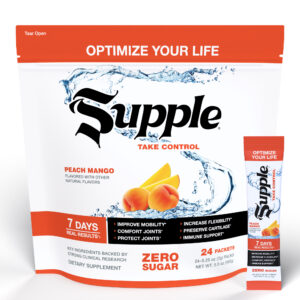 Discovering Supple® Performance Products
A PR firm I work with introduced me to Supple, a nutritional supplement line aimed at “orthopedic performance optimization.” Its formulas are designed to improve joint comfort, mobility and flexibility using chondroitin, glucosamine, Boswellia extract, and vitamins C and D3. The company offers Instant drink packets, a canned carbonated version, Turboflex capsules and even a joint supplement for dogs.
I tested the Instant drink, the Supple canned drink, and the Turboflex capsules. Supple claims improvement in seven days, but I noticed changes even sooner. Within three days, the popping in my back decreased. By day five, the popping and grinding sensations were gone. Both drink formulas tasted good enough to use daily, and I continued to feel better even when skipping days.
How It Affected My Shooting
The difference on the range has been noticeable. Shooting my Mossberg 940 Thunder Ranch was far more comfortable. Handgun work improved too, since the shoulder pain I’d been dealing with disappeared. I’m not moving like I did at 40, but I’m moving better and with far less pain.
Supple isn’t the cheapest option, but feeling better — and staying active in shooting — makes it worth the cost. I believe senior shooters don’t need to give up the sport. Sometimes we just need a little help to keep doing what we love.