The new Taurus RPC is getting quite a bit of attention. The pistol has been sold out at many outlets but was becoming more available as of July 2026. As with many new designs that use a proprietary magazine, availability may take time to improve.
The RPC is a bold introduction for Taurus. The company made its name with affordable firearms, including familiar designs of existing firearms and more original models. The RPC moves Taurus into a different market.
The brace-equipped RPC is listed at $1,000, but prices are already settling at about $100 below MSRP. If quality control is maintained, the RPC could help Taurus break into a new market, as this pistol does several things a conventional concealed carry handgun cannot.
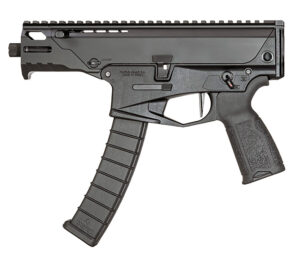 Taurus RPC Specifications
Overall height: 10.6 inches
Overall width: 2.5 inches
Barrel length: 4.5 inches
Overall length: 12.2 inches (brace folded)
Overall weight: 4.52 pounds
Caliber: 9mm
Magazine capacity: 32 rounds as tested
The RPC is supplied with two 32-round magazines and a spare locking piece. Taurus mentioned the possibility of other magazine capacities, including a 20-round magazine, and a variant with an 8-inch barrel may become available.
What Is the Taurus RPC?
The RPC is a large-format 9mm similar to the Ruger PC Charger or SIG Scorpion. It isn’t a concealed carry gun but can fit into spaces that carbines or larger pistols may not. In meaningful terms, it could be called a personal-defense weapon (PDW), though its primary role is home defense.
The larger format gives the RPC some advantages over a conventional handgun. It is easier to control, more accurate in practical shooting and well-suited to suppressor use. Depending on your needs, it could serve well as a truck or camper gun.
How the Taurus RPC Roller-Delayed Action Works
The RPC features roller-delayed blowback operation. Most 9mm carbines and large pistols use straight blowback. While a simple and reliable design, straight blowback tends to produce more recoil than locked-breech pistols.
A roller-cam system delays the rearward movement of the bolt, helping the pistol to maintain its excellent reliability while reducing recoil. A 5-pound 9mm shouldn’t kick much in the first place, but the roller-delayed operation makes the RPC kick even less. Recoil is comparable to that of a pistol caliber carbine weighing much more than the RPC.
Roller-Delayed vs. Straight Blowback
The origins of delayed-blowback firearms go back more than a century. Straight blowback is the simplest action. The bolt, which must be heavy enough to counter the gas pressure generated by up to a 9mm cartridge, is held closed by spring pressure.
The system is simple. Simplicity is desirable, but so is reducing recoil and slowing bolt movement. That’s where delayed blowback has its primary advantage.
The benefits of roller-delayed are reduced recoil energy and less load on the springs. Because of the delayed action, the bolt and recoil springs can be lighter than those used in a conventional blowback design.
How the Roller System Delays the Action
When the fired case begins to move rearward, the bolt head retracts from the pressure. The rollers are propelled inward via curved locking shoulders, in turn, force the bolt to the rear.
The delay allows propellant gas pressure to drop to drop to a safer level before the case is extracted. The result is reliable function with softer recoil.
100-Degree vs. 85-Degree Locking Piece
The RPC is supplied with a spare locking piece, and this is one of the more interesting features of its design.
I left the 100-degree locking piece installed throughout my test. The RPC functioned with a wide range of ammunition, and there were zero stoppages. Most of the firing was done with 124-grain FMJ practice loads, but I also used Federal 147- and 150-grain loads rated for use with a suppressor and had no malfunctions.
The 85-degree locking piece is intended for low-impulse, lower-velocity heavy-bullet suppressor ammunition. Because high-velocity ammunition produces a supersonic crack, suppressors are more effective with subsonic loads.
The RPC also ran a limited amount of Hornady 147-grain subsonic ammunition without difficulty using the standard locking piece. I did not need the 85-degree wedge during my testing, but it is there for shooters who need to fine-tune the roller-delayed action for their particular subsonic load.
Taurus RPC Features and Controls
The RPC features upper and lower receiver shells around the action, not unlike an AR-15. The controls are well laid out and, for the most part, ambidextrous.
Ambidextrous Controls and Charging Handle
The safety is ambidextrous and positive in operation. The charging handle must be moved to the other side for true left-handed operation and does not reciprocate as the action fires.
To switch the handle, a pin must be removed. Moving it to the right side of the pistol makes the RPC ready for left-handed racking. As well, in its standard position, the handle can’t be operated effectively while the brace is folded.
I liked the control layout overall. Speed shooting and speed reloads are intuitive.
Folding Brace
The folding brace works well and proved useful in firing the RPC accurately. It folded easily and locked up more tightly than a competing brace I had on hand.
Forend and Hand Placement
The forend is modest in size, so hand placement may require some attention. Maintain a secure grip and don’t let your hand run forward toward the muzzle. There is a safety bump to help stabilize the support hand, but the muzzle remains close and gets hot.
For that reason, I would not use what appear to be M-LOK slots on the forend to mount a combat light. Instead, I would mount a Streamlight on the top rail ahead of the optic. There is plenty of room, and that setup worked with the several optics I used for testing.
The 4.5-inch barrel is threaded for suppressor use.
Grip and Magazine Controls
Some large-format pistols do not work particularly well with a strong support-hand grip around the magazine well because the shooter may accidentally activate the magazine release. That was not a problem with the RPC.
The magazine release is positioned so as not to be pressed accidentally yet operates positiviely. Shooters who prefer stabilizing the pistol with a grip around the magazine well may appreciate that design.
The AR-style pistol grip fits most hands well and may be replaced if the shooter prefers a different design.
The 32-round magazines are well designed and proved feed reliable. While many 9mm carbines use Glock magazines, a purpose designed carbine magazine will prove more robust and useful in the long run.
Overall, my initial inspection and handling pointed to a well-designed and well-fitted handgun. But firing is the proof.
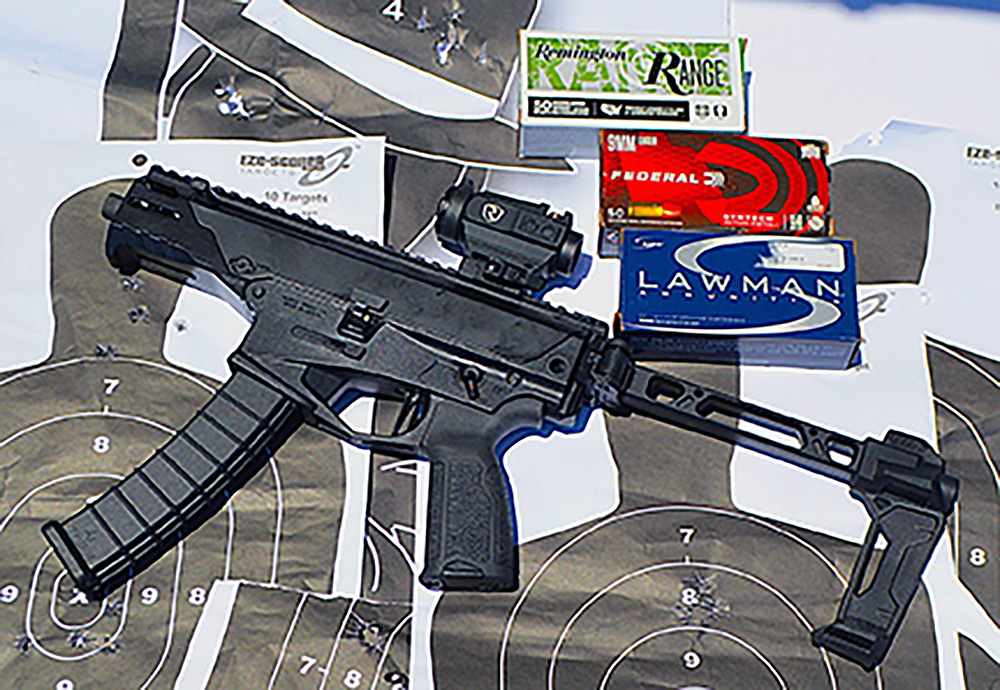
Taurus RPC Range Performance
Ammunition is an important component of any firearm review. For economy, I used primarily FMJ ammunition, with loads from Black Hills, CCI, Federal, Remington and Speer.
I loaded the 32-round magazine with four or five rounds at time, tapping the rear before continuing to load to capacity. This helps to properly seat the cartridges, ensuring feed reliability. I snapped the bolt quickly when cocking the RPC for firing.
Trigger and Shooting Impressions
The straight trigger is a good design for control. It features some take-up before breaking at about 6 pounds, followed by a sharp reset. Pressing a 6-pound trigger against a pistol weighing more than 4.5 pounds isn’t difficult.
I fitted the RPC with a Riton 1 Tactic Ard red-dot sight. I have used Riton on a number of firearms with good results. This tube type sight is well suited to personal defense use.
After firing a few shots at 25 yards to sight the RPC, I proceeded to fire for accuracy.
Recoil and Control
I shot mostly rapid-fire from 7 to 15 yards, aiming center mass and firing in three- to five-shot strings. My focus was cohesive groups and rapid control.
The RPC simply hangs on target. The roller-delayed action, weight and overall design deliver excellent control.
At 25 yards, I slowed down and concentrated on accuracy. The RPC ate out the X ring. This is a controllable firearm with excellent handling.
Taurus RPC Reliability
Reliability was never a question. In addition to my FMJ practice loads, I ran several JHP loads of 115-, 124- and 147-grain ammunition through the RPC. The RPC handled the range of bullet weights and ammunition types without difficulty.
Shooting the Taurus RPC Suppressed
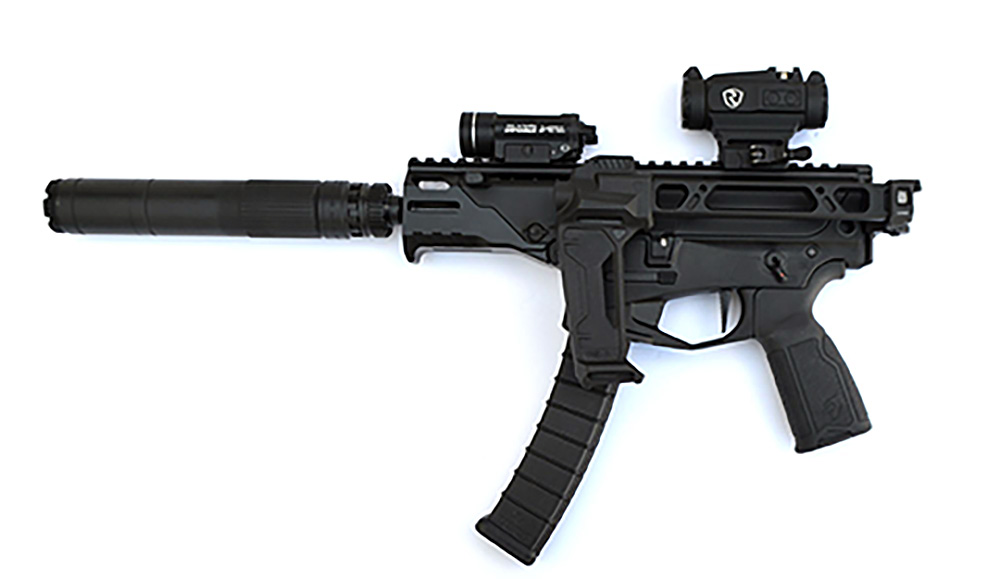
Since the RPC seems ideal for suppressor use, I screwed the Dead Air Mojave 45 on the 4.5-inch threaded barrel.
For testing, I used the Federal American Eagle 150-grain Match load. Sound modulation was excellent and the RPC continued to run well. I did not change the standard locking piece and experienced normal function.
With the suppressor in place, I fired several five-shot groups at 25 yards, using Hornady 147-grain subsonic, Federal 147-grain HST and Speer Gold Dot 147-grain ammunition. Firing from a braced barricade, these loads competed for top place. Most groups measured well under 2 inches.
Is the Taurus RPC Good for Home Defense?
Personal defense and home defense are serious business. The Taurus RPC’s primary advantage in this role is that it is simple to operate and easy to use well.
The pistol may be kept with a loaded magazine in place, allowing the user to grasp it and rack the bolt when needed. If the threat profile is higher, it may be kept ready with a cartridge chambered.
In tight conditions such as hallways, interior rooms and living areas, the RPC handles quickly. It is larger than a conventional handgun, but that size contributes to low recoil and a modest learning curve. Practical accuracy is also much greater than with a conventional handgun.
Small-statured shooters and occasional shooters should not find the RPC’s recoil abusive. For someone who needs a capable firearm for home or property defense, the RPC is a strong choice.
Taurus RPC Pros and Cons
Pros
- Low recoil
- Excellent practical accuracy
- Easy to use well
- Handles quickly in hallways, interior rooms and living areas
- Simple operation
- Reliable with a wide range of ammunition
- Excellent control during rapid fire
- Performs well with a suppressor
- Accurate with subsonic and defensive ammunition
- Well suited to home and property defense
- Easy handling encourages recreational shooting and practice
Cons and Considerations
While there were no notable drawbacks, there are a few practical considerations buyers should understand:
- Spare magazines remain difficult to find at this time
- The standard charging-handle position is not useful with the brace folded
- The short forend requires careful support-hand placement
- The brace-equipped version costs around $1,000, although Bob observed prices beginning to settle below MSRP
Final Verdict: Should You Buy the Taurus RPC?
The RPC’s primary strength is simple: It is easy to use well.
Recoil is low, practical accuracy is much greater than with a conventional handgun and the pistol handles quickly despite its larger size. If you need a capable firearm for home or property defense, the Taurus RPC is a good choice. I found no notable drawbacks during testing.
The RPC is a force multiplier. It allows the shooter to deliver a 9mm payload more accurately than most conventional handguns, potentially helping even the odds against an armed group intent on violence.
There is another advantage that should not be overlooked. The RPC’s easy handling makes you want to shoot it. It is enjoyable for recreational use as well as serious defensive practice.
It is a friendly firearm. The RPC should have a bright future.
Taurus RPC FAQs
What is the Taurus RPC?
The Taurus RPC is a large-format 9mm pistol described as a personal-defense weapon. Its primary role is home defense, although it may also serve as a truck or camper gun depending on the owner’s needs.
Is the Taurus RPC good for home defense?
Yes. It offers low recoil, excellent practical accuracy and quick handling in hallways, interior rooms and living areas.
Is the Taurus RPC reliable?
The RPC proved reliable throughout evaluation, testing FMJ ammunition, 115-, 124- and 147-grain jacketed hollow points, 124-grain +P ammunition and heavy loads intended for suppressor use without reliability concerns.
Does the Taurus RPC have much recoil?
No. The roller-delayed action produces recoil comparable to a pistol-caliber carbine weighing considerably more than the RPC.
Can you use a suppressor on the Taurus RPC?
Yes. The RPC has a threaded 4.5-inch barrel. It was tested with a Dead Air Mojave 45 suppressor, proving excellent sound modulation, normal function and strong accuracy.
How accurate is the Taurus RPC?
The RPC was exceptionally controllable and accurate. At 25 yards, it “ate out the X-ring” during unsuppressed shooting. With the suppressor installed, most five-shot groups with the tested 147-grain loads measured well under 2 inches at 25 yards.
What magazines does the Taurus RPC use?
The test pistol came with two proprietary 32-round magazines. Both proved to feed reliably. Spare magazines remained difficult to find at the time of review.
What is the purpose of the Taurus RPC’s spare locking piece?
The RPC comes with an 85-degree locking piece intended for low-impulse, lower-velocity heavy-bullet suppressor ammunition. The standard 100-degree locking piece was used throughout testing and did not need to be changed, even when firing the subsonic loads he tested.
Is the Taurus RPC easy to shoot?
Its low recoil, control and practical accuracy make the RPC easy to use well.
Is the Taurus RPC worth buying?
For someone looking for a home- or property-defense firearm, the RPC a good choice.