Winter has a way of slowing things down: Motivation dips, range time gets shorter and gear stays tucked away a little longer. Spring is the chance to reset and get moving again.
If you’re serious about personal defense, this is the time to knock the rust off, rebuild your fundamentals and pressure-test your skills with purpose-driven drills. Training doesn’t mean just shooting for the sake of shooting. It means sharpening the skills that translate to surviving a violent encounter.
Self-Defense Training Is a Commitment
Spring training isn’t about burning ammo. It’s about building capability. Because just having the concealed carry permit, owning a gun or even taking a class doesn’t make you prepared.
Skill, awareness and judgment do, and those are perishable.
Firearms drills aren’t about recreating a gunfight but building the individual skills you’ll need when things go bad. Carrying a firearm is a daily responsibility, and the skills that support it require consistent, intentional work.
Training isn’t something you did. It’s something you do. Let’s get to work.
Start With the Foundation: The 5 & 5 Drill
Anticipation may make Christmas morning more exciting, but most gun owners would agree that anticipation of the recoil of a gun prior to firing can cause all sorts of problems.
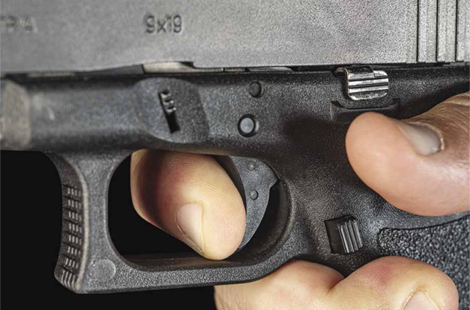
Many of us call this issue “jerking” the trigger. Technically, though, there can be much more to it than just a problem with the trigger (or, really, the trigger finger).
Physically, the issue could include sympathetic movement of the other fingers, the hands and perhaps even both arms. Mentally, it could be anxiety, excitement, fear or a combination of many different thoughts and emotions.
Another common situation is when a shooter who anticipates recoil ends up overcontrolling the gun or perhaps moving too soon to ready himself or herself for effective recoil management.
No matter the mental or physical causes, jerking the trigger or anticipating the shot causes a shooter to add movement to the gun before he or she presses the trigger. And this unwanted movement causes the bullet to go somewhere other than where he or she intends.
The “5 & 5 Drill,” created by the co-founder of SIG Academy, George Harris, exposes that problem fast. Fire five live rounds, then immediately follow with five dry-fire presses at the same pace.
The dry-fire portion reveals any movement you’re adding to the gun.
To set up this drill, you will need a target of choice as well as a gun, a magazine and ammo. Set up at around 5 yards or at a distance that enables you to get consistent and consecutively accurate hits.
Run five live rounds, immediately followed by five dry-fire trigger presses at the same cadence. The contrast is where the magic happens.
Any flinch, dip or unwanted movement becomes obvious during the dry-fire portion.
Feel free to record your actions so you can verify for yourself, or ask a shooting partner to work with you to see if you are unintentionally adding any movements to your trigger press. Once observations are noted and any needed adjustments are made, you can repeat the “5 & 5” sequence while continuing to address any trigger-press imperfections.
Spring Training Focus:
- Slow it down
- Watch the sights
- Eliminate unnecessary movement
This drill helps pull focus back on what’s important to land consistently accurate hits: the smooth, consistent manipulation of the trigger.
Refresh Your Defensive Shooting Skills This Spring
Understanding self-defense drills and range fundamentals is just the first step. Proper training transforms you from a gun owner into a confident protector.
USCCA’s expert-led classes cover everything from firearm fundamentals and accuracy training to legal considerations and conflict avoidance – giving you the confidence and skills to protect what matters most.
Over 1 million students trained nationwide. Find certified instruction in your area and take the next step in your protector journey.
Build Defensive Thinking: The 3-RSquared Drill
Real fights aren’t static. They’re messy, unpredictable and require you to think while you act. The best thing you can do is be prepared.
You may work through some sort of “failure to stop” drill in which you send two rounds to the body and then another one immediately to the head. You might prefer to focus on natural reactions and reaction times and practice shooting somewhere between two to five rounds while visualizing yourself stopping the threat.
The “3-RSquared Drill” incorporates some marksmanship strategies but still requires a defensive mindset. You will encounter three separate shooting problems along with two “R” actions: an emergency reload and a return to the ready position.
To run this drill, you will need to set up two separate targets — 2 to 4 yards apart — about 7 yards away (or choose a distance that is appropriate to challenge your skills). Each target will need a defined high-center-chest area of approximately 8 inches (or a paper plate) and a head shot or smaller target of around 2 to 3 inches (or a post-it note).
You will begin with your pistol holstered, but feel free to start at a low-ready position if holstering is not allowed. Be sure to set up with a magazine loaded with two rounds and have another full magazine prepared and ready on a bench, table or, preferably, however you carry your reload.
On the start signal of your choice, you’ll engage one target with two rounds, perform an emergency reload and deliver a precision headshot. Then return to high-compressed-ready to scan and assess.
Recognizing a new threat, you transition to a second target and engage again, sending two to five shots into high-center chest.
Spring Training Focus:
- Clean reloads
- Controlled transitions
- Intentional assessment (don’t rush it)
This drill will help you work on several important defensive shooting skills, such as presentation from the holster, recoil management, emergency reloads, assessment, target transitioning and precision shots.
The 3-RSquared Drill can also add a small cognitive load for you to remember the order and sequence of the targets and the number of shots needed to stop the threat or to respond to the directions from a partner regarding which target to engage first.
Stretch Your Capability: The Odd Man Out Drill

When you consider the available data regarding average, everyday folks using firearms to protect life, you’ll typically see a defensive-shooting range of around 3 to 5 yards.
Undoubtedly, this means that practice and training within those distances is vital for someone to be better prepared to stop a threat. However, training at distances beyond close range is also important.
The “Odd Man Out Drill” forces you to work across multiple distances: 3, 5 and 7 yards.
To prepare for this drill, you’ll need your firearm and holster, three magazines, magazine pouches (if you have them; if not, just use pockets), IDPA targets or paper plates (or any targets with a 6- to 8-inch target area), and about 100 to 200 rounds of ammunition.
Set up three targets at 3, 5 and 7 yards, and load each magazine with four rounds.
Starting with the first target at 3 yards, present the firearm from the holster to the target and fire all four rounds from the first magazine. Be sure to use target-focused shooting.
You do not need to use your sights at this distance, as you likely would not be able to focus on them during a threat.
Conduct an emergency reload and continue to engage the first target with four more rounds. Reload again and work your way through the third (and final) magazine.
You should have 12 rounds on target when you get through all three magazines.
Repeat the drill at 5 yards, then run it twice at 7 yards. This farthest distance will force you to apply all of the skills necessary to get defensive-accurate hits on the target and should also prove that you can engage the threat a bit faster when you’re shooting at the closer distances.
Spring Training Focus:
- Don’t sacrifice accuracy for speed
- Track your performance at each distance
- Push your limits without losing control
By successfully incorporating the longest distance, you will notice your ability to increase speed at the 3- and 5-yard lines.
Master the Draw: The 5-Point Draw Drill
In a defensive encounter, you won’t have time to think through your draw stroke. You’ll default to whatever habits you’ve built.
The 5-Point Draw Drill breaks your presentation into a consistent, repeatable sequence that eliminates wasted motion and builds efficiency from the holster.
To set up this drill, you will need your defensive firearm or a training pistol, a holster and a safe environment for dry-fire practice. Be sure all live ammunition is removed from the training area.
Select a target roughly the size of a human torso.
Start with your firearm holstered and your hands in a relaxed position.
- Grip the firearm while it is still in the holster.
- Clear: pull the firearm straight up until it clears the holster.
- Rock and lock: rotate the muzzle toward the target.
- Smack: Bring your support hand in to meet the firing hand, forming a solid two-handed grip.
- Extend the firearm toward the target, acquire your sights and press the trigger.
After each repetition, step off the line of attack and conduct a slow, deliberate 360-degree scan. This reinforces the habit of assessing your surroundings after an engagement.
Spring Training Focus:
- Build a consistent, repeatable draw stroke
- Eliminate wasted motion from presentation
- Always scan and assess after the shot
Keep the Gun Running: Emergency Reload Drill
At some point, your gun will run empty. When it does, your ability to reload efficiently may determine the outcome.
The Emergency Reload Drill focuses on getting the firearm back into the fight quickly and consistently, without hesitation or wasted movement.
To set up this drill, you will need your defensive firearm, two to three magazines and a safe dry-fire environment. If available, training tools such as dummy rounds or a dedicated system can help simulate realistic reload conditions.
As always, remove all live ammunition from the training area.
Begin with your firearm in a shooting position with the slide locked to the rear. Bring the firearm into your workspace — close to your line of sight — while simultaneously activating the magazine release.
Allow the empty magazine to fall free as your support hand moves to retrieve a fresh magazine.
Index the magazine properly and insert it firmly into the firearm. Once seated, cycle the slide to chamber a round and immediately reacquire your sights on the target.
Repeat this process deliberately, focusing on smooth, efficient movement rather than speed.
Spring Training Focus:
- Bring the gun into your workspace
- Keep your eyes on the threat
- Make every movement deliberate and repeatable
A fumbled reload in a fight isn’t just a mistake. It’s a liability. Creating a smooth reload that keeps your firearm full of ammo and ready to defend is paramount.
Add Movement: The Bob and Weave Drill
Standing still on a flat range is easy. Real life is not.
The Bob and Weave Drill introduces movement, obstacles and decision-making, forcing you to engage while navigating a dynamic environment. It also elevates your heart rate, simulating the physical stress of a real encounter.
To set up this drill, you will need a target that allows for 360-degree engagement, several obstacles (such as chairs or barrels), a safe training area and a training partner if possible.
This drill should be conducted using dry-fire tools such as a SIRT or laser training pistol. Remove all live firearms and ammunition from the area.
Position the target in an open space and arrange obstacles between you and the target. Starting from a ready position, move laterally to the first point of cover or obstacle.
From there, engage the target with multiple shots.
Continue moving from position to position, weaving through the obstacles while maintaining awareness of your environment. If working with a partner, coordinate movement so that both shooters are engaging and repositioning safely without crossing lines of fire.
The goal is to move with purpose, engage accurately and maintain control under physical stress.
Spring Training Focus:
- Move with purpose
- Maintain muzzle discipline
- Identify your target — and what’s around it
Shooting and moving simultaneously is a skill that few get to practice on a regular basis. Training while your body is experiencing similar reactions to that of a live encounter will help to evaluate your shooting capabilities and limitations.
Pressure-Test Accuracy: The Mozambique Drill
Sometimes, center mass isn’t enough.
The Mozambique Drill — two rounds to the chest followed by one to the head — trains rapid follow-up shots and precise transitions between target zones. It reinforces the need for accuracy under pressure, not just speed.
To set up this drill, you will need your defensive firearm, ammunition and a target with clearly defined center-mass and head zones.
Begin from a ready position or from the holster, depending on your skill level and range rules. On your start signal, present the firearm and acquire a sight picture on the center mass of the target.
Fire two controlled shots into the chest area.
Immediately transition your focus to the head zone, acquire a new sight picture and fire one precise shot. This should be a deliberate transition, not a rushed or uncontrolled movement.
Repeat the drill at a consistent pace, focusing on clean hits rather than speed.
Spring Training Focus:
- Two distinct sight pictures
- Controlled cadence
- Clean transition to the head shot
The Mozambique Drill addresses the issue that two center mass rounds may not be enough to stop an attacker. The body of an attacker and his actions can continue, even with significant blood loss.
Take Your Protection to the Next Level
Join over 860,000 USCCA Members for leading self-defense education, training and legal protection benefits.
Train With Purpose This Spring
You’re not training for the range. You’re training for the fight you hope never happens.
No single drill will prepare you for everything. But each one builds a piece of the puzzle, working through trigger control, movement, reloads and decision-making.
Stack those skills together, and now you’re getting somewhere.
Use this spring as a reset to get back on the range, be consistent with your dry-fire and to train with intent.
When it matters most, you won’t rise to the occasion but fall back on your training. Make sure it’s solid.