EDITOR’S NOTE: The “Drill of the Month” column from Concealed Carry Magazine offers readers new practical drills with each installment. The following is from the November/December 2025 issue, updated for the web. To read the original and catch up on all Drill of the Month articles, log in to your USCCA Member webpage.
Teaching the next generation proper firearms use is not about rushing them to the range but laying a strong foundation of safety, respect and responsibility. For many families, that begins at home with structured, supervised dry-fire training for kids.
When done correctly, dry-fire practice at home is safe, smart and incredibly effective for introducing important concepts while reinforcing the four firearms safety rules. Here’s the key: Children learn best not just by listening, but by watching and doing. Every dry-fire session becomes an opportunity to model safe gun handling and demonstrate what responsible firearms ownership looks like in real life.
What Is Dry-Fire Training?
Dry-fire training is practicing firearm handling skills without live ammunition. No round is fired. No ammunition is present in the training area. Instead, students focus on safe manipulation, grip, stance and movement.
For parents teaching kids gun safety, dry-fire offers a controlled way to introduce:
- Safe gun handling for kids
- Proper grip fundamentals
- Muzzle discipline
- Trigger finger awareness
- Ready positions and controlled movement
Before getting started, ensure you have:
- A designated safe direction
- A table or stand
- A distraction-free environment
- Absolutely no ammunition in the dry-fire area
For drills, you can use a blue gun, a SIRT pistol or equivalent training tool, or an empty, verified-clear handgun. Always double-check that the firearm is unloaded.
Is Dry Fire Safe for Kids?
Yes, when supervised and structured correctly.
Dry-fire drills for children are not about speed or performance. They are about reinforcing responsibility and repeating safe habits until they stick. The adult must model safe behavior at every step.
The activities I’m sharing come from the USCCA’s Children’s Firearms & Self-Defense Fundamentals curriculum, created with parents and instructors in mind.
Every child develops differently. What may be perfect for one 7-year-old might not be appropriate for another until age 12 — or even later. Good judgment, caution and careful observation are non-negotiable.
Pay attention to each child’s:
- Physical development
- Emotional maturity
- Cognitive understanding
Don’t hesitate to adjust — or even stop — an activity if it isn’t the right fit. This isn’t about pushing kids forward. It’s about meeting them where they are and building confidence through responsible firearms education.
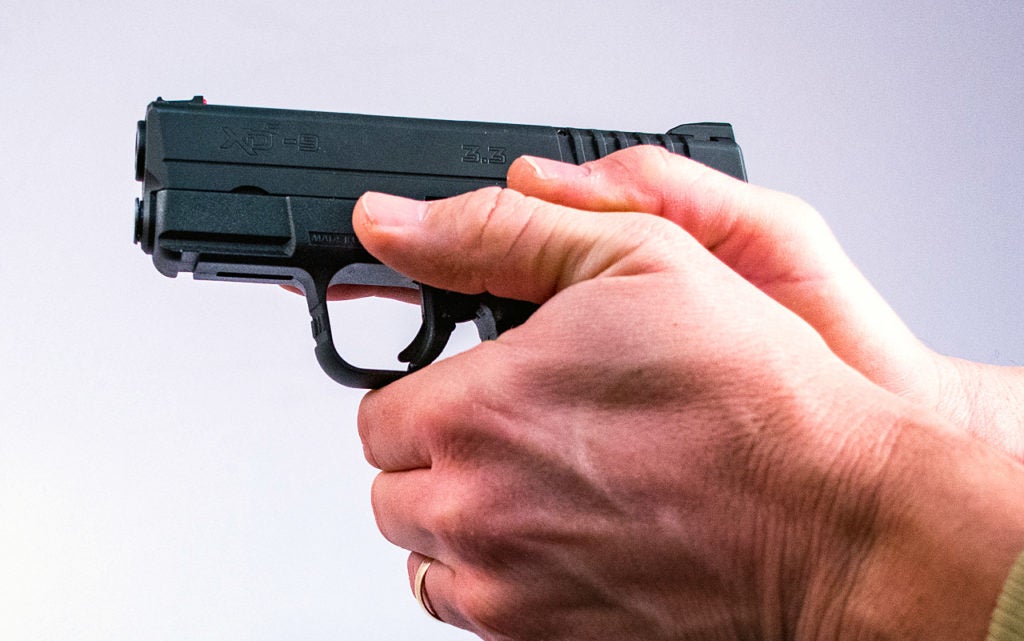 Dry-Fire Drill #1: Make a Gun to Take a Gun
A longtime Scout leader once shared this gem with me, and it has stuck ever since. Here’s how it works:
- Start by making a “gun” shape with your dominant hand, thumb up and index finger pointed straight.
- When you “take a gun” from a table or a bag, use that same “gun” shape. Ensure your trigger finger is straight and indexed along the side of the slide or frame. The seam is an ideal reference point.
- Your support hand helps by tipping or stabilizing the firearm so you can firmly and properly grip it with your dominant hand.
- Say, out loud, “Make a gun to take a gun.”
- Reverse the motion to safely put the firearm back down.
This drill may look simple. The child is only picking up the gun and putting it back. But it is incredibly effective. Watch closely for a straight trigger finger and a disciplined muzzle. Offer helpful corrections as needed. These small repetitions build lifelong habits.
Dry-Fire Drill #2: Get a Grip
Once a child can safely pick up a handgun, you can introduce a proper two-handed grip.
Begin slowly, using the same “gun” hand shape:
- Ensure the handgun is snug and secure in your dominant hand, high on the backstrap, like a firm handshake.
- Keep your trigger finger straight along the slide or frame.
- Put your dominant thumb in a “thumbs up” position to make room for your support hand.
- Guide your support hand to wrap firmly but comfortably around the grip and your shooting hand.
- Both thumbs point forward toward the target, with your dominant thumb resting on your support-hand thumb underneath.
This is also a good time to assess fit. Many firearms are too large for smaller hands, and that’s okay. Some compromises may be necessary when introducing youth firearms training. Work on this fundamental until the student can go through the motions independently and safely.
Dry-Fire Drill #3: Out and Back
Now that we have a safe way to pick up the gun and establish a proper grip, let’s add controlled movement.
- Stand in a comfortable shooting stance: feet shoulder-width apart with a slight forward bend at the waist.
- Pick up the handgun and establish a solid grip.
- Hold the gun firmly in a high-compressed-ready position: close to your chest, muzzle pointed in a safe direction. Elbows should be bent.
- Extend your arms straight toward the target area while keeping the muzzle in that safe direction.
- Avoid “fishing” upward or “digging” downward. Movement should be straight out.
- Smoothly bring the firearm back toward your chest, elbows tucked.
- Repeat: Out and back.
Remind your student:
- Finger remains off the trigger
- Muzzle stays in a safe direction
- Movement is controlled and deliberate
Each repetition reinforces safe gun handling for kids and builds confidence before any live-fire experience.
Let Safety Be Your Guiding Principle
Introducing kids to firearms should never be rushed. Dry-fire practice at home provides a structured way to teach responsibility before live ammunition is ever involved. Every controlled motion — picking up a firearm, establishing a grip, moving to extension and back — becomes a teachable moment.
You’ll find these examples and many more in the USCCA’s Children’s Firearms & Self-Defense Fundamentals program. It’s a valuable resource for parents and instructors committed to raising responsibly armed Americans.
Stay patient. Stay observant. And model safety every single step of the way.
Build Safe Habits That Last a Lifetime
Introducing kids to firearms starts with the right foundation. Structured, age-appropriate training helps reinforce safety, responsibility and confidence every step of the way.
The USCCA’s Children’s Firearms & Self-Defense Fundamentals classes are designed specifically for young learners and the adults guiding them. These expert-led courses focus on safe gun handling and awareness in a supportive environment.
Join other families who are taking a proactive approach to responsible firearms education.
Frequently Asked Questions About Dry-Fire Training for Kids
At what age can kids start dry-fire training?
There is no universal age. Readiness depends on maturity, attention span and the ability to follow directions. Some children may be ready around 7 or 8 years old, while others may need more time. Focus on responsibility and comprehension, not age alone.
Is dry-firing bad for a handgun?
Most modern centerfire firearms can be safely dry-fired. Some rimfire firearms may require snap caps to prevent damage. Always consult the manufacturer’s recommendations before beginning dry-fire practice at home.
Should kids use real firearms during dry-fire?
That decision depends on the child’s maturity and your comfort level. Many families begin with inert training tools such as blue guns or SIRT pistols before transitioning to a verified unloaded firearm under direct supervision.
How do I make dry-fire practice safe at home?
Follow these rules every time:
- Remove all ammunition from the training area
- Verify the firearm is unloaded
- Use a designated safe direction
- Supervise closely
- End each session with a clear verbal confirmation that training is over
Consistency builds safety.
How do you transition from dry-fire to live-fire with kids?
When a child demonstrates consistent muzzle discipline, trigger finger awareness and emotional maturity, you may consider a controlled live-fire experience at a reputable range. Keep sessions short, positive and focused on safety rather than performance.