Few handguns have altered the firearms landscape so much as the pistol Gaston Glock created for the Austrian Military in 1980, which would come to be known as the Glock 17.
Glock 17 Development
When it first appeared in the early 1980s, it challenged nearly every assumption shooters and law enforcement officers held about what a duty gun should be. Today, its influence is so widespread that it’s easy to forget just how revolutionary it once seemed.
The Glock 17, named for Glock’s 17th patent and not its magazine capacity, was intended to meet military requirements, not redefine the industry. Lightweight, simple and reliable, the Glock 17 quickly attracted attention beyond its country of origin once it was adopted by Austrian military and police forces.
The Glock Revolution
I was working as a municipal police officer in 1984 when the Glock 17 started circulating in America. Rather than its performance, the first thing anyone talked about was the fact that the pistol was “made of plastic.”
Rumors spread that Glocks would melt in the sun. Those stories were taken seriously by many officers at the time. I’ll admit, I believed some of it myself.
Every duty handgun at the time was made of blued steel, nickel-plated steel or, later, stainless steel, often with wood grips. That design had remained largely unchanged for nearly a century.
Against that backdrop, a polymer-framed handgun was a radical departure from everything we thought we knew.
Once the myths were debunked and officers began carrying and shooting the Glock 17, acceptance followed. What initially seemed strange soon proved practical.
The Glock 17 didn’t just work—it worked consistently, under conditions that challenged many traditional designs. And that reliability would ultimately change how duty pistols were designed, issued, and evaluated.
Master the fundamentals behind legendary reliability.
Understanding defensive handguns like the Glock 17 is just the first step. Proper training transforms you from a gun owner into a confident protector.
USCCA’s expert-led classes cover everything from firearm fundamentals and accuracy training to legal considerations and conflict avoidance – giving you the confidence and skills to protect what matters most.
Over 1 million students trained nationwide. Find certified instruction in your area and take the next step in your protector journey.
Glock 17 Reliability and Service Life
One area where the Glock 17 has never needed defending is reliability. Over the years, Glock pistols, including the Glock 17, have consistently demonstrated the ability to withstand extremely high round counts with minimal parts replacement.
Documented endurance testing has shown Glock pistols routinely exceeding 30,000 rounds, with the majority of maintenance limited to normal wear items such as recoil springs and magazines rather than core components.
From a practical standpoint, this is one of the reasons the Glock 17 remains in service decades after its introduction. It’s a pistol that continues to work even when it’s dirty, dry or neglected — qualities that matter far more in real-world use than fine tolerances or cosmetic refinement.
Accuracy and Practical Performance
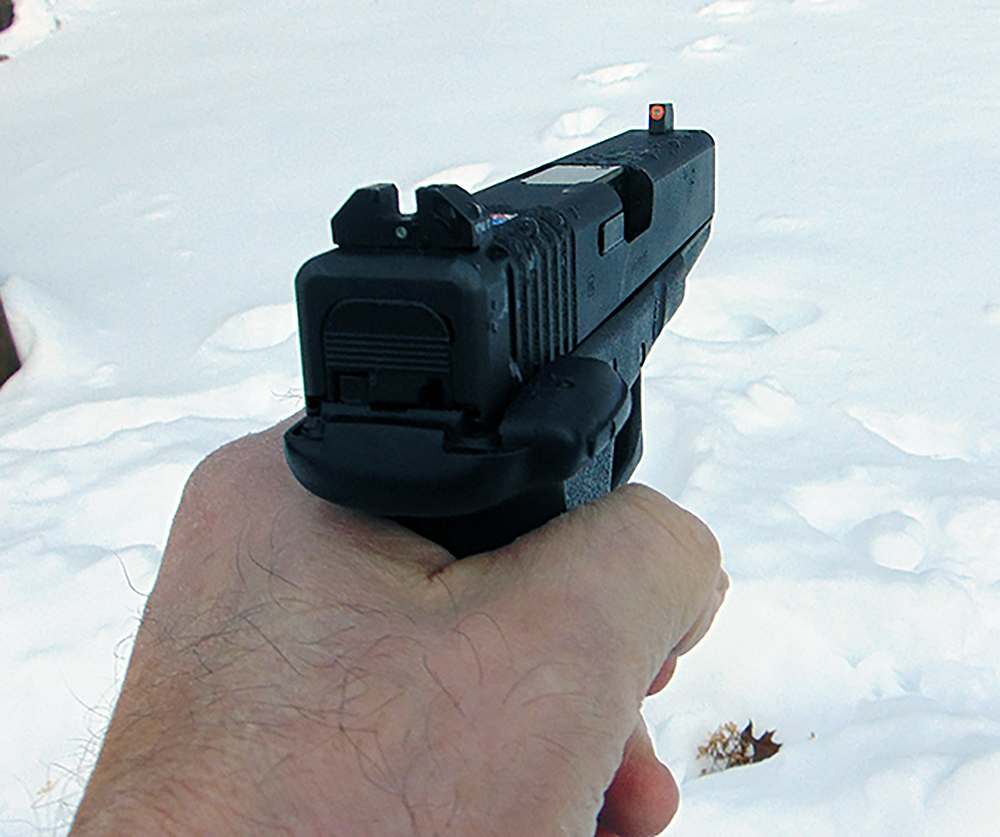
The Glock 17 was never marketed as a target pistol, yet its real-world accuracy has consistently proven more than adequate for duty and defensive use. Glock’s design places a premium on consistency rather than precision tuning, and that approach pays dividends when the pistol is shot under stress or adverse conditions.
While individual results will vary, the platform is fully capable of practical accuracy well beyond typical defensive distances.
The Glock 17 Refined Over Time
After decades of incremental changes and refinement, Glock introduced the Generation 5 Glock 17. It was immediately clear the company wasn’t interested in reinventing the pistol.
Instead, Glock focused on improving details that matter while preserving the reliability and simplicity that made the original Glock 17 successful in the first place.
The most noticeable change is the removal of finger grooves, something many shooters had been asking for over multiple generations. Grip size and hand shape vary widely, and eliminating fixed grooves allows the pistol to fit a broader range of shooters more naturally.
The grip texture itself was also refined, providing secure purchase without being overly abrasive.
Gen 5 Updates
Glock also made meaningful updates to handling and administration. The ambidextrous slide stop on the Gen 5 was a welcome addition for left-handed shooters and simplified manipulation for anyone running the pistol hard.
The flared magazine well, while modest, makes reloads smoother and more forgiving, especially under stress.
Internally, the Gen 5 Glock 17 features Glock’s updated Marksman barrel, along with a revised barrel crown and changes to internal geometry intended to enhance durability and consistency. While the pistol remains unmistakably a Glock, these refinements reflect Glock’s continued focus on reliability and practical performance rather than cosmetic change.
Trigger operation remains familiar to long-time Glock users. Pull weight stays in the same range as previous generations, and while some shooters describe subtle differences, the overall character of the trigger is consistent with Glock’s long-standing design approach.
Glock 17 Pros and Cons
Pros
- Proven reliability: Decades of service use across military and law enforcement organizations
- Simple design: Fewer internal parts and straightforward operation
- Lightweight polymer frame: Reduced overall weight compared to all-steel pistols
- High magazine capacity: Standard 17-round capacity in a full-size handgun
- Incremental refinement: Gen 5 updates improved ergonomics and handling without altering the pistol’s character
- Ease of maintenance: Simple field stripping and widely available parts
Cons
- Minimal external controls: Some shooters prefer manual safeties or decockers
- Utilitarian aesthetics: Design prioritizes function over appearance
- Grip angle: While improved over generations, it may not suit every hand shape
Why the Glock 17 Still Sets the Standard
Taken as a whole, the Gen 5 Glock 17 represents Glock at its most predictable, and that’s not a criticism. It is still a full-sized, double-stack 9mm service pistol built around simplicity, reliability and ease of maintenance.
Glock didn’t chase trends but refined what already worked.
Shooters looking for that same Glock reliability in a more carry-focused package may find our Glock 43X review a useful next read.
Sources:
Glock: US.Glock.com
XS Sights: XSSights.com
Arachnigrip Slide Spider: TalonGunGrips.com
Crimson Trace: CrimsonTrace.com
This article contains copy regarding Glock Gen 5 upgrades from a 2018 Concealed Carry Magazine article by Bob Campbell.
Glock 17 FAQs
What is the Glock 17?
The Glock 17 is a full-sized, striker-fired 9mm pistol originally developed for military service in the early 1980s. Gaston Glock’s handgun design became the foundation for the company’s entire product line.
Why is the Glock 17 considered revolutionary?
When introduced, the Glock 17 challenged long-standing handgun norms by using a polymer frame, a simplified internal design and a high-capacity magazine. These features were uncommon at the time and sparked widespread skepticism before being widely adopted.
What changes were made to the Gen 5 Glock 17?
The Gen 5 Glock 17 features several refinements, including the removal of finger grooves, an ambidextrous slide stop, a flared magazine well and Glock’s updated Marksman Barrel. These changes were intended to improve handling, accessibility and consistency while retaining the pistol’s core design.
Is the Glock 17 reliable?
The Glock 17 has earned a long-standing reputation for reliability through decades of military, law enforcement and civilian use. Glock’s design philosophy emphasizes durability, simplicity and consistent function.
Is the Glock 17 still relevant today?
Despite the availability of newer handgun designs, the Glock 17 remains widely used due to its simplicity, proven track record and ease of maintenance, along with Glock’s continued incremental refinements.
Take Your Protection to the Next Level
Join over 860,000 USCCA Members for leading self-defense education, training and legal protection benefits.