Safe gun storage is one of the most important decisions a gun-owning household must make. Whether you’re safeguarding children, deterring theft or protecting your investment, secure firearm storage is a crucial part of responsible ownership.
There’s no one-size-fits-all solution to storing guns safely. Fortunately, gun owners can choose from a range of options based on their needs, from budgeting and space restrictions to security features and accessibility.
The best gun storage solution is one that prevents unauthorized access, protects your firearms and works for your household. That might mean a traditional gun safe for long-term storage, a smaller lockbox for a handgun or a quick-access safe for a home-defense firearm.
But before choosing a safe, it’s important to understand what each option can — and cannot — do.
Key Takeaways
- Safe gun storage helps prevent unauthorized access, theft and damage while allowing authorized users to retrieve firearms when appropriate.
- Firearms should be secured against unsupervised access by children. Hiding a gun or teaching children about firearm safety does not replace locked storage.
- When choosing a gun safe, consider your household, the firearms being stored, accessibility, locking mechanisms and installation.
- Firearm storage laws vary by state and locality, particularly when children may gain access.
Why Is Safe Gun Storage Important?
Gun safes aren’t just for people with children. They’re for anyone who wants to protect firearms from theft, damage or unauthorized use.
A firearm kept for personal protection should never become a danger to the people it’s intended to protect. That means considering not only how you’ll access your firearm but also how you’ll prevent someone else from accessing it.
A good storage solution should address several concerns:
- Unauthorized access: Preventing children, visitors and others who should not handle firearms from reaching them.
- Theft: Making firearms more difficult to remove from your home or vehicle.
- Damage: Protecting firearms from environmental conditions and other hazards.
- Accessibility: Allowing authorized users to retrieve firearms when appropriate.
These considerations don’t always lead to the same type of safe. A large, traditional safe may be appropriate for storing several firearms, while a smaller, securely mounted handgun vault may better suit someone who needs access to a single home-defense firearm.
The important thing is to choose deliberately rather than simply finding a convenient place to put a gun.
How to Store Guns Safely Around Children
As a mom and firearms instructor, I understand the challenge of balancing firearm accessibility with keeping children safe. And I think most parents would agree that there’s no such thing as being too careful when it comes to children and firearms.
Children are naturally curious. Some are too young to understand the importance of gun safety, while others may become interested in something precisely because they’ve been told not to touch it.
That’s why teaching children about firearms is important, but education alone isn’t enough. Firearms should be secured to prevent unplanned or unsupervised access.
Why Hiding a Gun Isn’t Enough
There are plenty of creative ways to conceal firearms. Some people use hidden compartments in furniture, bookshelves, mirrors or other everyday objects. Others place guns on high shelves or in drawers they believe children cannot reach.
But don’t be fooled: A secret location may not be a secret at all.
Children are often more observant than we give them credit for. A firearm tucked behind an unusual mirror or stored in a particular drawer may attract attention rather than prevent it.
Concealment shouldn’t be mistaken for security. If children can discover and open a storage compartment, hiding the firearm hasn’t prevented unauthorized access.
Safe Firearm Storage Checklist
No matter which storage option you choose, keep these precautions in mind:
- Store firearms where they’re accessible only to other authorized individuals.
- Use a secure, locked gun safe, cabinet, vault or storage case.
- Keep firearms and magazines unloaded when storing them.
- Store ammunition separately in a locked location inaccessible to children.
- Keep keys, combinations and other access devices away from children and unauthorized users.
- Establish a consistent routine for securing your concealed carry or home-defense firearm.
- Consider a firearm-specific locking device, such as a cable lock, as an additional precaution when appropriate.
Review your storage arrangements as your children grow and your household’s needs change.
And remember that children learn by watching the adults around them. Consistently practicing safe firearm handling and storage reinforces the lessons we teach.
What Are the Laws for Safe Gun Storage?
Firearm storage laws vary by state and locality, particularly when children may gain access to a firearm.
Some laws address how firearms must be secured when they aren’t under an owner’s immediate control. Others impose requirements or penalties when a child gains access.
Understanding the laws that apply to your household is an important part of responsible firearm ownership.
States With Safe Storage Laws
| State | When does the law apply? | |
|---|---|---|
| California | Under 18 and anytime when not in immediate control of the firearm by the owner | |
| Colorado | Under 18 and when child may or is likely to gain access | |
| Connecticut | Under 18 and anytime when not in immediate control of the firearm by the owner | |
| Delaware | Under 18 and after child gains access | |
| Florida | Under 16 and after child gains access | |
| Hawaii | Under 18 and after child gains access | |
| Illinois | Under 14 and after child gains access | |
| Iowa | Under 14 and after child gains access | |
| Maine | Under 16 and after child gains access | |
| Maryland | Under 18 and when child may or is likely to gain access | |
| Massachusetts | Under 18 and anytime when not in immediate control of the firearm by the owner | |
| Michigan | Under 18 and after child gains access | |
| Minnesota | Under 18 and when child may or is likely to gain access | |
| Nevada | Under 18 and when child may or is likely to gain access | |
| New Hampshire | Under 16 and after child gains access | |
| New Jersey | Under 16 and after child gains access | |
| New Mexico | Under 18 and after child gains access | |
| New York | Under 16 and when child may or is likely to gain access | |
| North Carolina | Under 18 and after child gains access | |
| Oregon | Under 18 and anytime when not in immediate control of the firearm by the owner | |
| Rhode Island | Under 18 and anytime when not in immediate control of the firearm by the owner | |
| Texas | Under 17 and after child gains access | |
| Vermont | Under 18 and after child gains access | |
| Virginia | Under 14 and when child may or is likely to access | |
| Washington | Under 18 and after child gains access | |
| Wisconsin | Under 14 and after child gains access |
What Are the Different Types of Gun Safes?
Gun safes and storage containers come in a variety of shapes and sizes. Some are designed for portability, others for quick access and still others for protecting an entire firearms collection.
Understanding the differences can help you narrow your choices.
| Storage option | Best for | Advantages | Limitations |
|---|---|---|---|
| Portable gun safe or lockbox | Handguns, travel and limited storage space | Compact, convenient, available with different locking mechanisms | Limited capacity and protection against theft |
| Vehicle gun safe | Securing a firearm in a vehicle | Designed for vehicle installation, discreet storage | Limited capacity; vehicle-specific security concerns |
| Quick-access gun safe | Authorized access to a home-defense firearm | Multiple entry technologies, convenient placement | Electronic systems may require batteries or backup access |
| Hidden firearm storage | Discreet storage in the home | Concealed appearance, varied designs | Concealment alone doesn’t prevent unauthorized access |
| Traditional gun safe | Long-term storage and multiple firearms | Greater capacity, substantial construction, available fire-resistant designs | Heavy, expensive and requires dedicated space |
Portable Gun Safes and Lockboxes
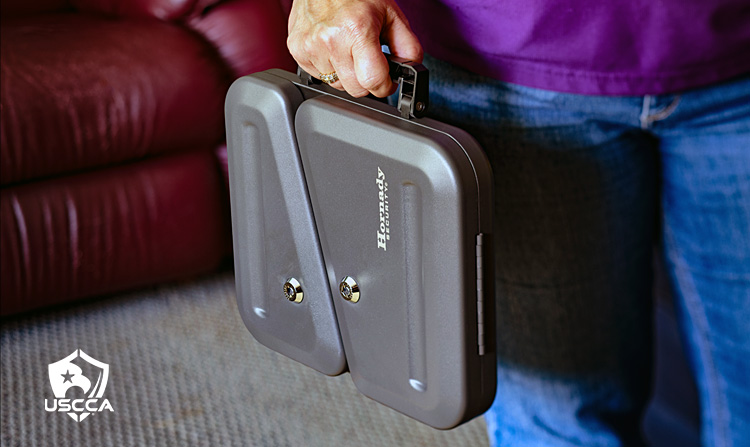
If you’re new to firearms or looking to safely secure a home-defense firearm that you also carry concealed, you might want to invest in something compact and lightweight. Portable safes are available with keyed locks, combination keypads and biometric entry systems. Some also include security cables that allow the container to be attached to another object.
Brands like Vaultek offer portable, quick-access safes that allow you to retrieve your firearm swiftly in case of an emergency. Hornady’s Dual-Lid Lock Box was designed with two separate locking compartments, providing space to secure a handgun and ammunition separately.
Portable safes can be useful when traveling or when a larger safe isn’t practical. However, their size and portability can also make them easier to remove. A security cable or other attachment method may provide additional protection, depending on the container and how it’s installed.
- Best for: New gun owners or those needing a mobile, quick-access solution
- Pros: Compact, lightweight, easy to transport, several locking options
- Cons: Limited capacity, generally less protection from theft compared to larger safes
Vehicle Firearm Storage
When carrying a self-defense firearm in your vehicle, a vehicle-specific gun safe can provide both convenience and protection. Vehicle safes may be mounted under a seat, inside a console or in other concealed spots within the vehicle. Some include mounting brackets or cables to help prevent easy removal.
Vehicle storage deserves particular attention because a firearm left unsecured inside a car may be accessible to passengers or anyone who gains entry. As well, a vehicle safe keeps firearms secure and compliant with many state firearm storage laws.
Vehicle-specific gun safes are particularly useful when firearms cannot be brought inside a building or if traveling to areas where firearms are prohibited. Many are tamper-resistant and come with mounting brackets for additional security.
- Best for: Storing firearms in vehicles while traveling or when carrying isn’t possible
- Pros: Convenient, secure, discreet
- Cons: Limited to vehicle storage, not ideal for home use
Quick-Access Gun Safes for Home-Defense Guns
For those who keep a firearm for home defense, accessibility is an important consideration. There are several options that offer both security and convenience. Quick-access safes typically feature biometric locks, RFID technology or keypads, ensuring a self-defense firearm is available to authorized users when necessary.
One unique option is the Reach 2S from VaraSafety. This safe can be bolted to a wall or furniture and uses fingerprint recognition to grant access. With its sturdy, holster-like compartment, it keeps the firearm locked until approved users unlock it with their thumbprints.
Brands like Hornady also offer safes that open via RFID key fobs, wristbands or cards, or through programmable keypads.
I’ve used the Hornady RAPiD Safe in my own home, and one of the features I appreciated was having several ways to open it. In addition to RFID entry, the model I tested offered a programmable keypad and a conventional key.
That flexibility is worth considering. If an electronic feature isn’t working or an access device isn’t available, a backup method may provide another way to open the safe.
- Best for: Securing a home-defense firearm while allowing authorized access
- Pros: Quick access, technologically advanced
- Cons: Can be expensive, power-source dependent
Is Your Home-Defense Firearm Secure and Ready?
Choosing a gun safe is an important first step. But how do you balance secure storage with access when you need it? Explore practical considerations for keeping a home-defense firearm secured against unauthorized use while preparing for emergencies.
Hidden Firearm Storage Solutions
For those seeking unique and discreet firearm storage, hidden gun safes can be a great choice. These solutions blend safety with camouflage, concealing firearms in everyday objects.
Companies like Tactical Walls offer mirrors, shelves and clocks designed to conceal firearms in hidden compartments. Some use magnetic access devices, while others incorporate locking mechanisms.
Skinner Sights offers a durable, lockable garment bag designed to hold firearms and ammunition, hanging unobtrusively in a closet. This could also double as a bug-out bag for emergencies.
These products can be convenient, but there’s an important distinction between hidden and secured. A firearm concealed behind a mirror or inside furniture isn’t necessarily protected from unauthorized access.
- Best for: Those who want secure yet discreet storage
- Pros: Camouflaged, convenient
- Cons: May take longer to access, may require installation
Traditional Gun Safes

For the most robust, long-term firearm storage, traditional gun safes remain the gold standard. Brands like Liberty Safe and Fort Knox offer large models that accommodate handguns, long guns, magazines and accessories. These are ideal if you own multiple firearms or want to protect a collection.
Many high-quality safes are designed with substantial steel construction and offer protection against fire, water and other hazards. Though large and heavy, they provide unparalleled security. When storing guns long-term, clean and oil them properly to prevent rust or damage.
- Best for: Long-term storage of multiple firearms
- Pros: Maximum security, fireproof, waterproof, spacious
- Cons: Expensive, heavy, require dedicated space
How to Choose the Right Gun Safe
Choosing a gun safe involves more than finding a model that fits your budget. When it comes to storing firearms, safety is the top priority. Think about what you need the safe to accomplish, where it will be located and who should be able to open it. The right storage option depends on your specific needs and circumstances.
Consider Your Household and Storage Needs
Start by asking a few practical questions.
- How many firearms do you need to secure?
- Are you storing handguns, long guns or both?
- Do you need storage primarily for long-term protection or for a firearm kept for home defense?
- Who lives in your home?
- Are children or visitors regularly present?
- Who should have authorized access?
The answers can help determine whether a traditional safe, smaller handgun vault or combination of storage solutions makes sense.
For a household with several firearms, a larger safe may be the most practical option. For a single handgun, a smaller securely mounted container may be sufficient.
Think About Location and Accessibility
Knowing where you’ll place your safe is important, particularly when selecting one for a home-defense firearm.
Consider your home’s layout and whether the location allows authorized users to reach the safe when needed. A storage location that’s convenient under ordinary circumstances may not be accessible from every part of the house.
Smaller handgun safes can be installed in bedrooms, living areas or other locations appropriate to the household. Larger safes generally require more dedicated space.
Look at the construction of the container, including the strength of its door, the locking mechanism and the way it can be installed.
Smaller safes may include predrilled mounting holes so they can be bolted to a floor or another suitable surface. This can help prevent someone from simply picking up the container and carrying it away.
Traditional safes may offer heavier construction and additional protection against theft or damage, while compact safes generally prioritize space and accessibility.
Whatever location or type of safe you choose, make sure it is secured appropriately and isn’t readily accessible to unauthorized users.
Compare Gun Safe Locking Mechanisms
Today’s gun safes offer several ways to control access.
Keyed locks: A traditional option that requires a physical key. Consider where the key will be kept and how you’ll prevent unauthorized access to it.
Combination locks and keypads: These allow access through a programmed sequence or code. Authorized users should be familiar with the entry method.
Biometric locks: These use fingerprint recognition to unlock the safe. They can be convenient, although performance may vary depending on the device and conditions.
RFID locks: These use programmed devices such as bracelets, cards, stickers or key fobs. The access devices themselves must be secured.
Some safes combine several methods. A keypad or RFID safe, for example, may also include a conventional key as backup.
When evaluating an electronic safe, consider how you’ll access it if its primary entry method is unavailable.
Remember, a gun safe is only useful if authorized users understand how to operate it. Just as you should train with your firearm, you should also be familiar with the equipment used to store it.
Once you’ve selected and installed a safe, take time to learn its features. Practice opening and closing it, become familiar with the locking mechanism and understand any backup access methods.
Gun Locks vs. Gun Safes: What’s the Difference?
A gun lock and a gun safe serve related but different purposes.
A cable lock or other firearm-specific locking device can prevent a firearm from being operated when properly installed. Some specialized devices, such as the ZØRE X Core, are designed to prevent a firearm’s action from operating without enclosing the firearm in a safe. Some new firearms include locking devices, and replacement locks may be available through firearm-related organizations or local programs.
However, a lock attached to a firearm doesn’t necessarily prevent someone from taking the gun. A locked safe or storage container adds another layer of protection by restricting access to the firearm itself. Depending on its construction and installation, it may also make theft more difficult.
Choosing the Best Gun Storage Solution for Your Home
There’s no single gun safe or storage method that’s right for everyone. The right storage option depends on your circumstances. Your needs may change depending on the firearms you own, who lives in your home and how you plan to use them.
Whether you choose a traditional safe, a portable lockbox or a quick-access option, take the time to understand its features and limitations. Make sure authorized users know how to operate it, keep access devices secure and establish a routine for putting firearms away safely.
Safe gun storage isn’t something you can simply check off your list. It’s an ongoing responsibility that deserves the same attention as safe firearm handling and regular training. Whatever you choose, remember that a gun safe is only one part of responsible firearm ownership. Secure storage, consistent safety habits and proper training all work together.
After all, the purpose of owning a firearm for protection is to help keep yourself and your loved ones safe. The way you store that firearm should support the same goal.
This article is a compilation of previous blog posts authored by Eugene Nielsen, John Caile, Beth Alcazar and Ed Combs.
Better Home Protection Starts Here.
Gear is the easy part of a home-defense plan. But effective home protection also means evaluating potential vulnerabilities, assigning family responsibilities during an emergency and making sure everyone knows how to respond.
The USCCA Home Protection Snapshot scores all of it and provides a customized Home Protection Blueprint that prioritizes what to improve first.
❓Safe Gun Storage FAQs
Why is safe gun storage important?
Safe gun storage helps prevent unauthorized access, theft and damage while allowing authorized users to retrieve firearms when appropriate. It’s an important part of responsible firearm ownership, whether or not children live in the home.
Do I need a gun safe if I don’t have children?
Gun safes aren’t just for households with children. A secure storage container can help prevent unauthorized access and theft while protecting firearms from damage.
What are the best gun storage options for new gun owners?
Portable gun safes and lockboxes may be practical for new gun owners who need compact storage for a handgun. They offer several locking options, but their limited capacity and portability can make them less protective against theft than larger safes.
How can I safely store a gun in my vehicle?
A vehicle-specific gun safe can be mounted under a seat, inside a console or in another appropriate location. Some models include brackets or security cables to help prevent removal. Consider unauthorized access and the firearm storage laws that apply to your situation.
What is quick-access gun storage and who is it for?
Quick-access gun safes are designed to secure firearms while allowing authorized users to retrieve them when needed. They may use biometric locks, RFID technology or keypads and can be useful for storing a home-defense firearm. Electronic systems may require batteries or backup access methods.
Can I use a gun lock instead of a safe?
A properly installed firearm-specific lock can help prevent a gun from being operated, but it doesn’t necessarily prevent someone from taking the firearm. A locked safe or storage container adds protection by restricting access to the firearm itself.
What’s a good option for storing multiple firearms long-term?
Traditional gun safes offer greater capacity and substantial construction for storing multiple firearms. Some models also provide fire-resistant designs. Consider the safe’s construction, installation requirements and protection features when choosing a model.
How do I choose the right gun storage for my needs?
Consider how many firearms you own, the types of firearms you need to secure, who lives in your household and who should have authorized access. Evaluate the safe’s size, location, locking mechanism and installation options. Also understand the firearm storage laws that apply to your household.