Let me start off by saying that I am not a gardener, nor have I ever been one. My wife gardens, and my dad raised a garden every summer from 1957 until his death in 2008. While I’ve never had much interest in gardening myself, there have been a couple of times when I’ve had to defend my wife’s garden from woodchucks attempting to gather her produce for themselves.
That brings me to a type of firearm that was once a common fixture on farms and rural properties: the garden gun.
What Exactly Is a Garden Gun?
Garden guns were much more common in the 19th and 20th centuries, when farm and ranch families used them to protect their fruits, vegetables and sometimes themselves from wild animals. Those animals could destroy a good portion of a family’s winter food supply or pose a danger through rabies and other diseases.
The garden guns of those days were purely utility pieces, often single-shot shotguns or .22 rifles kept in a barn or shed to be ready at a moment’s notice.
They were generally inexpensive firearms, often passed down through the family and sometimes showing a little rust from years of storage in a cold barn or shed. Country folks weren’t as concerned about theft in those days.
Some garden guns were kept by the kitchen’s back door or near the front door of the living room, where they were better protected from the weather and theft. They were also available should a human marauder show up.
Even in the 1970s, farm properties in my area were much larger than many are today. In fact, the house my family lives in now sits on what was once a large apple orchard that extended across several properties. Some of the old apple trees are still here.
When those large farms were operating, farmers had fewer concerns about stray bullets hitting neighboring homes when choosing a gun to protect their gardens and other parts of their property. Any number of rifles or shotguns might have served the purpose.
But times have changed, and so have the considerations involved in choosing a garden gun.
Choosing a Modern Garden Gun
Modern garden guns aren’t just for farms anymore. As such, they have to walk a fine line — being powerful enough to take down any predatory critters while minimizing the risks of stray shots on smaller properties.
I live on a 3.4-acre township property where shooting is legal. Behind my fence is a large stand of woods, part of which belongs to me while the rest is vacant land. I am very selective about the type of firearm and ammunition I use, the surrounding conditions and whether a shot can be taken safely. I also limit the amount of shooting I do.
Legal permission to discharge a firearm doesn’t eliminate the need to consider neighboring properties, a suitable backstop and what lies beyond the target.
With those considerations in mind, several traditional garden gun designs still have a place today.
Manually Operated .22 Rifles
A manually operated .22 rifle, such as a Henry lever-action H1 or H3 pump-action model, is about as good as it gets for the traditional garden gun mission.
Scopes can be easily mounted, and one of the major advantages of a manually operated .22 repeater is flexibility. You have the option to use .22 Short, .22 Long, .22 Long Rifle and specialty ammunition such as birdshot or CB rounds.
Two years ago, I had to deal with a couple of woodchucks that had burrowed beneath our shed next to my wife’s garden. They were mauling her vegetables, undermining the shed and raising their young underneath it.
After some quiet observation from our elevated patio, I used my scoped Winchester Model 62 .22 pump-action rifle to dispatch both woodchucks during two separate sessions. Since then, our shed has remained woodchuck-free.
.410-Bore Shotguns
The .410 shotgun is one of the best conventional garden gun designs and one of the most versatile.
One of the first purpose-built garden guns I remember seeing on the market was the Sporting Arms “Snake Charmer.”
The Snake Charmer was a unique single-shot .410 shotgun with an exposed hammer for manual cocking and a thumbhole stock for improved gripping. It was designed for dealing with snakes in “snake country.”
Interestingly, it arrived in the 1970s, long before Florida became so well known for its invasive snake problems.
The .410 is a versatile chambering, with ammunition choices ranging from birdshot to rifled slugs. Bond Arms helped renew interest in the .410 through its derringers, including models chambered for both .410 and .45 Colt cartridges.
Although the original Snake Charmer is no longer manufactured, examples can still be found on the used market.
A more modern alternative is the Rossi SS Poly Tuffy .410 break-open single-shot shotgun.
Though I’ve never fired the Poly Tuffy, I have worked with other Rossi firearms over the years and can vouch for their quality. I have no doubt the Rossi SS Poly Tuffy is a solid product as well.
The Poly Tuffy series features a thumbhole polymer stock with a four-round shell carrier on each side. At 47 ounces, GunBroker.com describes it as “light enough to keep behind a truck seat, strap to a pack or hang by the barn door for pests.” That sounds well-suited to the mission of a garden gun.
Savage Model 24 and Model 42 Rifle-Shotgun Combinations
One of the most versatile garden guns was the Savage Model 24 over-under rifle-shotgun combination.
Originally made with wood stocks and blued steel, the Model 24 could be found in rural homes everywhere. The combination of a .22 LR rifle barrel and a .410 shotgun barrel in one firearm was particularly handy.
Through the years, Savage offered the Model 24 with several different rifle and pistol cartridges in the upper barrel, with the lower shotgun barrel chambered in 20- or 12-gauge.
The Model 24 was discontinued in 2010 and replaced by the Model 42 in 2012.
The Model 42 uses synthetic stocks and carries forward the same basic concept with a .22 LR rifle barrel over a .410 shotgun barrel.
For anyone interested in the traditional garden gun concept, it’s easy to see why a combination gun like this would be appealing.
Garden Guns for 21st-Century Property Protection
Times change, of course.
There are probably still quite a few traditional garden guns in my area, particularly .22 rifles and .410 shotguns. But the mission of the garden gun has changed somewhat, which is what prompted me to write about them in the first place.
Many people now garden on suburban properties rather than large farms, changing the considerations of firearm use. Personal safety while working outdoors has become a bigger concern.
We’ve seen reports of people being attacked while doing ordinary activities around their homes, including gardening, mowing lawns and making repairs. Not every stranger presents a threat, but it is something I think about more than I once did.
I hate to admit it, but I can’t move as fast as I could just a few years ago. I’ve become more conscious of my vulnerability while riding the yard tractor or doing other work around the property.
That led me to carrying a handgun specifically for yard work — what I call a yard and garden gun.
Why I Chose the Bond Arms Honey-B as My Yard and Garden Gun
I wanted a handgun that would be easily concealed, readily accessible and capable of handling animal and human threats.
A revolver could certainly fill that role, especially given the variety of cartridges available. But I decided to go a different route.
The Bond Arms Honey-B .38 Special derringer already in my safe seemed to fit my needs particularly well.
Concealment and Outdoor Carry
First, I didn’t want my yard and garden gun carried in plain view.
I don’t want to alarm the Amazon, FedEx and UPS delivery people who bring packages to our porch if I walk up after getting off the mower.
Plus, why advertise that we have firearms available in our home?
I also wanted a handgun that would be relatively easy to clean after exposure to the dust and dirt that come with yard work.
.38 Special Shotshells
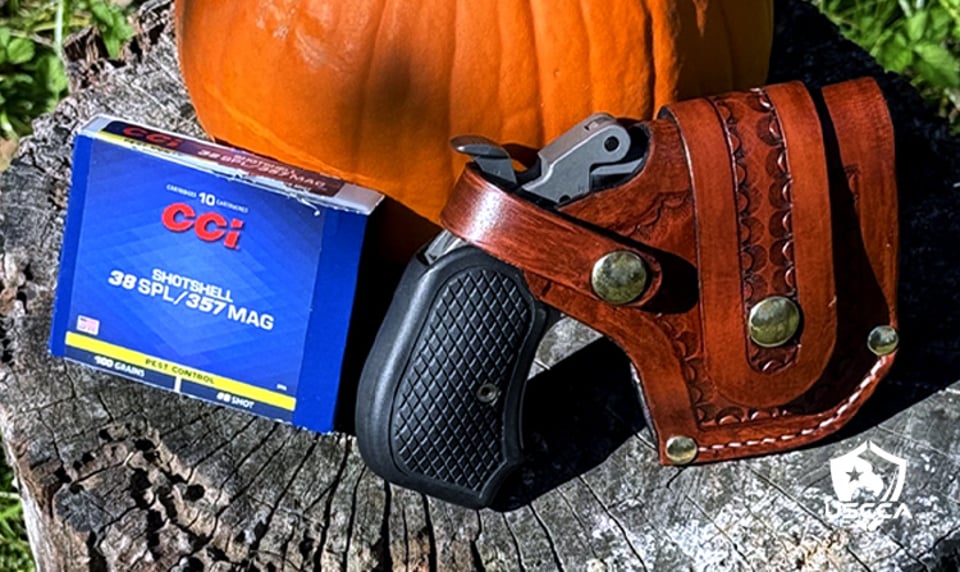
Because garden guns were originally intended for pest control, I wanted an appropriate loading for pests as the first shot. I chose CCI’s .38 Special/.357 Magnum shotshells ammunition.
The CCI shotshell uses an aluminum case and a translucent blue shot capsule containing 100 grains of No. 9 lead birdshot. The manufacturer lists a muzzle velocity of 1,050 feet per second.
For comparison, CCI’s .22 LR pest-control shotshell uses 31 grains of smaller No. 12 birdshot with a listed muzzle velocity of 1,000 feet per second. That’s a substantial difference in effectiveness.
I decided to load a standard velocity .38 Special round in the lower barrel in case the target is unaffected by the first shot.
Testing CCI .38 Special Shotshells
I had never fired CCI’s .38 Special shotshell ammunition at an inanimate target to see what sort of results it would produce. On a beautiful fall afternoon, I decided to conduct a backyard test using a small pumpkin purchased at the store — not one from our garden.
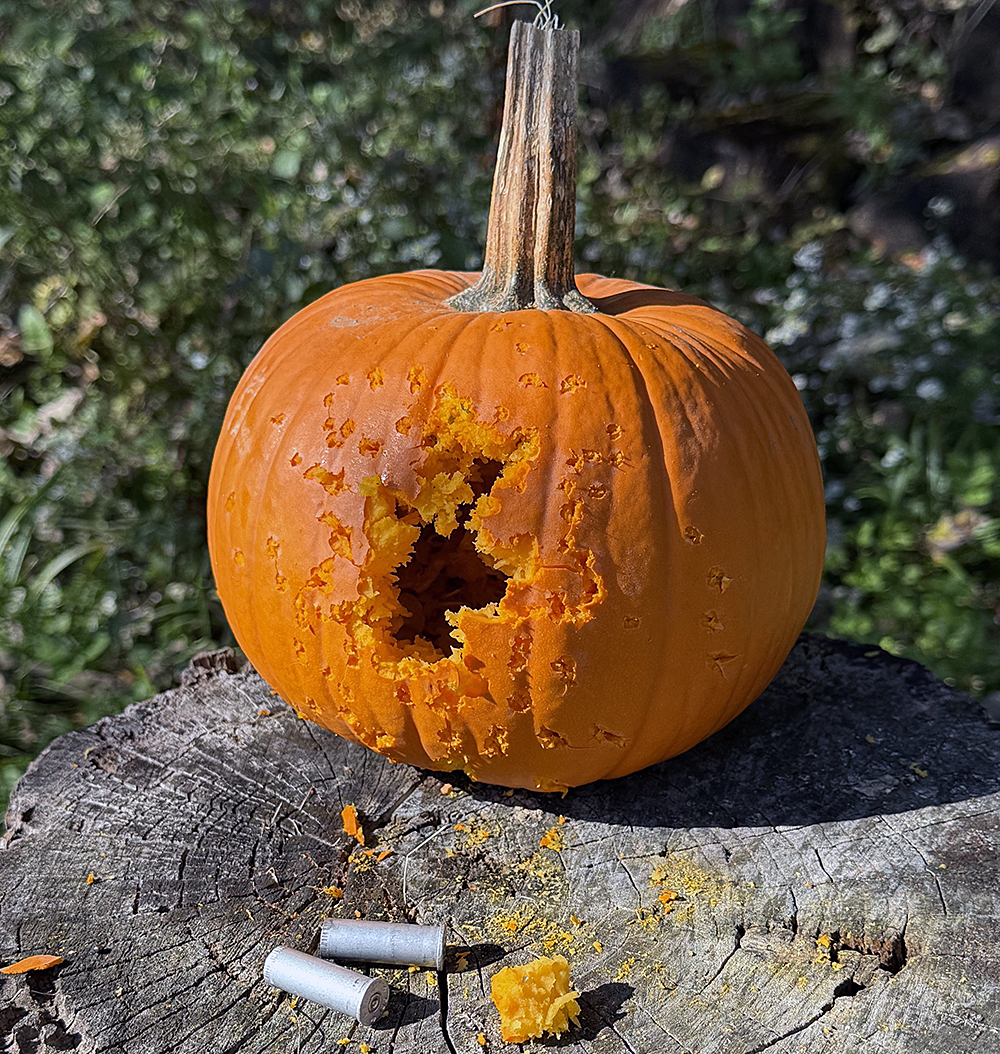
I set the pumpkin on a stump and moved back about 5 feet.
The first round struck the center of the pumpkin, leaving a central opening surrounded by multiple small pellet holes.
I fired a second round, which struck near the original opening and produced a much larger hole, giving a clear view of the pumpkin’s interior.
I was impressed by the visible effect of the ammunition at such a short distance and have no doubt a single shot at small varmints would do the trick. It’s also possible a single round could act as a good deterrent if needed in self-defense.
Are Garden Guns Still Practical Today?
While the modern garden gun may look different from the inexpensive single-shot shotgun or .22 rifle that once sat near the back door of a farmhouse, a yard gun still makes sense today.
For my own yard work, I really do like the Bond Arms Honey-B. It’s compact, concealable and easy for me to carry in the beautiful crossdraw holster a buddy made for it. I find the arrangement comfortable and accessible whether I’m on or off the tractor.
Of course, a good revolver or semi-automatic pistol can also be carried concealed under an outer shirt or jacket while doing property work. The important thing is choosing a firearm and carry method appropriate to your circumstances
Sources:
Bond Arms: BondArms.com
CCI Ammunition: CCI-Ammunition.com
Rossi: RossiUSA.com
Savage Arms: SavageFirearms.com