Springfield Armory introduced the Prodigy pistol as an enhanced, modern 1911, sometimes referred to as a 2011. The full-sized Prodigy DS (double stack) was the first model, featuring a grip frame engineered to accommodate a high-capacity 9mm magazine that could hold 17 rounds. (Extended 20- or 26-round magazines are also available.)
Upgrades made to the standard 1911 platform centered around shooter usability and accuracy. Though originally promoted for law enforcement tactical teams, the Prodigy was available commercially and sold well enough for Springfield to expand the line since its inception in 2022 to now 16 available 9mm variations.
Attending the Hillsdale College USPSA Collegiate Action Pistol Championship in Michigan this year, I observed how popular the Prodigy has become. Many members of the Hillsdale team, sponsored by Springfield Armory, had switched from their donated Echelon pistols, which had won them the national championships in 2024, to the Springfield Prodigy for the 2025 competition.
Everyone I spoke with about the change seemed pleased with the pistol. The team is composed of male and female competitors, and even the smaller-framed shooters handled the Prodigy without difficulty. It was particularly gratifying to see them competing — and winning — with a design rooted in the 115-year-old 1911 platform, albeit one that has been modernized significantly.
The DS Prodigy Compact AOS Series: Compact Size Without Compromise
Springfield Armory now offers two Compact DS Prodigy pistols: the 1911 DS Prodigy 4.25-inch AOS 9mm and the smaller 3.5-inch AOS Compact, which is the subject of this review.
Springfield describes the 3.5-inch Compact AOS as a carry-focused version of the modern 2011-style pistol. The controls and operating system are the same as the full-sized Prodigy models while reducing the overall size to make concealed carry easier.
With nearly identical controls, aside from the beavertail grip safety, shooters used to the full-sized Prodigy DS for competition or duty work can transition easily to a Compact model.
Springfield 1911 DS Prodigy Compact Specs
| Springfield Armory 1911 DS Prodigy 3.5” Compact AOS 9mm
|
Springfield Armory 1911 DS Prodigy 4.25” Compact AOS 9mm
|
|
| Caliber | 9mm | 9mm |
| Barrel | 3.5 inches Forged stainless steel Match grade, bull, 1:16 twist |
4.25 inches Forged stainless steel Match grade, bull, 1:16 twist |
| Overall length | 7 inches | 7.8 inches |
| Weight | 25.5 ounces | 29 ounces |
| Height | 5.1 inches | 5.1 inches |
| Magazines | Two 15-round magazines included | Two 15-round magazines included |
| Slide | Forged carbon steel Optics-ready |
Forged carbon steel Optics-ready Integral compensator |
| Recoil system | Captured guide rod | Two-piece full-length guide rod |
| Sights | Tritium front Black serrated rear |
Tritium front Black serrated rear |
| Trigger pull weight (author measured) | 4 pounds, 12.8 ounces | Not tested |
| MSRP | $1,582 | $1,582 |
How Does the Prodigy 3.5 Feel in Hand?
Right out of the box, the Prodigy Compact 3.5 had a solid, “big pistol” feel despite weighing only 25.5 ounces.
I began seeing some of the first commercially available compact double-stack 1911 handguns back in the 1980s. I never had the opportunity to fire one, but the examples I handled felt cumbersome. That’s not unexpected as the original 191 design was never intended to hold double-stack magazines. I am quite happy to report that the Springfield Armory DS Prodigy 3.5-inch AOS does not have the awkward feel earlier attempts at a cut-down 1911 had.
The Prodigy fits my hand like a glove, which immediately suggests comfortable shooting. The 4.25-inch Prodigy has the same grip frame dimensions, so the overall feel in the hand should be nearly identical aside from the extra weight of the longer slide.
Weighing 25.5 ounces, the Compact Prodigy 3.5 is more easily managed for all-day concealed carry than the full-sized Prodigy at 33 ounces. If I were younger, the weight of the full-size pistol might not bother me during long days of carry, though I’d still want a sturdy belt to support it.
Features That Make the Prodigy 3.5 a Strong Concealed Carry Pistol
Like all models in the Prodigy lineup, the DS Prodigy 3.5 AOS is chambered in 9mm Luger. Flush-fit double-stack magazines hold 15 rounds, while full-size Prodigy models are equipped with 17-round magazines.
The Prodigy uses a compact polymer grip module mounted to the lightweight aluminum frame, keeping overall weight manageable but still providing the solid feel expected from a 1911 handgun.
The grip module is subtly flared to assist in easy reloading but not so much as to print under clothing or make the grip uncomfortable for shooters with smaller hands.
The beavertail safety is shorter and recontoured to reduce printing, and the hammer is flatter than the ones used on the larger versions of the Prodigy. There was still plenty of protection for my hand from the hammer during firing, though.
The polymer grips are very finely stippled, providing a comfortable yet sure shooting grip even with wet hands. It is also fine enough that loose clothing is not going to adhere to it and cause printing.
The DS 1911’s Trigger, Safeties and Operating Controls
The Prodigy 3.5 is equipped with dual extended thumb safeties for ambidextrous operation. The magazine release is standard for a 1911 in size and its left-side location.
The trigger guard is squared, with a small section of stippling for shooters who like to rest their support-hand finger there. The guard is also undercut to accommodate the middle finger of the pistol gripping hand to help additionally enhance the feel.
The trigger itself is excellent. I measured a pull weight of 4 pounds, 12.8 ounces on my Wheeler trigger gauge. The break is crisp with little slack, and the trigger appears to be adjustable, though I wouldn’t change a thing. It is as good as any that I have seen on high-end or even custom 1911s.
The slide release is a standard 1911 design. With the slightly wider grips, I found it difficult to reach with my shooting-hand thumb. I use the lever in the traditional sense for faster reloads, but an extended slide release is also an option. Those with younger or larger hands likely won’t have difficulty with the larger grip circumference that comes with having a higher magazine capacity.
The slide features cocking serrations at both the front and rear, using the wider style commonly found on modern 1911 variants.
Sights and Optics on the Prodigy Compact
The DS Prodigy 3.5 ships already equipped with highly visible iron sights. The front sight features a tritium insert with a white outline, while the rear sight is serrated to reduce glare and uses a squared notch. Springfield also includes a replaceable rear sight with a U-notch, which some shooters prefer for faster sight acquisition.
The sights are adequate for a defensive pistol, but for shooters who prefer modern optics, the Prodigy’s Agency Optic System (AOS) makes adding a red-dot simple.
My sample arrived with a Vortex Defender ST Micro Red Dot already installed. This compact 3-MOA sight has a small footprint and features motion activation with a 10-minute shutoff. Vortext includes its “Fast-Rack” textured grip surface on the front of the sight to protect the slide if racked against a hard surface.
Shooting the Springfield Prodigy Compact at the Range
After watching the Hillsdale College Collegiate Action Pistol team perform so well with the full-sized Prodigy pistols, I expected good things from this compact concealed carry version. I was not disappointed.
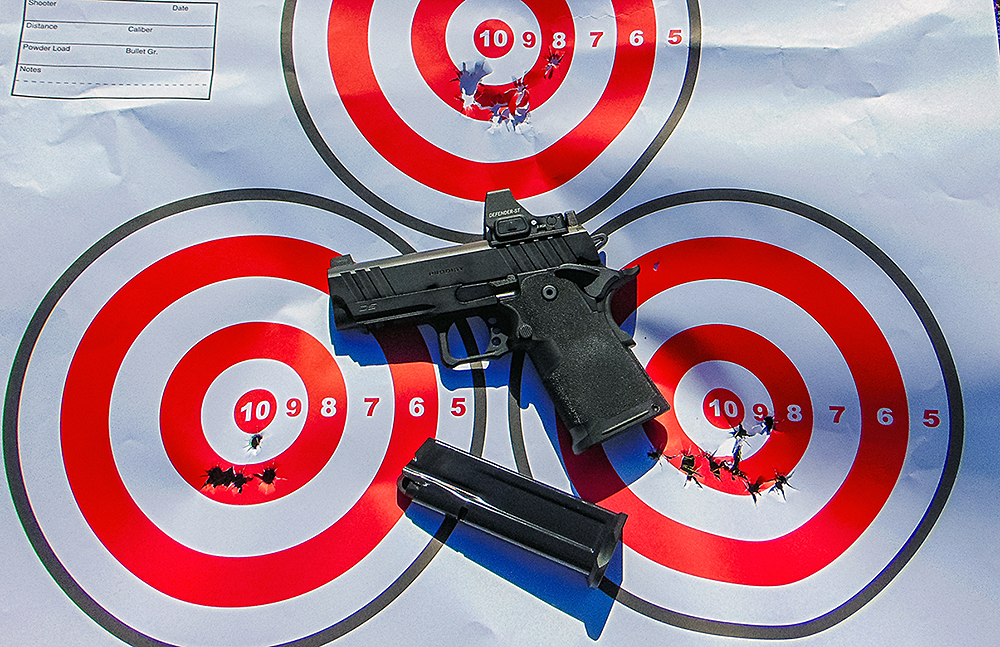
Because my outdoor range was practically underwater again, I headed to a local indoor range to test the Prodigy 3.5. I brought two types of ammunition: Remington Range 115-grain FMJ practice ammunition rated at 1,145 feet per second and Liberty Ammunition Ultralight 50-grain +P hollow-points with a listed velocity of 2,040 feet per second.
Using a Baker Targets multi-bullseye target, I set the distance to 21 feet. The bright orange and white bullseyes were easy to see even in the dim lighting conditions of the indoor range. I loaded 10 rounds of Remington first.
My first group, fired at the center bullseye, measured 2 ¼ inches, with all shots landing slightly low. If this were my personal pistol, I would have made a small upward sight adjustment.
The second 10-round group with the Remington ammo was also centered but slightly low, measuring 2 ¾ inches.
Lastly, I fired five rounds of the Liberty Ammunition Ultralight, again from 21 feet. Those rounds produced another centered but low 1-inch group. With the Liberty load traveling at nearly twice the velocity of the Remington, that result was a little surprising.
Recoil was not noticeable, and the Prodigy remained stable and easy to control. It responded gently in the hand during firing, making it easy to focus on accuracy. It should be easily handled by nearly any adult. As expected, there were no malfunctions. My total round count was somewhat lower than usual due to current ammunition supply concerns.
Is the Prodigy 3.5 a Good Concealed Carry Pistol?
The Springfield 1911 DS Prodigy 3.5 is a solid pistol that’s as close to perfectly balanced as any defensive pistol I’ve handled. This compact handgun sits firmly in the hand. It is easy to co-witness the front sight and red dot, making it a great defensive pistol option.
Although an ounce or two heavier than the similarly sized Glock 19, the Prodigy 3.5 has entirely different feel and accuracy. Its aluminum frame with polymer grips gives it a more solid feel without adding too much weight.
The Prodigy Compact AOS pistol is a better option for concealed carry than the full-sized Springfield Prodigy. I would opt for the 3.5-inch over the 4.25-inch as it’s easier to conceal and carry all day.
Galco offers a holster to fit the 4.25-inch Prodigy, and Springfield has a page of holster options on its site to fit the 3.5 variant.
At $1,582, the Prodigy 3.5 costs more than many polymer-framed competitors, but the added price reflects Springfield Armory’s careful assembly, solid construction and refined performance — qualities that would make it a top choice for anyone seeking a compact, double-stack 1911 for everyday carry.
Sources
Springfield-Armory: Springfield-Armory.com
Galco: GalcoHolsters.com
Remington: Remington.com
Liberty Ammunition: LibertyAmmo.com
Vortex Optics: VortexOptics.com