The double-barrel side-by-side shotgun is the most legendary designs produced, remaining highly recognizable through today. Originally, it gained popularity as a fowling piece because its second barrel allowed hunters to take a quick follow-up shot at fleeing game.
The Side-by-Side Shotgun: Its History and Why It Still Matters
Early versions, like the flintlock double-barrel shotguns, also saw use in more dangerous environments. British explorer Captain James Cook reportedly carried one during expeditions to remote islands, relying on its simple function and immediate second shot.
On American soil, the flintlock double-barrel shotgun is most well known for its use during the Battle of the Alamo in 1836. It continued to prove its usefulness across the frontier, becoming the primary choice for farmers, homesteaders and lawmen, especially once the shotgun shell was invented.
The side-by-side shotgun was affordable, simple to operate and effective for both defense and hunting, plus ammo was plentiful and powerful enough to provide defense as well as put meat in the pot.
Double-barrel shotguns remained popular through the 20th century and were often passed down through generations. Their simple design with fewer moving parts than newer pump-action shotguns meant a long service life when properly maintained. Over time, manufacturers expanded offerings beyond 12-gauge to include 20-gauge, .410, 16- and 28-gauge options, mostly aimed at the sporting market.
Many American manufacturers eventually moved away from producing double-barrel shotguns due to the complexity and cost of producing them. However, demand didn’t disappear, likely due to Cowboy Action Shooting. Today, companies import well-made model from countries like Turkey, renowned for producing quality firearms.
Stoeger Double Defense Double-Barrel Shotgun for Home Defense
Stoeger is one such company importing side-by-side shotguns for home defense as well as sporting use. Their lineup includes traditional models for sport like the walnut-stocked Uplander Field series and defensive configurations with synthetic stocks like the Double Defense series, available in both over/under and side-by-side formats.
I chose to review the Stoeger Double Defense side-by-side 20-gauge shotgun as I’ve always felt a short-barreled side-by-side has a uniquely intimidating presence compared to an over/under. With the barrels aligned horizontally, it creates a threatening impression that can be hard to ignore. In some cases, that alone is enough to stop a confrontation before having to fire a shot.
I opted for the 20-gauge model. These days, I’m less interested in heavy recoil than I once was, and the 20-gauge shotgun for home defense offers a solid balance of power and control. While the 12-gauge remains the standard for maximum power, the 20-gauge still delivers effective performance in defensive situations. For wilderness defense, I’d still choose the 12-gauge because the recoil from a larger shotgun shell is far less painful than having a limb gnawed off by a bear.
When comparing similar buckshot loads with pellets close in size, there is not as large a difference in power between 20-gauge and 12-gauge as many would assume. While there is some power loss, there is also a reduction in recoil.
20-Gauge vs. 12-Gauge for Home Defense
| Remington Express Buckshot Comparison | 20-Gauge | 12-Gauge |
| Shot size | #3 Buck | #4 Buck |
| Shotshell length | 2 ¾ inches | 2 ¾ inches |
| Muzzle Velocity | 1,220 feet per second | 1,325 feet per second |
| Shot type | Lead | Lead |
| Payload pellets | 20 | 27 |
| Usage | Big game or self-defense | Big game or self-defense |
Stoeger Double Defense Specifications and Features
Gauge: 20-gauge 3-inch chamber/12-gauge chambering also available
Barrel length: 20-inch, ported for recoil control
Overall length: 36.5 inches
Length of pull: 14.5 inches
Weight: 7 pounds
Chokes: Fixed-improved cylinder
Sight: Green fiber optic front
Accessory rail: Picatinny rail mounted under barrels for flashlight/laser
Ejection: Extraction only; no ejectors
Trigger type: Single trigger
Safety type: Tang safety/automatic operation on opening
MSRP: $649
The Stoeger Double Defense has a 3-inch chamber, allowing users to go up to 3-inch shells as well. With 3-inch shells, the 20 gauge can approach the performance of standard 12 gauge loads, making it a practical option
The Stoeger Double Defense shotgun in both iterations is specifically designed for close-range self-defense use rather than sport. While it could serve in tactical shooting competitions, its primary role is as a compact, straightforward home-defense shotgun.
From a design standpoint, it reflects that purpose. The short overall length and defensive-oriented features make it well-suited for confined environments where quick handling and simplicity matter most.
The Stoeger Double Defense features a blued receiver and barrels that provide a durable, low-glare finish suited for defensive use. The shotgun is fitted with a black synthetic stock, paired with a rubber recoil pad to help manage felt recoil during firing. Its standard stock configuration offers a comfortable, straightforward shooting position, consistent with the shotgun’s focus on simplicity and practical handling in close-range situations.
Controls and Operation
The Stoeger Double-Defense is a solid side-by-side shotgun. Though its short length of 36.5 inches may imply light weight and swift handling, it feels substantial (even at only 7 pounds) and capable of a lifetime of shooting and handling right out of the box.
This double-barrel shotgun comes with a stable Picatinny rail factory-installed atop both barrels at the chamber for optic mounting and another longer lower rail from the muzzles to the forend for mounting a flashlight or laser-light combo. Having these pre-installed saved setup time before I got to testing the shotgun.
The barrel latch opens by pushing it laterally to the right. Out of the box, the Double Defense felt a bit stiff, so I oiled the action before heading to the range. There were no problems loading and unloading.
The shotgun uses a single trigger for firing the barrels, with no selector. The right barrel fires first. My Wheeler Trigger Gauge measured the trigger pull weight as a crisp 6 pounds, 8 ounces.
The tang-mounted safety, common for most double-barrel shotguns, is automatic. It functions each time the action is opened. To fire, you must slide the safety forward toward the muzzle, but you don’t need to work the safety to fire the second shot. Both rounds, if loaded, can be fired rapidly once the safety is off.
This is an easily learned habit with repetition. However, there is no indication as to when the safety is on. If I owned this model, I would add a spot of red paint at the fire position on the tang.
Loading and Extraction
The Double Defense shotgun uses an extractor system rather than an ejector system, which prevents empty rounds from flying around. An extractor system is ideal for sporting clays shotguns. Opening the action lifts the shells out of their chambers just enough to pluck them out. This design simplifies operation and keeps shells contained, though it does require shooters to remove them by hand before reloading.
For defensive use, it would be better to have the empties fly free, allowing the shooter’s off-hand to reach for live rounds. Then again, two rounds of 20-gauge buckshot or game shot should be all you need in a close-range situation.
The green fiber optic front sight in the middle of the barrels is easier to pick up in your field of view than a brass bead sight and should serve very well without additional optics.
Range Performance: #6 Shot vs. #3 Buckshot
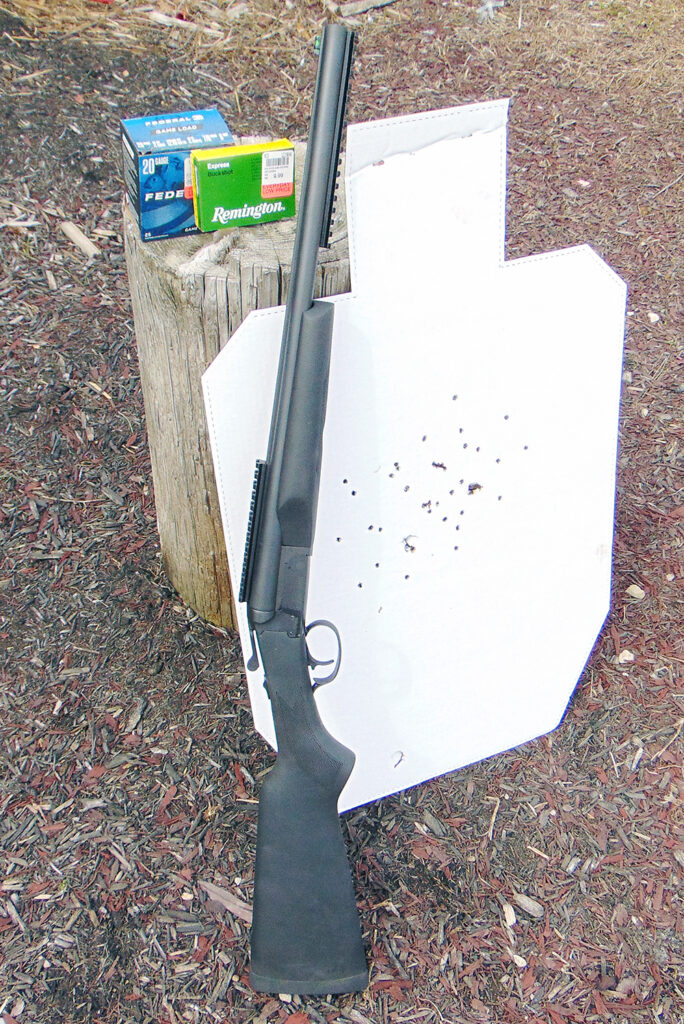
Since the Stoeger Double Defense is designed as a home-defense shotgun, I chose to test it with two 2 ¾-inch loads that reflect realistic indoor use. The first was Federal Game Load with 7/8 ounce of #6 shot at 1,210 feet per second. The second was Remington Express #3 buckshot, weighing just over an ounce and carrying 20 pellets at 1,220 feet per second.
I would choose #6 shot load for home defense where overpenetration is a concern, such as homes with nearby neighbors. The #3 buckshot serves better for exterior defense when your target is farther away or requires greater stopping power.
I set up a cardboard competition silhouette at 20 feet and loaded two rounds of the Federal #6. Shouldering the Stoeger 20-gauge, I noticed the fiber optic front sight was easy to pick up on that sunny day. The green dot stood out well above the blue-black barrel.
Firing the first shot, there was moderate recoil, but the compensator ports (the rows of small holes atop each barrel) performed as intended, reducing muzzle rise. The shot hit nearly dead-center, leaving a tight, mostly round pattern.
Squeezing the excellent trigger again, the second shot hit the same area, with most of the pellets hitting the center. Both rounds produced a 10-inch by 8-inch impact circle. Though #6 shot isn’t buckshot, it would certainly do a lot of damage at close range.
I tested the Remington #3 Buckshot next, again from 20 feet. The extra 105 feet per second of velocity were noticeable but not painful. The impact measure around 8.5 inches by 9.5 inches, with significantly larger holes. Dispersion was good. If the #3 buckshot can work safely for your situation, it certainly offers deeper penetration.
Is the Stoeger Double Defense 20-Gauge Shotgun Right for You?
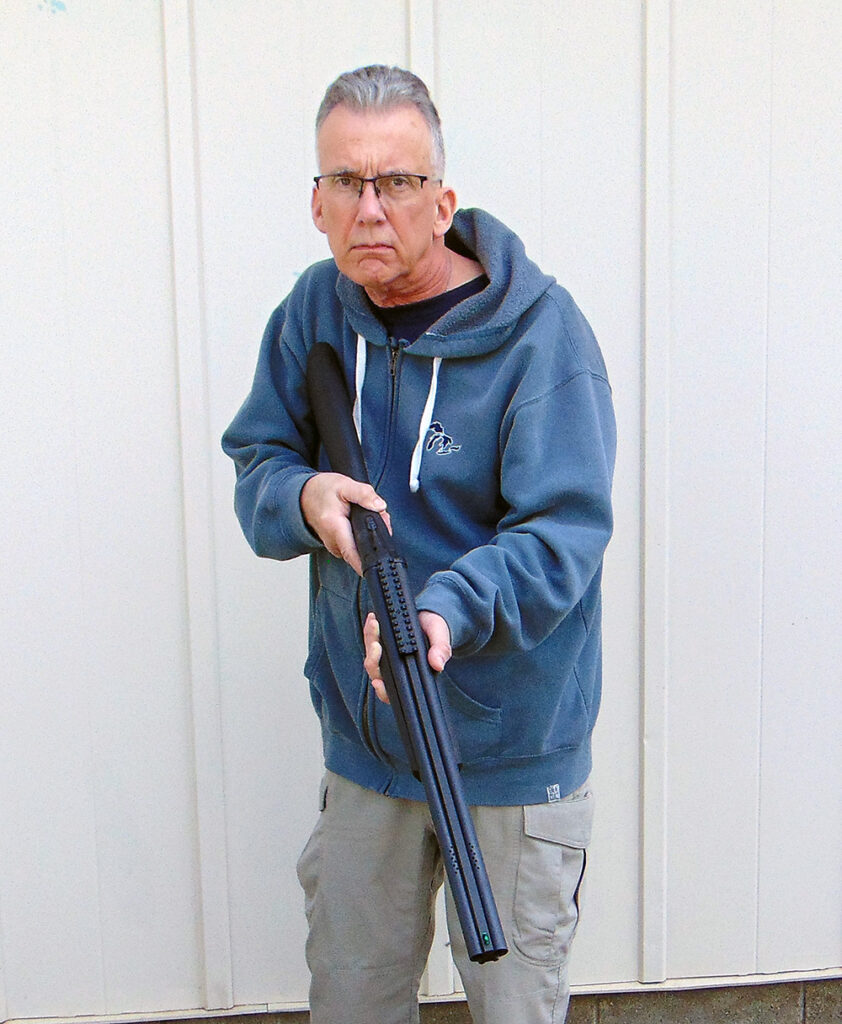
The Stoeger Double Defense 20-gauge side-by-side shotgun delivers a reliable approach to close-range protection, bringing the simplicity of a traditional double-barrel shotgun up to 21st-century standards like integrated Picatinny rails and a fiber optic front sight.
In practical terms, this side-by-side shotgun for home defense is built around immediacy. Two rounds are available instantly, and in most close-range defensive encounters, that may be all that is needed. The compact size and balanced handling make it well-suited for confined spaces where maneuverability matters.
The shotgun performed consistently with both #3 and #6 shot loads, and recoil was moderate and manageable. This a practical choice for shooters who want control without giving up effectiveness. For those who want maximum power, the 12-gauge version remains an option.
The quality and effectiveness, with its reasonable price point, make the Stoeger Double Defense a solid, purpose-built defensive shotgun with classic roots and modern capability that can again be passed down for generations.
Sources:
Stoeger: StoegerIndustries.com
Remington: Remington.com
Federal: FederalPremium.com