I’ve been evaluating and writing about firearms for civilian and law enforcement use since the early 1990s. In that time, I’ve handled and fired more handguns, rifles and shotguns than I can count. But there have been very few that have made me think, “Don’t change a blessed thing about this gun.” Testing the Smith & Wesson 432 UC in .32 H&R Magnum reminded me how rare that reaction is because, aside from possibly adding a supplemental sighting device, there is nothing about the 432 UC I would change.
The .32 H&R Magnum Cartridge
For those who are newer to shooting, the “H&R” in .32 H&R Magnum stands for Harrington & Richardson, an American firearms manufacturer that originally operating from 1871 to 1986. H&R was known for building inexpensive and reliable revolvers and shingle-shot long guns, often used for home defense, pest control and putting food on the table.
H&R didn’t introduce anything new to the firearms market until 1984 with the .32 H&R Magnum cartridge and the revolver that fired it. I believe that if H&R had possessed greater financial reach at the time, this cartridge would enjoy a much larger following today.
I first fired a .32 H&R Magnum around 1985 after helping a friend purchase and H&R revolver for self-defense at her home and business. When the salesman explained its ballistics put it in the same power range as a standard 158-grain .38 Special, I was interested. Even better, the smaller diameter allowed one extra round in the cylinder, turning a five-shot revolver into a six-shot of the same overall size.
At the range with my friend, my expectations were confirmed. There was a good amount of power as the bullet went downrange, but with less recoil that the .38 Special. My friend was completely comfortable shooting it, and the revolver — while inexpensive — was built like a tank. As far as I know, she still owns that gun today.
Opportunity Arises
I didn’t get a chance to write about the .32 cartridge at the time, between a full-time law enforcement career and part-time college teaching. Fortunately, Smith & Wesson chambered several J-frame snubnose revolvers for .32 H&R Magnum, giving me the opportunity to explore this cartridge further.
I purchased a concealed hammer S&W .32 H&R J-frame revolver for off-duty and backup use in the 1990s through 2000s. Though lightweight, pocket-friendly and offering an additional round, I eventually traded it for the latest combat-style handgun of the time. I’ve regretted that decision more than once.
About the Smith & Wesson 432 UC J-Frame Revolver
Smith & Wesson created the 432 UC in conjunction with Lipsey’s, one of the largest independently owned shooting sports distributors in the country. Its introduction is a long overdue acknowledgment of what the .32 H&R Magnum does well.
The 432 UC follows the standard J-frame revolver pattern: compact, lightweight and easy to conceal. It has a nominal 2-inch barrel and weighs just over 16 ounces. The overall finish is matte black. From the outside, it is hard to distinguish it from a .38 Special version of the same gun.
The grips on my 432 are VZ Blk Cherry G10 synthetic, though the appearance of the deep cherry can easily be mistaken for natural wood. While I don’t prefer G10 grips for their appearance, these were effective in controlling the limited recoil of the .32 Magnum
The grip design, with thumb rests at the top on both sides and finger grooves for the middle and ring fingers, provides a comfortable yet solid surface for either hand.
Trigger pull is smooth, whether the gun is held with one hand or two. I measured it at approximately 9.82 pounds. The smooth trigger pull, together with the superb grips, work to hold the vivid sights on target throughout the length of the pull.
S&W 432 UC Specifications
Caliber: .32 H&R Magnum
Capacity: 6
Weight: 16.3 ounces
Barrel length: 1.88 inches
Overall length: 6.32 inches
Width: 1.3 inches
Height: 4.3 inches
Frame: Aluminum
Barrel: Stainless steel
Additional refinements include titanium pins and an enhanced trigger. Chamfered charge holes and beveled cylinder edges help speed reloads and improve overall handling.
Why .32 H&R Magnum Still Makes Sense
The problem with the .32 H&R Magnum has never been performance. It’s always been perception. Shooters tend to equate larger caliber with greater effectiveness.
When the .32 H&R Magnum came out, it was touted as delivering the same amount of power on target as its larger rival, the .38 Special. It was accurate and relatively easy to control even in its increased pressure loading (+P).
Just as the .357 Magnum is a lengthened .38 Special with more powder, the .32 H&R Magnum is simply a lengthened .32 S&W Long with increased performance.
.38 Special vs. .32 H&R Magnum
| .38 Special | .32 H&R Magnum | |
| Bullet weight/style | 158-grain RNL | 95-grain lead SWC |
| Muzzle velocity | 770 feet per second | 980 feet per second |
| Muzzle energy | 208 foot-pounds | 203 foot-pounds |
The .32 H&R delivers energy comparable to the .38 Special, with the added advantage of fitting six rounds in a cylinder instead of five. That’s a meaningful advantage in a defensive revolver. The .32 H&R produces less recoil, faster recovery and better controllability.
Shooting the Smith & Wesson 432 at the Range
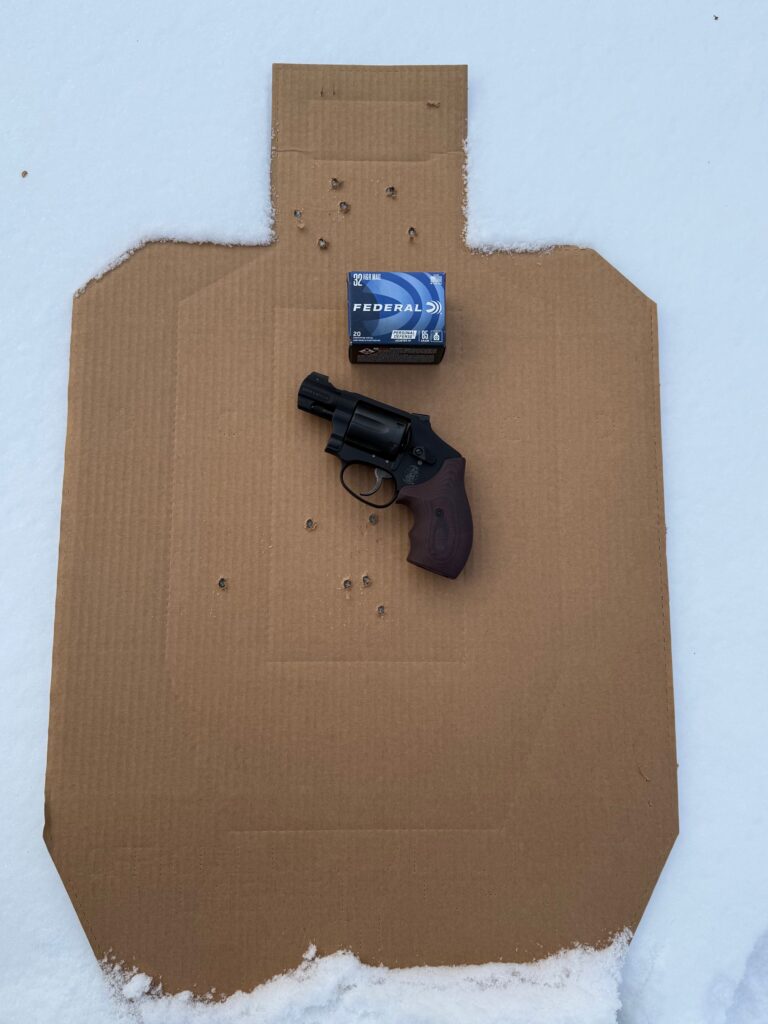 If anything can rebuild the popularity of the .32 H&R Magnum as an excellent self-defense cartridge (certainly better than the .22 Magnum) it should be the S&W 432 UC.
The XS Sights on the Model 432 are fixed. The rear sight is ramped and consists of a separate U-shaped notch screwed to the top strap rather than a grooved trough. The front XS Night Sight has a tritium central dot surrounded by a green ring that glows in sunlight or another bright light source.
Both front and rear sit more prominently that the traditional S&W ramped sights. It’s easy and natural to drop the front sight into the rear notch. This superb setup should be a snap for experienced or even new shooters.
The S&W 432 UC features an enclosed internal hammer, making this a true double-action-only revolver. An enclosed hammer prevents dust and grime from entering the frame.
Performance Results
I brought Federal’s 85-grain Personal Defense JHP ammunition, a slightly hotter load than the 95-grain SWC above. It has a muzzle velocity of 1,120 feet per second, resulting in 237 foot-pounds of energy.
I shot the first six rounds from 25 feet at a plain white cardboard silhouette target. The pop was forceful but pleasant, reminding me why I like the .32 H&R Magnum cartridge. The first shot landed dead center, and, aside from my second-shot flyer, the whole group measured 3.5 inches.
I fired the next six rounds from 25 feet again, aiming for the center of the head. All six rounds were well-centered around the nose and mouth, for a 4-inch group.
For my last six rounds, I backed up to 30 feet and sighted in on a steel silhouette. Firing as fast as I could, it was easy to keep the sights centered and have all six rounds hit with a satisfying clang.
A Revolver I Wouldn’t Change
In my opinion, the Smith & Wesson 432 UC .32 H&R Magnum is the finest double-action defensive revolver on the market today. It’s easy to carry and quick to sight and get on target.
Ammo for the .32 H&R Magnum is easy to come by on the internet, and shooters could also use the more sedate but once popular .32 S&W Long loads. There are also plenty of speedloaders and holsters available for this six-shot S&W. Though this gun doesn’t need anything, I believe any defensive handgun could benefit from a set of Crimson Trace laser grips.
For those willing to look past caliber bias and focus on practical performance, the 432 UC deserves serious consideration. Sometimes progress doesn’t mean inventing something new. Sometimes it means revisiting a good idea and getting it right.
Sources:
Smith & Wesson: Smith-Wesson.com
Lipsey’s: Lipseys.com
Federal: FederalPremium.com
XS Sights: XSSights.com