“Buy the best gun you can afford” is solid advice — within reason. When it came to my first everyday carry pistol, the problem was that I couldn’t afford very much.
What I Needed in a Concealed Carry Pistol
I was fresh out of college, living in a rented mobile home and working sales in the medical industry — and doing a poor job of it. If you’ve ever worked sales, you know pay is tied directly to performance.
Part of my sales territory stretched across northwest Indiana, just east of Chicago. The jokes about Gary’s violence existed for a reason, and nearby areas, such as East Chicago, Hammond and Hobart, weren’t much better. After walking out of a sales call one afternoon and witnessing a fight break out in the street, I decided I needed to take responsibility for my own protection.
I began looking at the reality of my situation and quickly realized that many of the available options weren’t going to work for me. What made it harder was the lack of a mentor to guide me through the selection process. My family members were hunters, not shooters. I had grown up with shotguns and .22 rifles.
Handguns were not my forte.
My daily attire consisted of slacks and a polo shirt, and I was constantly in and out of vehicles. Summers in Indiana were hot; winters brutally cold. While posted “no firearms” signs in Indiana do not carry the weight of law, I had no interest in printing or letting anyone know I was carrying.
I started visiting gun shops and talking to people about options, looking at what was within my budget (which wasn’t a lot).
I eventually decided that the easiest way for me to carry would be in my pocket. At the time, BlackBerrys were still common, and I figured I could pass my concealed gun off as just another cellphone.
Why I Bought the SCCY CPX-1
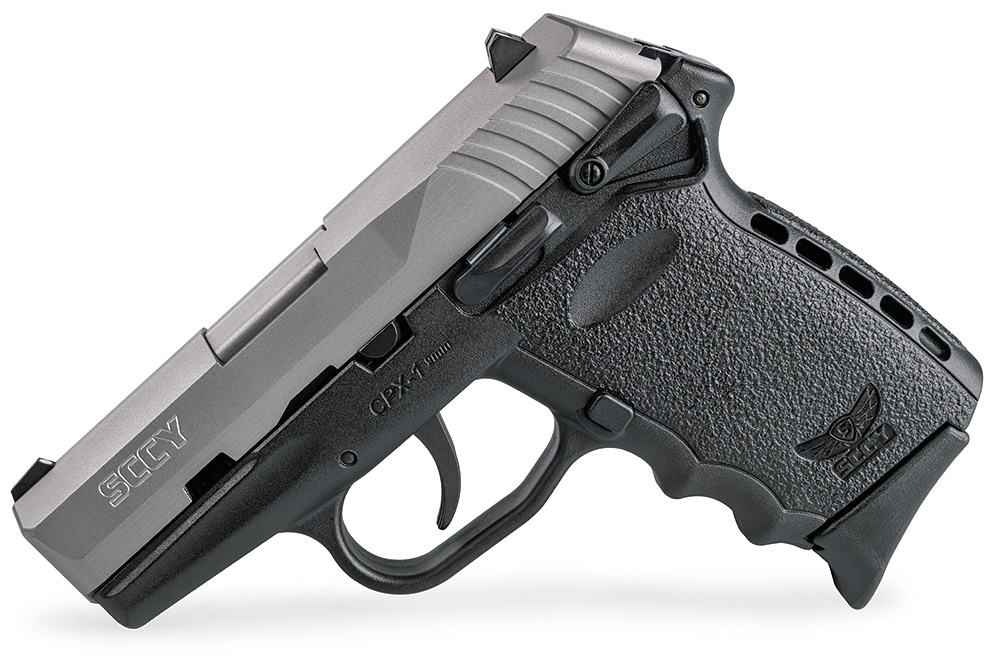
Eventually, the handgun that checked all of the boxes for me was the SCCY CPX-1. In fact, it checked several boxes pretty definitively.
For my first pistol, I leaned toward something that felt comfortable when I picked it up. That initial fit in the hand gave me a small but important measure of confidence at a time when I wasn’t feeling particularly comfortable.
Paired with a pocket holster and slipped into a pair of slacks, the pistol disappeared while I walked around. It was rare that I wasn’t on my feet with customers, so that was my focus. That level of concealability was very important to me.
Above all, though, it was a gun I could afford. I didn’t know the old adage at the time, but that day in northwest Indiana — watching a violent altercation erupt right in front of me — drove home the first rule of a gunfight: Have a gun.
Now I did. And the next step was learning how to shoot it.
Learning to Shoot a Budget 9mm
You really couldn’t call what I was doing in those early days “training.” I bought whatever full metal jacket ammo was on sale and took the shop owner’s advice to carry Hornady Critical Defense, and was told to run at least 200 rounds through the pistol before trusting it for carry, just to make sure it functioned. I also ran a box of my carry ammo through it to confirm it didn’t cause problems the training loads hadn’t revealed.
Being pretty good at turning what little money I had into noise, I’d print off paper targets and tape them to cardboard boxes at which to shoot. Luckily, I had space to shoot at home, which saved me range fees.
I didn’t realize it at the time, but that SCCY became a lesson in trigger management. Because the pistol was hammer-fired rather than striker-fired, the trigger pull was significant. Subcompact pistols have come a long way in the last decade, but in the early 2000s, the engineering hadn’t yet made them as shootable as today’s versions.
I missed more than my fair share of 8.5-by-11-inch sheets of paper at 10 yards while acclimating to that pistol. But after a couple hundred rounds and some research into why I was so awful, I reached a level of competence I considered satisfactory.
Looking back, that was an overly optimistic view of my skills.
Bias Against Budget Carry Guns
About the time I was getting comfortable with my purchase, a good friend began shopping for a carry gun of his own. I went with him to a few gun shops, partly to support him and partly to see if I could pick up anything of value.
As he was handling a few options, I spotted a couple of SCCY CPX-1s in the case and said something along the lines of, “I’ve been pretty happy with my SCCY so far. You could see how that fits you.”
Almost as soon as the words left my mouth, the guy working the counter chimed in with, “If that’s really all you think your life is worth, we can sell you one, but I wouldn’t advise it.”
His comment struck even me — a pistol neophyte — in a sour way.
First of all, that shop had the pistol in stock. If the people who work there don’t trust the gun enough to sell it to someone, they shouldn’t stock it. I’m lucky to have a couple of shops on which I can rely, but when I find myself in a new spot or shopping away from home, that kind of mixed message has become a major red flag.
That exchange was enough to put me off the store entirely. As I sit here writing this, I realize I haven’t been back in the years since. There are plenty of ways to sell something, but the way that employee handled himself that day wasn’t one I was ever going to support with my time, traffic or dollars.
Second, maybe that gun is all someone can afford. That should never be a point of shame, dismissal or mockery. Every legally eligible American who chooses to become responsibly armed deserves to do so without having some joker behind the gun counter make him or her feel “less than” because of his or her limited budget.
We live in the golden age of firearms. We’re incredibly lucky that the performance floor has risen so high but that guns remain affordable. And while it’s true that some guns don’t have the bells and whistles or the latest this or that, finding one that won’t run is rare. Might some require a little more care with ammo selection or a more rigorous maintenance routine? Sure. But a gun that simply refuses to function, despite what internet trolls and other brand fanboys might claim?
Sorry, I call shenanigans.
We are fortunate to live in an age in which competition, engineering and manufacturing processes have provided us with a wide variety of shapes, sizes and designs at such a variety of prices.
How the SCCY CPX-1 Held Up After 10 Years
That SCCY CPX-1 was my everyday carry pistol for about a decade before I had the funds and flexibility to justify an upgrade. Even though I wasn’t really training, I enjoyed shooting and wanted to get better. So even in those early years, I was putting rounds through that gun.
By my best estimate, I sent somewhere between 250 and 500 rounds per year through it over that decade. As I’ve added other guns and carry options, I don’t shoot it nearly as often. Still, I sometimes throw it in my Ex Umbris pack when I want to carry that way.
That gun still shoots. The only repair I’ve had to make was replacing a broken safety selector, which SCCY sent me without issue a few years ago. It’s worth noting that SCCY Industries ceased operations in early 2025, with its assets being auctioned off in June.
While I’ve added other options, the SCCY CPX-1 remains a viable answer to some carry questions. It may not be the best answer for all, but dismissing it outright is just as reckless as claiming it’s the one and only gun anyone needs.
That pistol has provided me with more than my fair share of peace of mind — certainly worth the $300-some investment I made nearly 20 years ago.
And isn’t that the point?
Dependability On a Budget
In the last issue of CCM (Page 72), I touched on how Sears, Roebuck & Co. once sold guns anyone on a budget could afford. They were basic but serviceable. Today, manufacturers such as Hi-Point Firearms and previously SCCY Firearms have filled the void left by Sears’ exit from the firearms market, offering Americans a true “working man’s gun.”
But for nearly a century, Sears — the brainchild of Richard W. Sears and Alvah C. Roebuck — was the go-to seller of budget firearms. In 1888, the partners published their first mail-order catalog, offering watches and jewelry. Over time, it grew to include almost anything imaginable, from ladies’ traveling or automobile coats to tombstones to entire model-home kits. Sears believed his company should embody four guiding principles: “a fixed price, a fair profit, a fine organization and the faith of the customer.”
Shotguns, rifles, revolvers and semi-automatic pistols were eventually added to the wide range of items Sears offered to rural Americans.
“Sears saves you money by planning one shotgun model with everything you want,” an ad in the Fall/Winter 1950 Sears catalog read. “Seven years ago, Sears set out to put all the features you liked best into one model shotgun. We knew what you wanted because we’d been selling guns for 50 years.”
The ad explained that Sears sold the J.C. Higgins Deluxe Model 20 at a low price because it focused on a single pump-action repeating shotgun, streamlining production and reducing costs, which in turn lowered the price for consumers. It sold the shotgun with a POWer-PAC choke control and a ventilated rib for $69.95 (or without the add-ons for just $59.95).
By 1988, Sears had ended the sale of firearms but had already put affordable guns into the hands of generations of Americans. No doubt, many people still have their fathers’ or grandfathers’ shotguns tucked away in a bedroom closet or a gun safe. Are these firearms highly desirable collectibles today? No. Most hang on to them for sentimental value, not collector’s value. But these guns were there when people needed protection and didn’t have the budgets for anything beyond the basic essentials to support their families.
As Marsh noted, any American who wishes to be responsibly armed deserves the opportunity to do so with a reliable gun that fits his or her budget. From the late 1800s until Sears ended its firearms sales, that likely meant a Sears offering or a comparable budget-friendly brand. For Marsh, that was a SCCY. For others, it might be a Hi-Point or another brand. As the old saying goes, “Any gun is better than no gun.”
— Frank Jastrzembski, Contributing Editor