If you’re in the market for a lever-action .357 rifle, there’s no shortage of options these days. I could be wrong, but there may be more centerfire lever-action rifles available today than at any point in the past 50 years. Not only that, but today purchasers can choose anything from traditional Old West designs to modern variants chambered in newer calibers. The lever-action platform continues to evolve while holding onto its roots.
Historically, lawmen and outlaws alike relied on lever-action rifles because their handling, capacity and cartridge power made them useful in a wide range of situations. That same appeal drives interest today. Now, manufacturers offer lever guns in everything from the classic cartridges to newer options like Remington .360 Buckhammer or even 5.56mm and .300 Blackout, fed from AR-style box magazines.
With the great variety available, it’s clear the lever-action rifle is here to stay, whether modern or classic in design. For shooters who appreciate traditional design, rifles based on the Winchester 1892 pattern continue to stand out. The Heritage 92 .357 lever-action rifle follows that lineage closely, combining classic styling with modern materials.
First Impressions
The Heritage 92 Stainless Steel is a full-length lever-action rifle, not a carbine, with a 24-inch octagonal barrel true to the original Winchester 1892 design. The only deviation is an update to the materials. The receiver, lever, trigger, barrel, magazine tube and buttplate are all constructed of stainless steel.
When I lifted this full-length lever-action rifle out of the box and shouldered it, I was reminded of just how tough the men and women of the frontier had to be to carry a rifle like the Winchester 92 for defense against both human and animal threats. The Heritage 92 Stainless Steel weighs 7.39 pounds unloaded. The rifle’s balance also differs from modern rifles like the AR-15 as most of the 92’s weight comes from the heay octagonal barrel.
For comparison, the 20-inch Model 92 in .357 Magnum weighs 6.18 pounds. That difference becomes noticeable over long distances, so I’d rather carry the 24-inch Model 92 in a saddle scabbard or vehicle than slung over my shoulder.
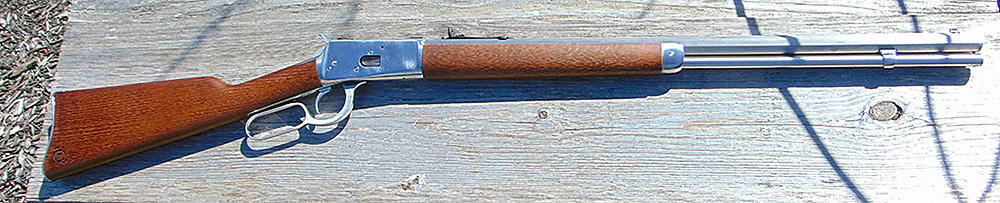
Heritage 92 Lever-Action Stainless Rifle Specifications
Caliber: .357 Magnum/.38 Special +P
Capacity: 12 rounds of .357
Front sight: Drift-adjustable brass bead
Rear sight: Ladder-adjustable buckhorn
Barrel length: 24 inches
Overall length: 42.8 inches
Overall width: 1.5 inches
Weight unloaded: 7.39 pounds
Frame material: Polished stainless steel
Barrel material: Stainless steel
Safety: Dial safety on bolt
Trigger pull weight: 4 pounds, 6.3 ounces
Stock and forend material: Walnut-finished smooth wood with Heritage branded on both sides of the buttstock
MSRP: $1,030.99
Heritage 92 Features, Safety and Operation
The buttstock, featuring a polished steel buttplate, is curved in the traditional period style. The hammer has an easy-to-reach spur that makes cocking or de-cocking easy. A half-cock notch provides the traditional lever-action manual safety, now supplemented by a modern dial safety mounted at the rear of the bolt.
The dial is unobtrusive and easy to operate. Turning it clockwise to the red dot allows the rifle to fire, while turning it away from the dot puts the rifle in the safe condition. Even with the dial safety engaged, the hammer can be put into the half-cock position. Compared to receiver-mounted crossbolt safeties on some lever-action rifles, this design is much less obvious and better aligned with the rifle’s traditional look.
Aside from the manual safety lever, the Heritage 92’s operation remains true to the original platform. It comes with a standard-size lever loop and loads through a right-side loading gate. While the traditional loading gate is not the quickest method, it is faster to fire than a single-shot or double-barrel firearm and can be easily topped off while maintaining target acquisition.
Unloading requires manually cycling rounds through the action. With the safety engaged and proper trigger finger discipline, this process is straightforward, though it may be unfamiliar to shooters accustomed to detachable magazine systems. Be sure to check the action and magazine loading gate before putting the rifle away.
The rifle features a traditional black buckhorn (so named because it looks somewhat like the head of a male deer with antlers) rear sight paired with a brass bead front sight. This setup has worked well throughout history and performed well on the bright, sunny range when I tested the rifle. There is no provision for optics, keeping the rifle consistent with its historical roots.
Range Results: Shooting the Lever-Action With .357 vs. .38
The weather finally cooperated, allowing me to test the Heritage 92 .357 lever-action rifle at my friend’s backyard range. It was a warm, sunny day, ideal for testing a new firearm. I brought my 11-year-old son, Owen, along too.
We tested two loads. The first was PPU .38 Special 158-grain round nose lead, a standard load used in law enforcement for many years, rated at 982 feet per second with 285 foot-pounds of energy. The second was SIG Sauer Elite Performance .357 Magnum 125-grain V-Crown, rated at 1450 feet per second and 583 foot-pounds of energy. These rounds represent a good range of what the .357 Heritage 92 is capable of handling.
I set up my first USPSA cardboard silhouette target at 30 feet, and my friend shot first from the offhand standing position. He sent five rounds of the PPU .38 Special downrange, producing a nice fist-sized group.
From his first shot, I noted how quiet the load was. The .38 Special out of the longer 24-inch barrel allowed a more complete burning of the powder, reducing noise.
He switched to five rounds of the SIG Sauer .357 Magnum. Though louder than the .38 Special, it was not nearly as loud as from a handgun. Point of impact remained consistent, with the .357 grouping landing in the same area as the .38.
Both loaded smoothly through the loading gate.
My son went next. At almost 12, I wasn’t sure how he would handle a rifle of this weight. After confirming the rifle was clear, I carefully handed it to him and stood ready to assist if needed. My worries proved to be unfounded.
He shouldered the rifle and took a steady aim at the paper silhouette target. I handed him five rounds of the .38 Special, and he loaded the 92 with ease. He sighted in on the cardboard target from 30 feet and produced a good group that overlapped with the previous shots. Owen asked to shoot at the steel silhouette, so we loaded the rifle with the .357. He clanged the center with all five rounds.
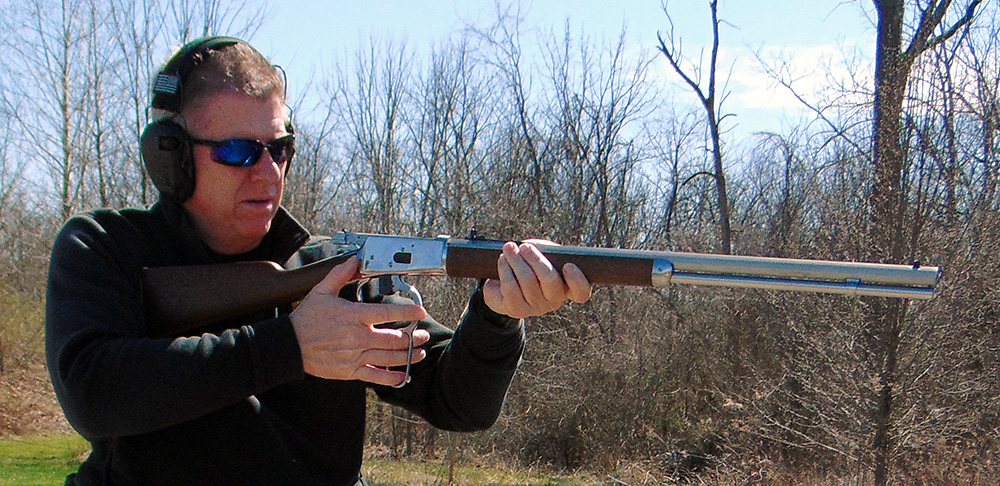
Shooting the Heritage 92
I went next, starting with the .38 Special, standing and aiming at a clean cardboard silhouette. The Heritage 92 Lever-Action is one of the smoothest shooting rifles I’ve handled. Recoil was non-existent, and there was no noticeable muzzle blast.
Stepping up to the .357 Magnum load, there was still no felt recoil and very little muzzle blast, despite the cartridge’s power. Both loads cycle reliably.
My mixed-ammo group measured 6 inches and was slightly left of center. I wasn’t focused strictly on marksmanship. The rifle demonstrated consistent performance and was fun to shoot. With a shooting bench, I have no doubt tighter groups are achievable. You could easily handle deer-sized game, though the bright stainless finish would need camouflage in the field.
Can Kids Handle Rifles?
Owen took a final turn on the steel silhouette using the .38 Special load, again producing five solid hits with no assistance required.
As some readers know, I started Owen at a young age with BB guns and .22 rifles, gradually working up to larger platforms. The Heritage 92 is the longest and heaviest rifle he has handled freehand, and he performed well. Owen is an example of how exposing shooting sports to young kids can help them safely progress to larger firearms, developing discipline and confidence.
Despite the rifle’s weight, Owen summed up shooting the Heritage 92 simply, saying he enjoyed shooting with both loads and that it was easy to handle with minimal recoil.
“I like lever-action rifles.”
Heritage 92 .357 Review: Final Thoughts
The Heritage 92 .357 lever-action rifle was a lot of fun to shoot and reliable, with no failures to feed or eject. It cycled both .38 Special and .357 Magnum ammunition smoothly, proving why defensive lever-action rifles were a trusted choice in the Old West era.
Though constructed with modern materials, the Heritage 92 maintains the look and handling of a traditional Winchester 1892-style rifle. Shooting it offers a sense of how these firearms earned their reputation and were once widely regarded as “America’s Rifle.”
For those interested in a Winchester 92-style centerfire lever-action rifle at a reasonable price point, the Heritage 92 stands out as a great option.
Sources:
Heritage: HeritageMFG.com
PPU Ammunition: PPU-USA.com
SIG Sauer: SIGSauer.com