According to the FBI, an estimated 661,800 burglaries occurred in the United States in 2025, with residential properties accounting for 53.4 percent of those offenses. Although burglaries have declined in recent years, protecting your home and the people inside it is still something worth taking seriously.
So, what’s the best gun for home defense? The short answer is the firearm you can handle safely, shoot accurately and use confidently under stress. Whether that’s a handgun, shotgun or rifle depends on your experience, training and home-defense needs.
Ideally, that means using a gun you regularly train with and know well. For many people, that’s their concealed carry gun. But what makes a handgun convenient for concealed carry — particularly its smaller size — doesn’t necessarily make it the best choice for defending your home.
Which Type of Gun Is Best for Home Defense?
Handguns, shotguns and rifles all have advantages and limitations. Handguns are compact and convenient, but they can be harder to shoot accurately. Long guns offer different handling characteristics and capabilities, though their size and other considerations may make them less practical in some homes.
| Firearm | Main Advantages | Main Trade-Offs |
|---|---|---|
| Handgun | Compact, familiarity for concealed carriers, can be operated with one hand | More challenging to shoot accurately, smaller projectiles |
| Shotgun | Multiple ammunition options, reliability of pump-action models | Length, limited capacity in many models, ammunition penetration must be considered |
| Rifle or Carbine | Shoulder-fired stability, typically greater capacity, optic compatibility | Legal and ammunition considerations |
The goal isn’t necessarily to find the biggest gun or the most powerful ammunition. It’s to choose a reliable firearm that fits your needs and that you can use effectively.
How to Choose a Home-Defense Gun
Of course, we cannot walk the streets of modern America with a large-caliber rifle like cowboys in the Old West. But when it comes to defending our homes, size and concealability don’t matter nearly as much.
There is a lot to consider in choosing the best firearm to protect your home. For comprehensive guidance, our detailed guide on how to choose a home-defense gun covers the key factors.

Choose a Gun You Can Operate Safely
Consider your personal situation and comfort level. Make sure you test-fire anything anyone suggests before buying.
You should like and be totally comfortable with your selection. Any home-defense firearm — long gun or handgun — should be one that you can operate entirely on your own without assistance from anyone else.
This includes safely loading and unloading.
Consider Your Experience and Training
Get advice from someone you trust.
The average cop may know about the gun he or she carries daily, but not necessarily about the numerous other models out there. Gun salesmen, although well-meaning, are so enthused about guns that they only suggest the newest, latest and “greatest.”
NRA- or USCCA-certified instructors should be able to offer sound advice. Firearms trainers are likely to be more oriented toward helping an individual find something that meets his or her defensive needs.
Be Prepared for the Reality of Home Defense
Make sure that if you are considering a firearm for home defense, you are absolutely willing to take another human life. If you scrutinize yourself and find that you couldn’t under any circumstances take a life to save yourself or a family member, consider another means of defense.
A Taser is a great less-lethal option for personal defense.
Think About Your Home’s Layout
When choosing your home-defense gun, remember the old real-estate adage: “Location, location, location.” Where you live will determine which type of firearm and caliber may work best.
If you live in a multi-family unit — with shared walls, floor or ceilings — your own personal safety is not the only concern. You must also consider the safety of your neighbors and the gunfire you could unintentionally be sending in their direction.
When protecting your home, it’s important to consider not only your own safety but also the safety of neighbors and anyone else who could be affected by a stray bullet.
Understand Ammunition and Overpenetration
Take into consideration the ability of different rounds to penetrate interior and exterior walls. The calculation of which gun and ammo to use varies with each individual’s situation, including everything from where the person lives to the layout of his or her home.
Data such as power factor*, which incorporates the round’s weight (grains) and velocity (feet per second), can provide a guide to estimate which rounds may be more or less penetrative. For instance, almost all civilian defensive rounds will likely be stopped by concrete or brick walls — regardless of velocity and weight.
However, common interior walls are made of particle board, paneling and sheetrock. None of these building materials are initially going to stop a bullet.
And a round may penetrate many such barriers (dependent on the power factor of that round). Thus, if the person is worried about penetrating interior walls in a home-defense situation, he or she can assume that lower-power-factor rounds (less penetration) would be preferred to higher ones (more penetration).
*Power factor alone can not reliably predict barrier penetration.
Plan for Safe Firearm Storage
Choosing a home-defense gun is only part of the equation. You also need to think about where and how you’ll store it. The goal is to keep your firearm out of unauthorized hands while still allowing you to access it when needed.
There’s no one-size-fits-all solution. Quick-access safes with biometric locks, keypads or RFID technology can be useful for home-defense firearms, while larger traditional safes may make more sense for storing multiple guns. Consider who lives in your home, how much space you have and how quickly you may need access. And don’t forget to check your state’s firearm storage laws, particularly if children are in the household.
For a closer look at the options, see our guide to safe gun storage.
Know Your Local Home-Defense Laws
You must also keep local laws and regulations in mind regarding the use of home protection weapons.
Many states have what is known as the Castle Doctrine, which provides homeowners with the legal entitlement to use force, potentially even the use of deadly force, for self-protection against an intruder in their homes.
Are Handguns Good for Home Defense?
When it comes to the effectiveness of firearms, larger is usually better.
Larger guns have larger bullets — one key to effective stopping power. Bigger bullets make bigger holes, which tend to incapacitate living targets faster. Again, keep your location and the potential for overpenetration in mind.
Again, keep your location and the potential for overpenetration in mind.
Additionally, larger firearms may have a larger ammunition capacity. While five rounds of .38 Special may be adequate for your average confrontation on the street, there is no reason to limit yourself so drastically in a home-defense weapon.
The types of confrontations that can happen at your home (e.g., armed home invasions) have a higher potential for multiple attackers. The immediate availability of more rounds will never be a disadvantage in a gun stored in your home.
Advantages of Full-Sized Handguns
Big guns weigh more, which absorbs more of the perceived recoil. And larger handguns distribute the recoil better and are easier to hold onto under recoil.
Plus, longer barrels (even on handguns) create a larger sighting radius between the front and rear sights, making slight errors in the sight picture far less important.
Choosing a Full-Sized Home-Defense Handgun
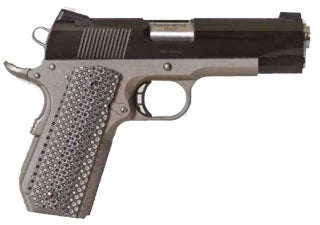
At a minimum, you should consider having a full-sized handgun of a larger caliber (preferably a .40 S&W or .45 ACP, although a 9mm would do) available for home defense. A full-sized gun like a Glock 24 (or better yet, a Glock 35) with 16 rounds of .40 S&W on tap may be hard to carry concealed but makes for a decent home-defense gun.
Weapon-mounted lights make sense on a home-defense gun more so than on a gun for concealed carry. It is easy to store your home-defense gun with a light attached.
And the ability to have a free hand to open doors, flip light switches and dial 911 is a real plus. You should still keep a regular flashlight handy as part of your home-defense plan.
For more detailed recommendations on specific models, see our guide to the best handgun for home defense.
Home-Defense Carbines

A carbine is a light, short-barreled semi-automatic rifle that is often referred to in the popular media as an “assault weapon.” There are a wide variety of carbines from which to choose, from pistol-caliber carbines like the Beretta Storm to more traditional carbines like the AR-15 or AK-47.
For those new to rifles, our beginner’s guide to best home defense rifles provides essential information on getting started.
Carbine Advantages
Carbines offer a lot of versatility over a handgun for home defense. Carbines are available in serious rifle calibers like .223 or .308 which provide far superior stopping power compared to pistol rounds.
Furthermore, carbines are long guns that are capable of far more accuracy and greater usable range. While realistic pistol ranges may top out at 25 to 50 yards, carbines can be easily used at 100+ yards or more, depending on your sighting system.
Carbines also tend to have a larger magazine capacity, with magazines of 30 or more rounds being fairly commonplace. Of course, if a carbine is your home-defense weapon of choice, it might be a good idea to start stocking up on high-capacity magazines.
Carbine Accessories
Any long gun used for home defense should be equipped with some type of weapon-mounted light. While this is optional with a handgun, there is just no good way to operate a long gun and hold a flashlight.
Since nighttime encounters are likely with a home-defense gun, some type of weapon light should be considered as required equipment. Carbines are also great platforms on which to mount optics because the rifles are generally capable of much better accuracy than the average shooter can wring out of iron sights.
Shotguns for Home Defense

Shotguns may just be the quintessential home-defense weapon. First, shotguns are extremely versatile.
There is a wide variety of ammo available, from bird shot to buckshot to slugs. Ammo choices can be tailored for use inside a home, where overpenetration of walls can be an issue, or for much longer ranges.
When selecting a shotgun, our guide on choosing a home defense shotgun covers the key features to consider.
Shotgun Versatility
Shotguns can throw a brutally effective shot pattern at 10 feet or be deadly accurate with slugs at 100 yards or more. Other types of specialty loads can fit most every need in between those ranges.
New loads are even available that greatly reduce felt recoil, even with serious defensive loads.
Shotgun Reliability
The right shotgun is also very reliable. Pump shotguns in particular have a very simple manual of arms, are easy to operate and are not prone to failure, even with minimal maintenance and lack of regular cleaning (not recommended, but it happens).
Recommended Shotgun Setup
Pump-action shotguns are quite inexpensive and are readily available. The classic pump shotgun is the Remington 870 series.
An 18- or 20-inch barrel is recommended for home defense for ease of handling in tight spaces.
While the common bead front sight will do, you may want to consider holding out for or upgrading to a barrel with actual rifle sights. Eighteen-inch replacement barrels with rifle sights are available from several sources, and most shotgun barrels are easily interchangeable by the user.
Many other accessories can be added, like replacement stocks, extended (high-capacity) magazine tubes and more.
Which Home-Defense Firearm Is Best?
This article briefly touches on some of the more popular options for home defense but is hardly a comprehensive guide to this vast topic.
Most importantly, take your home-defense weapon as seriously as your carry weapon and obtain professional home-defense training and practice regularly.
Once you have settled on your home-defense firearm, practice working with it in your home — unloaded, of course. If you don’t feel like it works for you, it might be time to reconsider your choice.
There is no shame in learning. It’s better to know before you need it.
Final Considerations
Each of our needs for home defense is different based upon where we live and the threats we face. Give serious consideration to how you will protect your home in a variety of extreme circumstances, whether it be for defense from a home invasion or defense of life and property following a riot or natural disaster.
Your home is your castle. It should be well-protected!
This article is a compilation of previous blog posts authored by Bob Campbell, Scott W. Wagner, Duane A. Daiker, Joel T. Nadler and Kevin Michalowski.