Despite my longtime love of revolvers, I recently discovered a cartridge I’d somehow missed: the .38 Special Short.
A few weeks ago, I was browsing the ammunition shelves at my favorite Central Ohio gun store, Vance Outdoors, when I spotted a blue-and-white Magtech box that was shorter than the others and labeled “.38 Special Short.”
I thought, “What the heck is that?”
I’d heard of .38 Short Colt and .38 Smith & Wesson ammunition, both of which are shorter than the .38 Special, but this was a new one to me. Inside the box were exactly what it claimed: short .38 Special cartridges loaded with 125-grain round-nose lead bullets in plain brass cases.
I went home to do some research. What I discovered made me wonder whether this little cartridge might be an excellent training option.
What Is .38 Special Short Ammunition?
According to Magtech, its .38 Special Short ammunition uses a traditional lead round-nose projectile intended to be a low-cost option for range and recreational shooting.
I was surprised by the listed ballistics.
Bullet weight: 125 grains
Type: Lead round nose
Velocity: 686 feet per second
Energy: 131 foot-pounds
Those numbers caught my attention. But first, I had to clear up some confusion about the various short .38-caliber cartridges.
.38 Special Short vs. Other .38 Cartridges
To get things straight, I dug through my copy of Cartridges of the World, originally written by Frank C. Barnes and published by Gun Digest.
The history of .38-caliber revolver ammunition is a bit complicated. Several cartridges have similar names, and some are close in overall dimensions without being interchangeable.
.38 Long Colt and .38 Short Colt
The .38 Special was developed from the .38 Long Colt, which gained an unfavorable reputation during the Philippine-American War. It could be fired from any .38 Special or .357 Magnum revolver.
The .38 Long Colt was eventually replaced by more powerful handgun cartridges, including the .45 ACP adopted in the Colt 1911 pistol.
The .38 Special was developed from the .38 Long Colt by lengthening the case slightly and increasing the bullet weight. It became one of the most popular revolver cartridges of the 20th century.
The .38 Short Colt was another cartridge from that time period. It was used in smaller revolvers, though it could be fired from guns chambered for .38 Long Colt or .38 Special. It remains of interest today, particularly among some revolver competition shooters.
All these early .38 cartridges originated with blackpowder numbers.
What About .38 Smith & Wesson?
There was another cartridge on the market during that period: the .38 Smith & Wesson. Not to be confused with the .38 Special.
Though the .38 S&W is about the same length as the .38 Short Colt and new .38 Special SHORT, it has a larger bullet diameter at .359 inches. It is not interchangeable with .38 Special or .357 Magnum ammunition.
Is .38 Special Short the Same as .38 Short Colt?
The Magtech .38 Special Short is not simply another name for .38 Short Colt.
The two cartridges have similarities, and both are relevant to this discussion, but their exact dimensions differ. The shorter cartridges may offer additional shooting options in compatible .38 Special and .357 Magnum firearms, including some rifles. However, compatibility should be confirmed with the firearm and ammunition manufacturers.
During my research, I also discovered that .38 Short Colt ammunition is available from online retailers in several bullet weights, ranging from 105 to 125 grains.
What could these shorter .38-caliber cartridges offer today’s revolver shooters beyond competition and historical interest? Quite a lot, I think.
Could .38 Special Short Be a Good Training Round?
I’ve been a state-certified police firearms instructor since 1986. That means I’ve spent a great deal of time teaching police officers and other shooters how to handle revolvers. By 1991, I was teaching full-time in the Columbus State Police Academy program and running its firearms training.
Though we had purchased 9mm semi-automatic pistols, which were becoming increasingly popular in law enforcement, we retained our Smith & Wesson Model 10 and Model 19 revolvers. We continued using them as a foundation for firearms instruction.
Those same revolvers were also used to introduce new civilian shooters to handguns, including many women who signed up for basic handgun training. This was well before Ohio established its concealed carry permit system.
The standard .38 Special, particularly a traditional 158-grain lead round-nose load propelled at around 750 to 850 feet per second, is a relatively mild cartridge compared with the .357 Magnum or .45 ACP.
Its mild manners helped make it a law enforcement and self-defense standard for much of the 20th century. But even standard .38 Special ammunition can be a bit much for someone who has never fired a handgun.
I always wanted a cartridge that would let a brand-new shooter, young or old, start with less recoil, even if he or she were learning on a snub-nosed revolver.
Train With the Revolver You’ll Actually Carry
Certainly, you can introduce a new shooter to handgun shooting with a .22 revolver.
But the .38 Special Short offers an interesting possibility: A shooter might be able to practice with the same .38 Special revolver he or she eventually intends to carry, using a cartridge that produces considerably less felt recoil.
That could be particularly helpful for someone learning to shoot a lightweight snubnose revolver.
If the .38 Special Short turned out to be as good as I hoped, I would certainly consider keeping some on hand for training new revolver shooters.
 Magtech .38 Special Short Range Test
I took the box of .38 Special Short ammo to my buddy Bret’s outdoor range for live-fire testing. It was dry and sunny with without a cloud in the sky and 68 degrees—a perfect day for a test.
Originally, I had planned to use one of my full-sized, six-shot .38 Special revolvers. I was thinking of the cartridge strictly as a training round for someone working up to standard .38 Special ammunition.
But the more I thought about it, the more interested I became in testing it from a lightweight snubnose revolver. It could make a useful close-range self-defense cartridge for shooters sensitive to recoil.
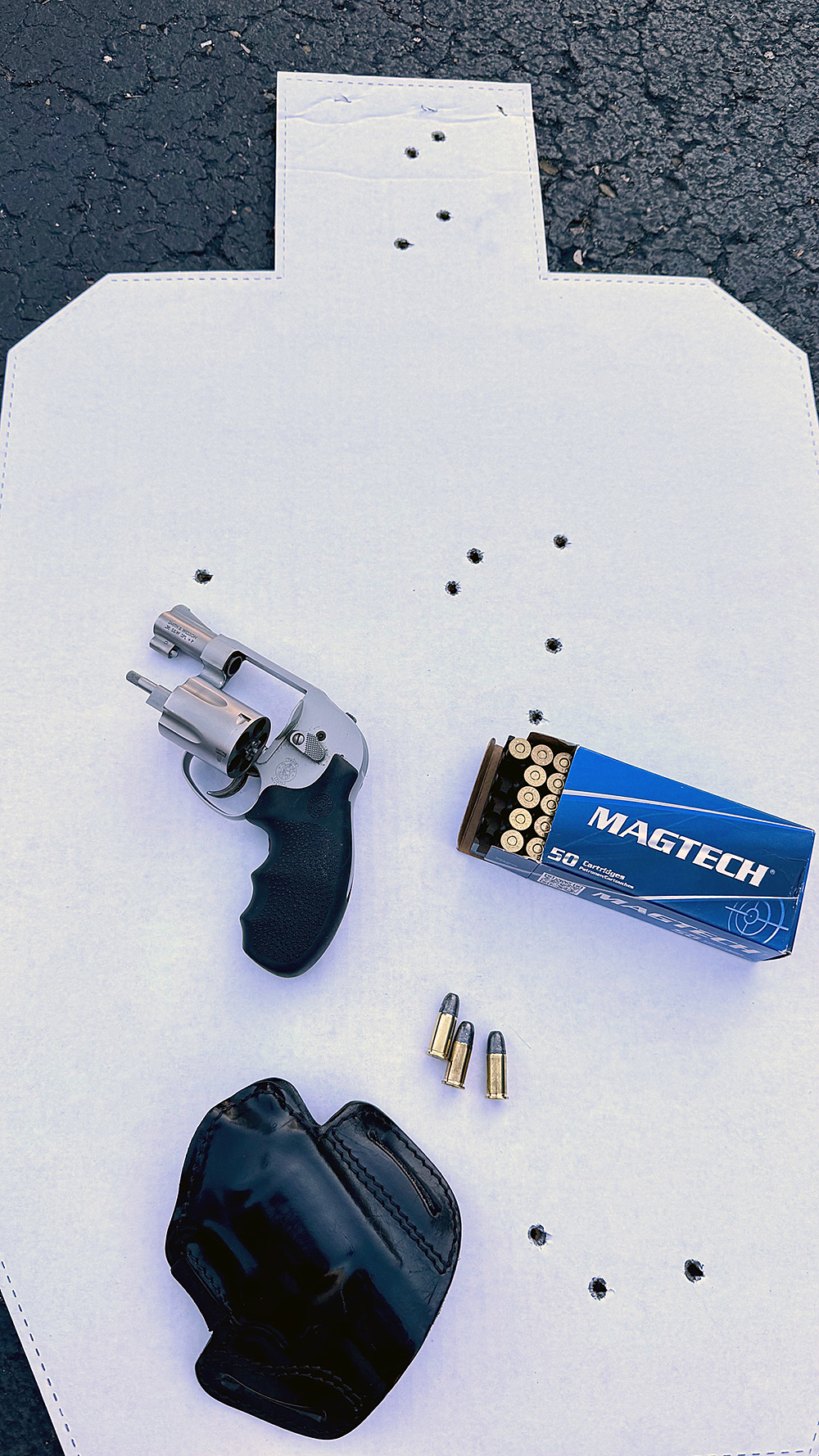
Fortunately, I had my Smith & Wesson Model 638 Bodyguard, a five-shot, aluminum-frame .38 Special revolver.
My Model 638 is equipped with a Hogue red laser grip that is no longer in production. Unfortunately, the laser wasn’t much help under the bright sunlight directly overhead.
Speedloader Compatibility
One thing I discovered before shooting was that the short cartridges didn’t work well with the standard five-round .38 Special cylindrical speedloader I’d brought along.
The distance between the bullet noses and the loader was too short to ensure the cartridges would enter the chambers properly when I turned the release knob. The rounds failed to enter the cylinder.
However, while writing this review, I discovered that my Safariland Comp I Size 1 speedloader worked properly with the cartridges. I was able to load all five rounds with one push.
Recoil and Shooting Impressions
With a plain white cardboard silhouette at the backstop, I loaded five rounds and moved back to approximately 15 feet. I aimed at the center of the target and fired the rounds slowly, double-action.
The first shot struck dead center, and I realized I might have been underestimating the effectiveness of the .38 Short. I had been expecting a shooting experience closer to the old .32 S&W Short or Long cartridges.
“Wow, that could hurt somebody,” I thought. My impression was based on the muzzle blast and felt recoil, not a conclusion drawn from ballistic testing.
I fired all five rounds, and the experience was definitely easier on my hands than firing conventional .38 Special ammunition from a lightweight revolver.
I think this cartridge has real potential to help reduce a flinch response in anticipation of recoil. Had I fired it from one of my full-sized, all-steel revolvers, I suspect the recoil would have been almost negligible.
Bret felt much the same way after firing his five rounds. His group consisted of four tightly clustered shots centered in the silhouette’s head area, with one called flyer.
Both of us came away impressed with the cartridge’s mild shooting characteristics.
Is .38 Special Short Suitable for Self-Defense?
My original interest in this cartridge was as a training round, but shooting it from the Bodyguard made me consider another possibility.
The ammunition I tested produced noticeably less felt recoil than I expected, and I found it easy to manage in a lightweight revolver. Someone who is uncomfortable with a handgun’s recoil may struggle to practice consistently or shoot accurately.
Could a mild-recoiling .38-caliber cartridge offer an option for someone who has difficulty controlling standard defensive ammunition?
There are some important limitations.
The Magtech ammunition uses a plain lead round-nose bullet rather than a hollow-point projectile. My range test evaluated recoil, not penetration or terminal effectiveness.
With the addition of 21st-century gear like laser sights, a firearm chambered for .38 Special Short has the potential to be a credible self-defense cartridge when overpenetration and recoil are concerns.
I would rather see someone become comfortable and proficient with a handgun than remain afraid to practice with it. And I believe the .38 Special Short could be useful in helping a recoil-sensitive shooter develop that confidence.
After 40 years in law enforcement, I know that confidence and the ability to handle a firearm safely matter a great deal in stressful situations.
Does .38 Special Short Have a Place?
I’m glad I wandered past that unusual Magtech ammunition box that reminded me there are still things to discover even after decades of shooting and teaching.
For initial practice, particularly with new shooters or those who are sensitive to recoil, I think the .38 Special Short has considerable potential. It allows a shooter to practice with a .38 Special revolver while experiencing less felt recoil than with conventional ammunition.
I remain interested in the cartridge’s possible defensive applications, but that would require more testing than my initial limited range session. For now, I’m convinced of one thing: The .38 Special Short deserves a closer look as a low-recoil revolver training round.
Sources:
Magtech Ammunition: MagtechAmmunition.com
Safariland: Safariland.com