There can be no doubt that the reputation of and support for law enforcement officers as guardians of American liberty took a major hit during the lockdown years. Even as a retired 40-year veteran of law enforcement as well as a criminal justice professor, I was ashamed of the numerous law enforcement officers I saw on video who were involved in civil rights violations against law-abiding citizens — their traditional supporters — as I watched what seemed to be an endless stream of unconstitutional actions taken by these officers. These incidents occurred in major cities, small towns and villages, and even remote counties as these officers unquestioningly enforced unconstitutional and unreasonable lockdown rules across the nation. I will also say I cheered on the officers who refused to enforce those temporary restrictions. I used — and still use — the bad examples as journal questions for students in my constitutional law and government classes.
Fortunately, Hillsdale College’s Law Enforcement Outreach Program was established to reintroduce and, in some instances, introduce law enforcement officers to what the U.S. Constitution is all about and the rights it guarantees to every American.
Lost on Our Past
Over a decade ago, I realized that our nation faced serious constitutional problems when I discovered that nearly all of my police academy cadets and criminal justice students knew less about the Constitution and the founding of our nation than did previous cadets.
One particular encounter with a student struck me hard. During a class break, I talked with one of our academy cadets in the U.S. Army, and he told me that he hated going down South for his annual two-week summer training requirement because of the heat. I responded with, “Well, at least it wasn’t like the conditions at Valley Forge.” He replied, “Valley Forge, what was that?” He not only had never learned about the Continental Army’s incredible sacrifice during the winter of 1777-1778 in school but also had never learned about it in Army basic training. How could we have soldiers dedicated to liberty and the rights of citizens if the U.S. Army was not teaching its soldiers its glorious history? The rest of the cadets were likely in the same boat.
My generation of cops — now long retired — were constitutionalists. We were taught American history and government, we said the Pledge of Allegiance every day, and we learned all of the great patriotic hymns and folk songs of our nation very early on. We were taught to love and respect our “Sweet Land of Liberty” and the people who fought to preserve that throughout the centuries. I took it seriously because my dad was a World War II veteran.
Explore USCCA Training for Civilians
Love of country and respect for the Constitution has been wiped out in all but the best private and religious schools (and among some families that homeschool). The young people who went to public schools and who have been entering the field of policing for two generations now come to it unprepared to defend the Constitution — which we take an oath to do — because they know nothing about it.
This dire circumstance is further compounded by state and federal law enforcement curricula, which teach students only about search and seizure aspects of the Constitution without providing a comprehensive background in it. And if you saw the recent video of National Archives police officers doing nothing while vandals desecrated the Constitution’s display case with magenta-pink paint powder, that should tell you how bad things have gotten.
Hillsdale’s Legacy
Fortunately, Hillsdale College in Hillsdale, Michigan, has stepped into the breach. I first heard of Hillsdale while listening to the late Rush Limbaugh on his radio talk show, and I have been a subscriber to Hillsdale College’s free Imprimis newsletter ever since. I incorporate the college’s free online constitutional law and civil rights courses into my own classes as assignments for students.
Two years ago, I covered Hillsdale’s Action Shooting Team national championship win and its Ladies for Liberty Shooting Camps. In August 2023, I was invited to attend its new Law Enforcement Constitution Course and became certified as an instructor.
Hillsdale College was founded in 1844, when Southern Michigan was still semi-frontier. When the Civil War started in April 1861, more than 300 Hillsdale graduates and students volunteered for service in the U.S. Army.1 There is a beautiful statue on campus that commemorates the Hillsdale students who served and died for freedom.
It only makes sense that Hillsdale, with this kind of history, would take the lead in providing a Law Enforcement Constitution Course for state, local and federal law enforcement officers from across the U.S. The course provides a deeper knowledge of and appreciation for the Constitution they have sworn to support and defend — something no other college has ever done.
Hillsdale has long been proactive in safeguarding our rights through the education and programs it provides rather than trying to defend rights in the aftermath of violation; acting retroactively has played a large role in the erosion of our rights. Hillsdale’s staff sees the problem as not only a lack of understanding of our history and liberty but also an absence of appreciation for them. The only way to fix this problem among law enforcement officers is to front-load the concepts with young cadets before they get on the streets. And if Hillsdale-certified Constitution instructors can’t get to cadets while those cadets are in the academy, they can at least provide training to those individuals currently serving as officers.
Law Enforcement Constitution Course
The overall purpose of the class is twofold. The first part of the mission is to reestablish and preserve the rights of citizens guaranteed under the federal and state constitutions of life, liberty and property. The second part is to help prevent officers and their agencies from getting sued. The best way to decrease the liability for law enforcement officers is to train them to not violate the constitutional rights of the people they are supposed to protect and serve.
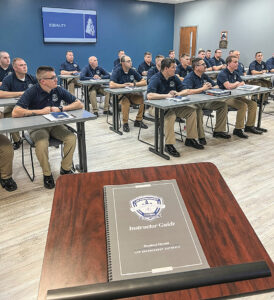
Hillsdale’s Law Enforcement
Constitution Course educates
officers on the importance of and
their responsibilities to the
U.S. Constitution.
The Law Enforcement Constitution Course for instructors is paid for by Hillsdale. The college can offer courses like this because it does not accept any government funding. This means it is funded solely by tuition and donations.
The other critical aspect of the training is that only law enforcement officers, instructors and criminal justice affiliates are accepted into the instructor program. This gives them the credibility to take the information provided in the class back to their states and teach the course with authority.
Dr. Jeremiah Regan is the driving force behind the class. I met him while I was covering a Hillsdale Ladies for Liberty Shooting Camp, and I was accepted into the second course that was offered. As of this writing, 121 officers who completed the fifth class were certified as instructors. In my class, there were 20 experienced officers — and one prosecutor — hailing from Michigan, Ohio, California, Idaho and Florida.
Hillsdale provided us with lodging in the outstanding Hillsdale Dow Center along with meals, materials and a stipend to defray transportation costs. There was just one condition: Since Hillsdale pays for everything, the instructors are not to charge agencies outside of their own when they teach the course, which seems to be a fair trade-off.
The first class session was taught by Michigan District Judge Bill O’Grady, who was formerly a lieutenant with the Michigan State Police. Other sessions were taught by Dr. Regan. Judge O’Grady outlined the purpose and key concepts of the course:
- To reestablish the overall idea of constitutional stewardship. We have a duty to protect and defend the Constitution and to pass it on — intact — to future generations.
- To refocus and realign our priorities as law enforcement officials to better protect all of our rights.
- To learn more about the Constitution. It exists as an attempt to preserve and document the law of nature and the natural rights initiated by God.
From there we moved into the curriculum listed in the instructor’s guide, which was provided by Hillsdale. (Hillsdale provides student handbooks for all students. That is quite an expense in and of itself.) Rather than cover every topic listed in the instructor’s guide, I will list a few that are never taught in law enforcement academy training:
- The Three Major Natural Rights
- State of Nature, Social Contract and Consent
- Colonial History
- The American Revolution
- The Declaration of the Causes and Necessities of Taking Up Arms
- The Declaration of Independence
- Articles 5, 6 and 7 of the Constitution
- All of the constitutional Amendments (not just the Fourth Amendment and searches and seizures, upon which most of today’s Constitution training in academies focus)
- When local laws conflict with natural rights and the Constitution (the most significant)
Revisiting Our Founding Documents
Let me say that the officers in my class, most of whom were younger than I am, came to the course with a firm belief in the Constitution and the rights established for all citizens of the United States. This gives me hope. It was a good group of law enforcement professionals who were excited not only to learn more about our founding and constitutional history but also to have their beliefs validated by Hillsdale College instructors and other law enforcement professionals in attendance. We quickly realized that we weren’t alone in our thought patterns and beliefs, and this fact further encouraged us to go forth and teach.
When the class began, our instructors had each of us take turns reading portions of the Declaration of Independence and the Constitution aloud to the class. I dare say that for some of the younger officers, it may have been the very first time that they had read parts of these documents or had even heard them.
On the last day, we broke into small groups, and each presented for 10 minutes on a related topic. I wanted to pick a topic that I knew the group at my table was not likely to select, so I chose this paragraph from the Declaration of Independence: “He [King George III of Great Britain] has excited domestic insurrections amongst us, and has endeavored to bring on the inhabitants of our frontier, the merciless Indian Savages, whose known rule of warfare, is an undistinguished destruction of all ages, sexes and conditions.”
Reading 10 of Allan W. Eckert’s historical novels about the bloody settling of the eastern American frontier gave me a good background in the topic and helped me explain why that particular grievance was part of the Declaration of Independence. A discussion of such a potentially sensitive topic is possible only in an environment like Hillsdale’s, in which students’ freedom of speech is still protected.
A Win-Win for All
The Second Amendment is glossed over in standard police academy training programs, and there is rarely any follow-up training in it unless your agency is blessed to have a great sheriff or chief. If you have seen my other reports on Hillsdale’s pro-Second Amendment activities and support of the shooting sports, you know where it stands. There is no other educational institution in the United States that works as hard as Hillsdale College does to restore our distressed rights of life, liberty and property.
Since completing this training, I’ve taught this course to one of my former agencies, and I am awaiting the chance to teach another of my former agencies in the upcoming months.
Learn how the USCCA For Saving Lives is upholding the Constitution
Hillsdale’s law enforcement outreach program represents a great opportunity through its certified instructors to create more law enforcement officers who fully understand the rights of American citizens enshrined in the Declaration of Independence and the Constitution. The program is a truly great vehicle for protecting and preserving our individual rights. Even better, it should also help protect law enforcement agencies from making costly mistakes in terms of lawsuits and lost tax dollars when officers are fired, charged or suspended. The course is a win-win for us all.
Endnotes
(1) Dr. Arlan K. Gilbert, “Hillsdale’s ‘Last Full Measure of Devotion,’” Hillsdale County Historical Society, accessed April 10, 2024, HillsdaleHistoricalSociety.org/hillsdale-last-full-measure-ofdevotion.
Sources
Hillsdale College: Hillsdale.edu/LEO
Hillsdale College Student’s Medal of Honor
On June 20, 1861, 18-year-old Moses A. Luce, a sophomore at Hillsdale College, enlisted as a private in the 4th Michigan Infantry to fight in the Civil War. He fought alongside his regiment in major battles, such as Gaines’ Mill, Malvern Hill, Chancellorsville and Gettysburg. In January 1863, Luce was promoted to sergeant.
On May 10, 1864, at around 11:30 a.m., 300 men of the 4th Michigan and the 22nd Massachusetts attacked the Confederate earthworks at Laurel Hill. When within 100 yards of the defensive line, one officer recalled, “Murderous flank fire was kept up on our left, and a sweeping fire of canister and shrapnel down the road, which cut our line.” Five of the seven men in Luce’s company were struck down by enemy musket and artillery fire.
As the assaulting column retreated, Luce sought refuge in a ditch, where he endured the sounds of bullets whizzing overhead, the agonizing cries of the wounded and the menacing yells of the enemy. To avoid being taken prisoner, Luce made a dash toward the safety of the U.S. rifle pits. Just as he emerged from the ditch, an enemy bullet struck the stock of his musket, while another grazed his face, leaving a gash above his eye.
From the relative safety of the friendly rifle pits, Luce heard the desperate cries of a wounded man lying in the perilous expanse between the opposing lines. He shouted out to inquire who the man was; the individual responded that he was Asher LaFleur, a fellow college friend. Without hesitation, Luce abandoned his musket and braved the danger once more. He found LaFleur with a shattered leg, bleeding profusely.
Unable to lift LaFleur, Luce instructed him to cling to his neck as he carried him on his back. Rising from his kneeling position, Luce moved as quickly as he could back toward the safety of the U.S. line.
Luce survived the war and resumed his studies at Hillsdale, graduating in 1866. In recognition of his selfless act of bravery at Laurel Hill, Luce was awarded the Medal of Honor in 1895.
-Frank Jastrzembski, Contributing Editor