For my money, the Charter Arms Bulldog .44 is one of the most intimidating-looking defensive revolvers since Dirty Harry’s .44 Magnum. But there’s more to this compact five-shot revolver than its appearance.
One of the most desirable outcomes of a self-defense encounter is stopping a threat without having to fire a shot. I’ve always believed that a firearm’s appearance, combined with the defender’s confidence, can sometimes play a role in that outcome. Of course, there’s no guarantee an attacker will recognize a firearm or respond as expected.
I owned a plain-looking matte-black Bulldog in the 1980s. But after testing Charter Arms’ .32 Magnum Undercoverette, the new Classic Bulldog caught my eye.
The Charter Arms Bulldog .44 Special
The Charter Arms Bulldog was introduced in 1973, at the beginning of Charter Arms’ timeline, and has become one of the company’s best-known revolvers. It even had a prominent good-guy role in the excellent 1986 movie Manhunter, the first film in the Hannibal Lecter series.
Charter Arms has come a long way since the Bulldog’s introduction. Today’s revolvers are more finely finished, with better triggers and a much greater array of styles and calibers to choose from.
At the time of my review, Charter’s catalog listed 11 .44 Bulldog models, compared with just one when the revolver was first introduced.
The Classic Bulldog is just what its name suggests … and then some.
It retains the basic features of the original .44 Special revolver, but today’s Classic is a much smoother-operating and more elegant handgun than the one I remember. When I first looked through Charter’s online catalog, I was particularly impressed by the photography showing the attention paid to the Classic Bulldog’s blued finish.
Why the Bulldog Uses .44 Special
The .44 Special cartridge has been around since the end of the Old West.
Smith & Wesson introduced the smokeless-powder cartridge in 1908 as the .44 Smith & Wesson Special, originally chambering it in the full-sized New Century revolver.
The .44 Special has always been a capable defensive cartridge. The original 246-grain lead round-nose bullet traveled at approximately 755 feet per second from a 4-inch barrel, delivering about 310 foot-pounds of muzzle energy.
Modern defensive loads improved even beyond those original ballistics.
The Bulldog’s Law Enforcement History
The Charter Arms Bulldog .44 was reportedly issued to the U.S. Sky Marshal service in 1973.
I can understand the attraction. The Bulldog was easily concealed and carried, particularly compared with a full-sized semi-automatic pistol or revolver.
Its relatively slow, heavy bullets offered less penetration risk, in theory, than high-velocity .357 Magnum or 9mm rounds, an important consideration aboard an airliner.
Later, the Federal Air Marshal Service (which replaced the Sky Marshall name) carried .357 SIG pistols, as did the Secret Service. While I consider the .357 SIG an excellent law enforcement cartridge, its muzzle velocity of more than 1,425 feet per second always struck me as an unusual choice for use aboard a passenger airliner.
The Air Marshals eventually transitioned to 9mm pistols.
But I digress.
Charter Arms Classic Bulldog Specifications
The Classic Bulldog is remarkably light for such a powerful revolver cartridge.
Caliber: .44 Special
Capacity: 5 rounds
Action: Double-action/single-action
Barrel length: 3 inches
Weight: 20 ounces
Finish: Polished black oxide
Sights: Fixed front sight and rear groove
At 3 inches, the barrel of the Classic is longer than most other .44 models, except the Target model. It gives the .44 Special a little more barrel length to work with while remaining very concealable.
Features and Controls
There aren’t many self-defense revolvers that make you think, “that’s a beautiful gun,” but the Classic Bulldog does.
Charter Arms applied a nicely polished black oxide finish to the carbon-steel frame, barrel and cylinder. The trigger guard is aluminum.
While traditional black oxide or blued finishes are not rust-resistant, a little attention, especially in humid environments or during rainy weather, the finishes are easily protected. A quick wipe with a lightly oiled cloth helps protect the finish.
I believe occasionally wiping down your traditionally finished handgun encourages you to handle the firearm, remain familiar with its controls and perhaps work in a little dry-fire practice after confirming the gun is unloaded
Sights
The Classic Bulldog uses traditional black fixed revolver sights, similar to those on handguns I carried for many years both on and off duty.
The front sight is prominent, while the rear trough-style groove is wide enough to make picking up the front sight relatively easy.
For shooters who want greater visibility, Birchwood Casey Sight Super Bright Pens can be used to add color to the front sight.
Dual Cylinder-Release System
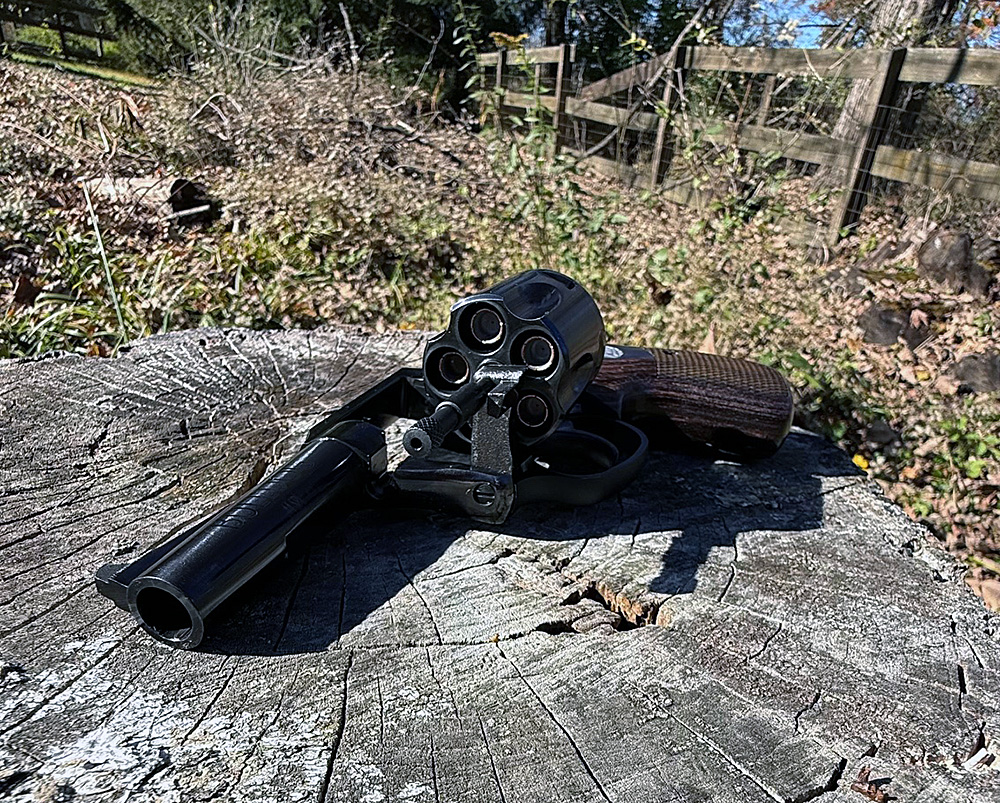
The Classic Bulldog retains the free-standing ejector rod, which I’ve always found useful on Charter revolvers. Colt also used free-standing ejector rods on its revolvers until the 1970s, its rods only served to eject cartridges. Charter Arms gave its ejector rod a second purpose.
Pulling the ejector rod forward toward the muzzle also releases the cylinder for opening. There’s still a conventional cylinder-release button on the left side of the frame, behind the recoil shield. In fact, you can operate both releases simultaneously. If a tight cartridge case or two makes the cylinder difficult to open, pulling the ejector rod forward while pushing the frame-mounted release provides additional leverage.
I’ve been using both releases during my testing, and now I find myself opening the cylinder that way all the time. I like this arrangement so much that I’d love to see Charter gradually eliminate the front underlug from its other revolvers and return to the original free-standing ejector rod system.
In my opinion, this design could be particularly useful for women, older shooters or anyone dealing with reduced hand strength.
Trigger, Hammer and Grips
The trigger on the Classic Bulldog is smooth, with rounded edges. Its pull quality is much improved over the Bulldog and Undercover .38 snubnose revolvers I owned many years ago.
The firing pin is free-floating and frame-mounted, while the hammer has a nicely color case-hardened finish. You don’t see that very often these days, and it’s a nice touch.
The hammer spur is grooved to provide non-slip cocking during single-action fire.
Charter finishes the Classic with nicely figured, checkered walnut grips featuring silver Charter Arms medallions near the top.
Reloading the Five-Shot Bulldog
The Bulldog holds five rounds of .44 Special ammunition, which can be reloaded via traditional cylindrical speedloaders or Bianchi’s nylon Speed Strips.
Bianchi offers Speed Strips for .38 Special/.357 Magnum cartridges as well as versions accommodating .44 Special/.44 Magnum and .45 Colt ammunition. Unlike a cylindrical speedloader, which holds cartridges in a circle and releases them together, a Speed Strip holds ammunition in a straight line. You can load one or two rounds at a time, depending on your technique.
The Classic Bulldog’s walnut grips aren’t specifically relieved for speedloader clearance on the left side, but I found they worked with the speedloaders I used.
Carrying the Bulldog in a Galco Holster
I wanted to get a feel for carrying the Charter Bulldog .44 again, so I turned to the leather artisans at Galco for a comfortable concealed carry holster. In short order, I had a polished black leather Galco Combat Master Belt Holster.
This fine, hand-molded holster fits the Bulldog like the proverbial glove. It provides good retention, while the open-top design allows a smooth draw and easy reholstering.
The polished black leather and polished black revolver also make a particularly handsome combination. I think it’s good for at least some of our firearms to be aesthetically pleasing.
This handgun-and-holster combination rides perfectly on my belt without chafing or discomfort. I didn’t feel the Bulldog’s grip digging into my side. The rounded edges prevented the gouging I sometimes experience with modern semi-auto handguns.
The Galco Combat Master is available in black or tan leather, and the gun and holster stayed easily concealed under a covering garment.
Charter Arms Bulldog .44 Range Test
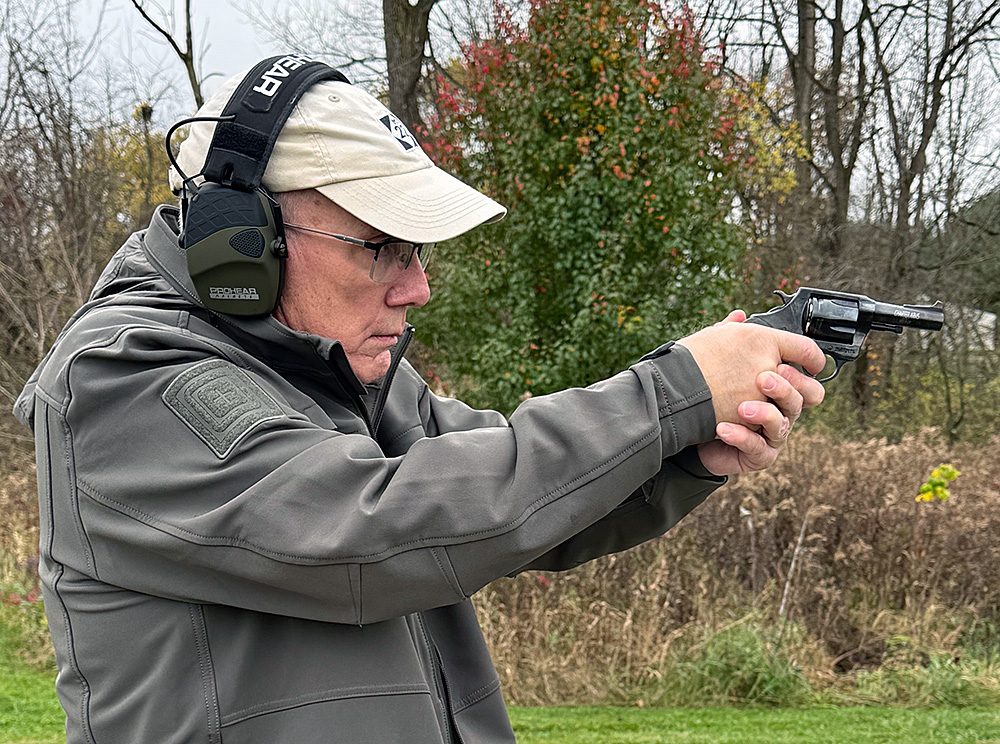
My range time with the Classic Bulldog was limited on a rainy Friday. I wanted to get to my buddy’s range and finish before the ground became too wet to drive across without messing up his yard.
I brought my son along to help with the test. Since I’d owned a Bulldog before and the Classic’s basic design hadn’t changed dramatically, I didn’t feel the need for an extensive familiarization session.
I brought three .44 Special loads to the range.
| Ammunition | Bullet weight and type | Listed velocity | Listed muzzle energy |
| Winchester Cowboy Action | 240-grain lead flat nose | 750 feet per second | 300 foot-pounds |
| SIG Sauer V-Crown | 200-grain jacketed hollow point | 700 feet per second | 218 foot-pounds |
| CCI Blazer Gold Dot | 200-grain hollow point | 920 feet per second | 376 foot-pounds |
The SIG Sauer V-Crown load is unfortunately no longer in production. I expected the Blazer load to be the most attention-getting in the Bulldog’s lightweight frame. Personally, I’d save that load for a larger revolver — not because I believe the Charter can’t handle it, but because 20 ounces isn’t much weight when you’re firing a relatively powerful .44 Special load.
I ended up firing the SIG Sauer and CCI Blazer loads before the rain arrived. The Winchester ammunition remained untested during this session.
Shooting the SIG Sauer V-Crown Load
I started with the SIG Sauer 200-grain V-Crown ammunition. Firing from a two-handed standing position, I selected a lower aiming point on a white cardboard competition target approximately 20 feet away.
I launched the first shot and felt, well, giddy!
That first shot was fun. It was great to shoot a Charter .44 again, and there was no stinging in my hands or discomfort. Unfortunately, my initial excitement caused me to lose focus as I fired the remaining four rounds.
I found myself enjoying the sensation of power in such a small package rather than concentrating as carefully as I should have on my shooting. I’m pretty sure the last time I’d fired a Charter .44, I was using the old standard 246-grain lead round-nose ammunition. That cartridge looked like a .38 Special on steroids but was relatively mild to shoot.
I liked the SIG Sauer V-Crown load in the new Bulldog, but I’d need to settle down and practice more before choosing it as a carry load.
Shooting the CCI Blazer Gold Dot Load
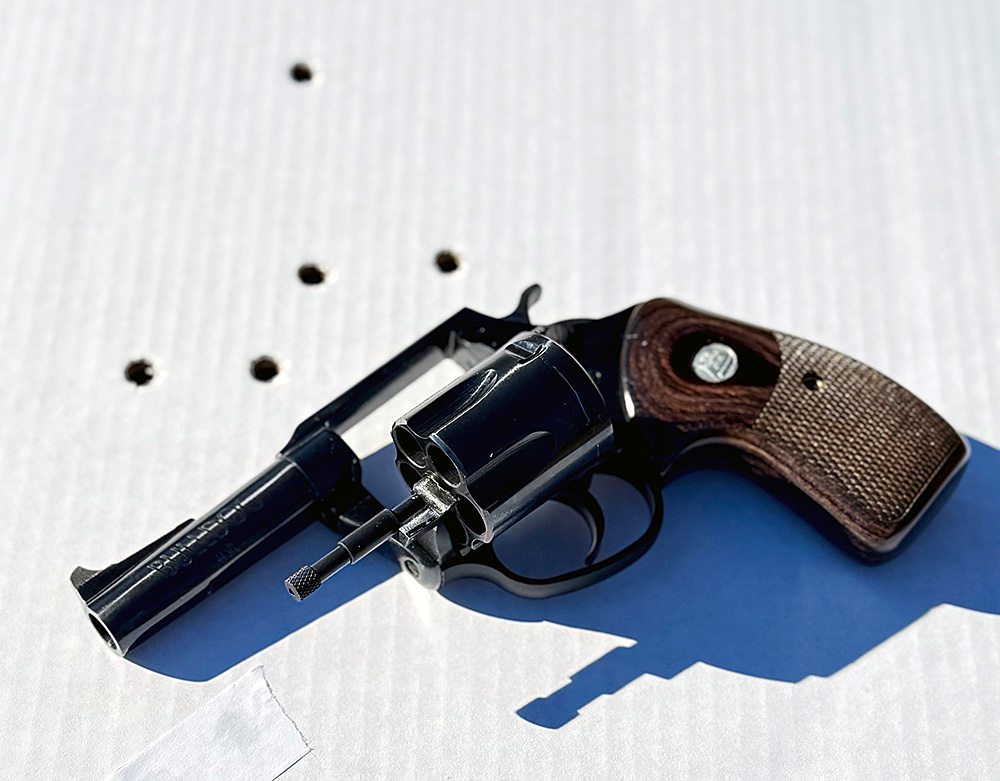
The second load I fired was the CCI Blazer ammunition with its 200-grain Gold Dot hollow-point bullet. This round was hotter than the SIG Sauer load. It produced noticeably stronger recoil but not uncomfortably so.
The Blazer ammunition also produced a decent group measuring approximately 4 by 5 inches, including a flyer that stretched things out.
I was getting ready to shoot more when the rain began threatening, and I decided to get while the getting was good. With a little more practice, I’m confident I could tighten those groups. Even with the flyer, the shots remained within the target’s central scoring area.
Final Verdict: Is the Charter Arms Classic Bulldog Worth It?
I managed only 10 rounds before the weather ended our session, and my son decided not to shoot the Bulldog himself. The revolver was a bit more than he expected, so he concentrated on taking photographs.
The Bulldog .44 isn’t the handgun I’d choose to introduce someone to shooting. But if you have some shooting experience under your belt, I think you’ll love it!
Either the SIG Sauer or CCI Blazer load would also interest me as a trail load if I wanted to carry the Bulldog outdoors.
The Charter Arms Classic Bulldog is a magnificent revolver.
Charter Arms has come a long way, offering an extensive line of quality handguns at affordable prices. These are firearms whose basic designs have withstood the test of time.
The revolver carries comfortably, looks great and was every bit as enjoyable to shoot as I’d hoped.
I think the Classic Bulldog has a lot going for it as a concealed carry revolver, particularly for someone who already has experience handling centerfire handguns. The improved trigger, attractive finish and traditional fixed sights add to the appeal, while the dual cylinder-release system remains one of my favorite Charter Arms design features.
Of course, the Bulldog’s light weight also means you’ll notice the recoil of more energetic .44 Special loads. That’s something to consider when selecting ammunition and deciding whether the revolver is a good fit for your experience and preferences.
As for the intimidating appearance I mentioned earlier, I still think the Bulldog has it in spades.
Revolvers are far from dead as defensive or sporting firearms. And Charter Arms deserves considerable credit for helping keep them relevant.
Sources:
Galco Holsters: GalcoGunLeather.com
Birchwood Casey: BirchwoodCasey.com
Charter Arms: CharterArmsManufacturing.com