I’ve reviewed a good number of Colt’s revolvers and semi-automatic pistols over the past few years, and every one has impressed me. Even a good friend who collects classic Colts could not find fault with the new guns.
So when I heard Colt was reintroducing the Viper, I had to get one for testing. The original was one of those classic Colt revolvers I had always admired but had never owned or fired.
Fortunately, the new Colt Viper is a lot easier to obtain than an original. While working on this article, I found one nice-looking 1977 Viper offered online for $7,995. It seems I will never own an original example.
Fortunately, Colt has created a modern .357 Magnum Viper that retains plenty of the old Colt flair while adding features that make the 3-inch version especially interesting as a concealed carry and general-purpose revolver.
The Return of the Colt Viper
The original Viper was produced for only one year, 1977. It was a sleek .38 Special revolver built on the same D-frame used for the original Colt Cobra, with an alloy frame, blued-steel construction and a 4-inch barrel.
The Viper’s return comes during an interesting period for Colt. There was plenty of chatter and hand-wringing when CZ acquired Colt in 2021. Many enthusiasts understandably worried that the old Colt brand might lose some of the characteristics that made Colt firearms what they were.
Admittedly, I can worry with the best of gun enthusiasts, especially older traditionalists like myself. But I was less concerned in this case because CZ has long held a solid reputation in civilian, military and law enforcement firearms.
Colt had already introduced its updated stainless-steel Python in 2020 using modern CNC manufacturing. I had learned about the wonders of quality CNC work years earlier and realized how much it could help preserve classic firearm designs while controlling manufacturing costs. The new Python was followed by the .44 Magnum Anaconda, another beautiful example of a classic Colt brought back through modern manufacturing.
Both were instantly recognizable for what they were: classic Colt revolvers at a more affordable price point.
The new Viper continues that trend.
Colt Viper Features and Specifications
The new Colt Viper was introduced in .357 Magnum, which also allows the use of lower-powered .38 Special ammunition. Instead of the original blued-steel configuration, the current Viper is constructed of stainless steel with a bright polished finish.
Colt offers it with either a 3-inch or 4.25-inch barrel. The longer version more closely resembles the profile of the original Viper, but I requested the 3-inch model because its shorter barrel lends itself better to concealed carry in either an inside-the-waistband or outside-the-waistband holster.
When the shipping clerk at my FFL called to tell me the Viper had arrived, he gave me some advance warning that it was a real beauty. When I opened the box, my first response was simply, “Wow.”
Classic Colt Styling
The new Viper is built on the same frame Colt uses for the .357 Magnum King Cobra line. The polished stainless finish is mirror-bright and about as close as you are going to get today to the magnificent nickel finishes of old.
The Rampant Colt emblem is etched into the left side of the frame beneath the cylinder release. The left side of the barrel carries the traditional italicized “COLT VIPER” marking with “.357 MAGNUM” underneath. The markings have a distinctly retro appearance and should bring a smile to the face of anyone who appreciates classic Colt double-action revolvers.
The Viper is equipped with nicely checkered walnut grips. From what I could determine, they are made by Altamont. The only thing missing is a set of silver or gold Rampant Colt medallions on the grips. Those medallions appeared on the original compact D-frame Colts, including my old “bargain basement” 1970s Colt Agent. The new Viper is crying out for them.
Controls and Trigger
The operating system of the new Viper will be immediately familiar to anyone who has handled older Colt double-action revolvers. There are subtle changes, but there is no doubt you are handling a genuine Colt.
The trigger is narrow and smooth without grooves. Colt enlarged the trigger guard somewhat to better accommodate a gloved hand or larger trigger finger. The narrow hammer has traditional cocking grooves, and the single-action trigger pull is crisp and typically Colt.
The cylinder release also works like the old Colts: Pull the latch toward the rear while pushing the cylinder open from the opposite side.
The cylinder rotates clockwise during the firing cycle. Colt revolvers have also long been known for their bank-vault-tight lockup when the trigger is held fully to the rear. There was no play in the old Colts, and I found none in this Viper either.
Like Colt’s newer D-frame revolvers, the ejector rod is completely shrouded rather than exposed like those on older guns. The muzzle is also crowned to help protect the rifling.
Fixed Sights
The Viper uses fixed sights. The rear is a square trough cut into the topstrap, while the front is a black serrated ramp.
The front sight appears to be pinned in place, and Brownells lists an XS tritium replacement sight for the Viper and Cobra line. Shooters with older eyes like mine may want to consider that upgrade for better visibility in uneven lighting. My range session reinforced that point.
Colt .357 Magnum Viper Specifications
Caliber: .38 Special and .357 Magnum
Capacity: 6 rounds
Construction: All stainless steel
Finish: Bright polished
Weight: 27 ounces unloaded
Overall length: 7.5 inches
Barrel length: 3 inches (tested); 4.25 inches (also available)
Action type: Double Action/Single Action
Hammer type: External
Grips: Walnut
Price: $1,149.00
How Does the Colt Viper Shoot?
One of the first things I noticed about the 3-inch Viper is its balance. Dare I say it is nearly perfect in the hand.
The 3-inch medium-weight barrel and 1½-inch ejector-rod shroud put enough weight forward to steady the revolver without making it feel muzzle-heavy. I do not think a 2-inch version would handle nearly as well.
Because of the conditions in Ohio this summer, I headed to a nearby indoor range for testing.
Test Ammunition
I brought along SIG Sauer .357 Magnum V-Crown JHP ammunition, which launches its bullet at a listed 1,450 feet per second and generates 583 foot-pounds of muzzle energy. That is a rocking load.
My .38 Special ammunition was a mixed selection, including custom-loaded 200-grain blunt-nose lead ammunition mimicking the old Winchester 200-grain “Super Police” round, though my loads were somewhat slower at roughly 550 feet per second from a 4-inch barrel.
I also had six SIG Sauer 125-grain .38 Special +P JHP rounds rated at 965 feet per second and 258 foot-pounds of energy, along with several 158-grain LSWCHP reloads running around 800 feet per second.
Because the Viper is intended as a close-range defensive revolver rather than primarily as a target gun, I fired all of the test groups double-action.
Testing With .38 Special
I started at 15 feet with the 200-grain .38 Special reloads.
The Viper’s double-action trigger has very little take-up and pulls through without any noticeable hitch. The first round gave a gentle push as the bullet exited the barrel.
My six-shot group measured approximately 5 inches by 2½ inches. Two rounds landed in the 7-ring, two in the 8-ring and two in the 9-ring.
Later, I tried the SIG 125-grain .38 Special +P ammunition at 20 feet. That load was downright comfortable to shoot from the Viper. One flyer landed in the 5-ring, but the remaining five shots clustered in a 3-inch group. Including the flyer stretched the total group to 5½ inches.
My final .38 Special group used the 158-grain lead semi-wadcutter ammunition at 15 feet. Those bullets cut nice, clean holes in the target. The six-shot group measured approximately 4 by 2½ inches, with rounds spread through the 7-, 8-, 9- and 10-rings.
Testing With .357 Magnum
I initially moved the target to 20 feet for the SIG Sauer .357 Magnum ammunition. Unfortunately, I had trouble getting a clean sight picture against that particular bullseye, and the results showed it. Only two of the six rounds landed inside the bullseye, so I did not bother scoring the group.
The problem was my sight picture, but the first string did teach me something about recoil.
The full-power .357 Magnum loads were fairly stout. My middle finger rested close to the trigger guard, and the guard gave that finger a noticeable rap with every shot. That did not happen with the .38 Special ammunition.
For that reason, I think Colt should consider offering the rubber grips used on the King Cobra as an option for the Viper.
I loaded another six .357 Magnum rounds, brought the target back to 15 feet and selected a bullseye that lined up better with my shooting position. This time I could see the front sight much more clearly.
What a difference.
Three rounds landed in the 9-ring, one in the 8-ring and two in the 7-ring. The group measured roughly ½ inch by 2 inches.
Now that was more like it!
Is the 3-Inch Colt Viper Good for Concealed Carry?
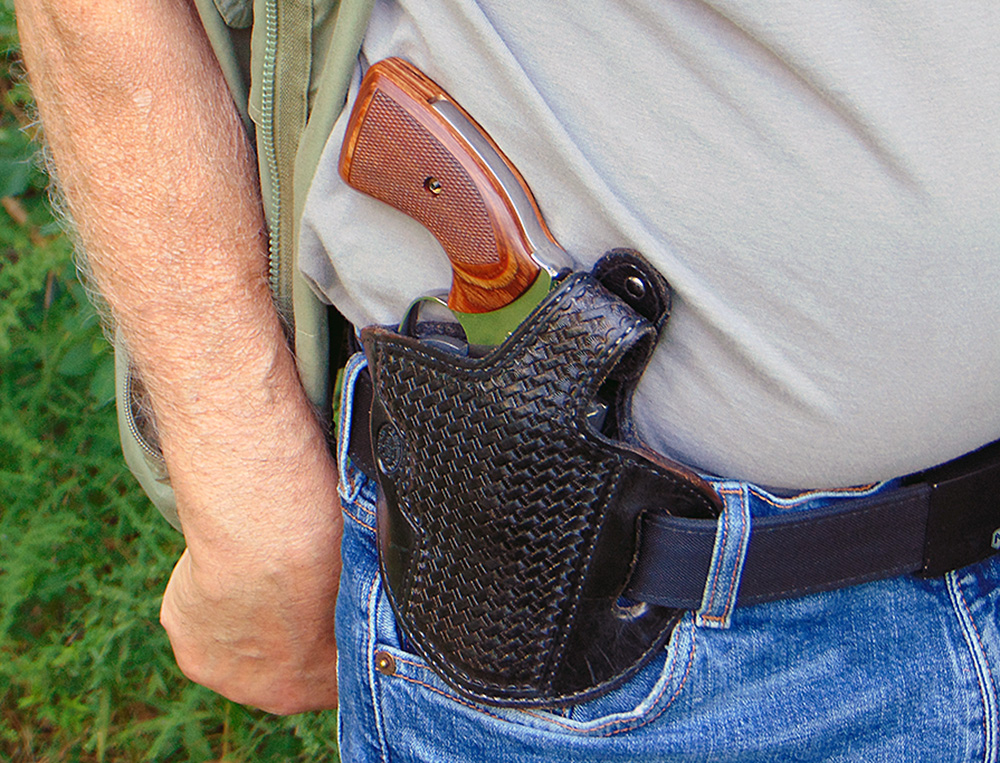
The Colt Viper would make an excellent concealed carry pistol.
At this size and weight, it is better suited to an OWB, IWB, shoulder or pack holster than an ankle rig. The 3-inch barrel gives the revolver excellent balance while remaining compact enough for practical daily carry.
Another major advantage is ammunition flexibility. The Viper can handle everything from standard .38 Special through .38 Special +P and full-power .357 Magnum ammunition.
For daily carry, I would lean toward a good .38 Special +P load because of the additional shooting comfort. Another possibility would be a reduced-recoil, reduced-flash .357 Magnum load such as those offered by Buffalo Bore.
If you plan to carry full-power Magnum ammunition, I strongly recommend trying it one-handed first. Make sure you can control it and keep your rounds where they need to go.
Colt Viper Final Verdict
The new Colt Viper is an excellent .357 Magnum/.38 Special revolver and one of the better multipurpose wheelguns I have handled recently.
The 3-inch barrel gives it excellent balance for concealed carry while retaining enough size and weight to make .38 Special ammunition very comfortable to shoot. It can serve as a general self-defense revolver around town, but it would be equally at home as a defensive handgun at a campground or on the hiking trail.
There are still two things I would change. I would love to see Colt medallions added to the walnut grips because the Viper deserves that final touch of classic Colt styling. I would also like Colt to offer the King Cobra rubber grips as an option, particularly for shooters who intend to run full-power .357 Magnum ammunition regularly.
Those are relatively small complaints.
Even straight out of the box, Colt has brought back the Viper as a handsome, well-balanced and highly shootable revolver that maintains the character of the original while giving
Sources:
Colt: Colt.com
SIG Sauer: SIGSauer.com
Buffalo Bore: BuffaloBore.com